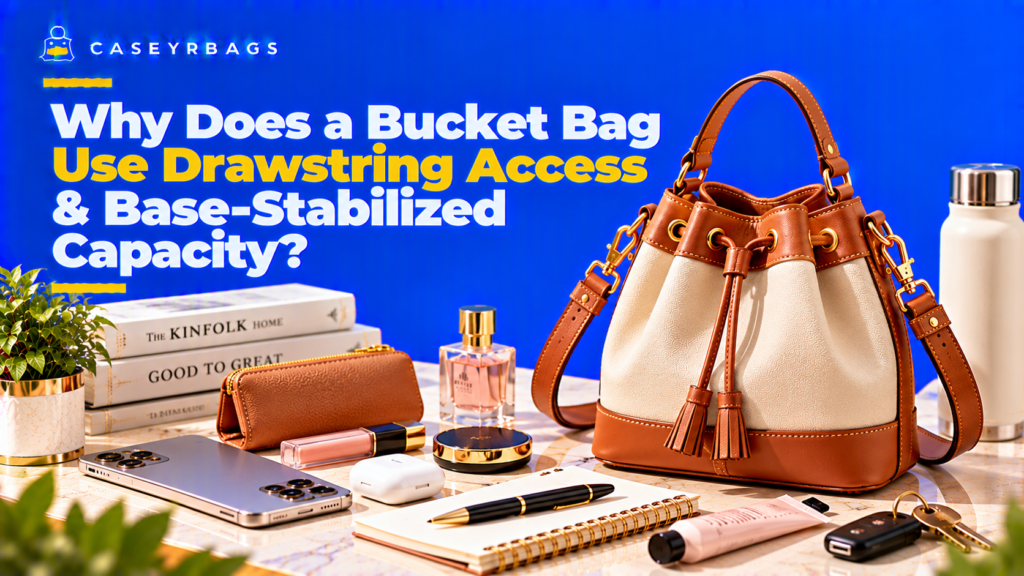
Why Does a Bucket Bag Use Drawstring Access & Base-Stabilized Capacity?
A Bucket Bag uses drawstring access because its broad upper perimeter needs to shift between an open retrieval position and a contracted carry position without requiring a rigid framed opening. Pulling the cords gathers the upper body inward, reducing the opening while preserving the bag’s generally vertical storage chamber.
Its capacity is stabilized from below because a defined or moderately supported base gives the chamber a consistent lower footprint for contents to settle into. The base does not need to make the entire bag rigid; it provides enough shape control for the side walls and vertical volume to remain functional while the upper body stays flexible enough for drawstring contraction.
What Defines Drawstring Access & Base-Stabilized Capacity in a Bucket Bag?
A Bucket Bag combines two complementary mechanisms: a variable upper opening controlled by the drawstring and a lower footprint that remains defined enough to support a usable vertical chamber.
The drawstring lets the upper perimeter loosen for access and contract for ordinary carry, while the lower base preserves enough width, depth, and resting shape to keep contents from collapsing into the same gathered form.
Functional identity comes from the interaction of these two zones. The top must remain flexible enough to gather, while the lower body must remain controlled enough to support contents, settlement, and retrieval under the normal load.
What Role Does the Drawstring Perform?
The drawstring changes the upper opening by transferring tension around the perimeter and gathering the flexible upper body. The drawstring as the mechanism that changes opening size by transferring tension around the upper perimeter. Explain loosened access, fabric gathering, reduced-opening carry, and upper-body compression without claiming that the cords lock the bag. The mechanism should be judged from the exact construction and normal loaded state rather than from a product label or empty appearance.
The cord system to the flexible upper body: the opening can expand and contract instead of remaining at one rigid width. End with the practical requirement that movement and gathering stay predictable under the normal load. The practical pass condition is smooth, repeatable behavior without forcing the drawstring, collapsing the lower chamber, or sacrificing retrieval.
What Role Does the Stabilized Base Perform?
The stabilized base gives the lower chamber a predictable footprint into which contents can settle without requiring a hard shell. The base as the lower footprint that gives contents a predictable place to settle and preserves enough width and depth for a vertical chamber. Explain that stabilization may come from shape, seams, material, layering, or reinforcement.
The base need not become a hard platform. The pass condition is retained lower geometry with controlled sag and wall behavior, not maximum rigidity. The practical pass condition is smooth, repeatable behavior without forcing the drawstring, collapsing the lower chamber, or sacrificing retrieval.
Why Must Both Mechanisms Work Together?
The drawstring controls upper access while the base controls lower capacity geometry, so neither mechanism completes the Bucket Bag system alone. The division of labor: the drawstring controls upper access while the base controls lower capacity geometry. Show how a flexible top without a workable lower footprint can produce collapse, and how a stable base without compatible upper gathering can produce poor access.
The defining rule: a Bucket Bag works when the variable opening, vertical body, and more defined base behave as a coordinated loaded system. Use this rule to anchor every later construction and capacity claim. The practical pass condition is smooth, repeatable behavior without forcing the drawstring, collapsing the lower chamber, or sacrificing retrieval. For the parent category context, see Fashion Bag Types: Silhouette Identity and Style-Led Carry. For the parent category context, see Fashion Bag Types.
Why Does a Bucket Bag Use a Drawstring Opening?
A drawstring opening suits a flexible vertical Bucket Bag because the access width can change without requiring a rigid frame. Cord travel, material behavior, opening clearance, and the normal load determine whether that access remains practical.
How Does a Loosened Drawstring Preserve Broad Access?
Loosening the cord removes perimeter tension and lets the upper body expand toward its practical opening state. Releasing cord tension lets the upper perimeter expand, reduces gathering, and exposes more of the chamber. Connect the practical opening—not merely the widest bag body—to hand entry, visibility, and item insertion. The mechanism should be judged from the exact construction and normal loaded state rather than from a product label or empty appearance.
Broad access by construction: cord travel, channel endpoints, flap or secondary closure elements, material stiffness, and contents near the top can limit the usable opening. Do not promise one opening width for all Bucket Bags. The practical pass condition is smooth, repeatable behavior without forcing the drawstring, collapsing the lower chamber, or sacrificing retrieval.
How Does Pulling the Cord Change the Opening?
Pulling the cord removes slack, distributes perimeter tension, and gathers the upper material into a smaller opening. The sequence exactly: cord pull → slack removal → perimeter tension → fabric gathering → reduced opening. Explain that the upper edge changes shape while most lower storage remains below the gathered zone. The mechanism should be judged from the exact construction and normal loaded state rather than from a product label or empty appearance.
Distinguish controlled contraction from maximum compression. The functional result is an opening that reaches its intended carry position with normal force, even gathering, and enough retained flexibility to reopen. The practical pass condition is smooth, repeatable behavior without forcing the drawstring, collapsing the lower chamber, or sacrificing retrieval.
How Is Opening Retention Different From Secure Locking?
Opening retention holds the drawstring near its carry position, but it does not by itself create a secure lock or theft-resistant barrier. Friction, a slider, cord lock, knot, or tension interaction may hold the cord position depending on the design. Treat these as retention methods rather than universal security mechanisms. The mechanism should be judged from the exact construction and normal loaded state rather than from a product label or empty appearance.
The boundary clearly: a reduced opening can discourage casual spreading but does not prove locked or theft-resistant access. Use “closure” here only to mean reduction and ordinary-carry retention of the upper opening. The practical pass condition is smooth, repeatable behavior without forcing the drawstring, collapsing the lower chamber, or sacrificing retrieval. For the subtype-specific security question, see How does Soft Bucket Bag drawstring closure affect security.
How Do Cord Routing, Guide Points, and Material Control Gathering?
Gathering quality depends on the complete tension path rather than the appearance of the cord alone. Routing continuity, guide-point spacing, friction, upper-material flexibility, and fill height all influence how evenly the perimeter contracts.
How Does Cord Routing Distribute Perimeter Tension?
Cord routing determines how pull force travels around the upper perimeter and whether the gather develops evenly. Continuous routing through a channel, eyelets, or loops transfers pull around the upper edge. Connect route continuity and friction to coordinated gathering rather than assuming every cord moves freely. The mechanism should be judged from the exact construction and normal loaded state rather than from a product label or empty appearance.
One-sided contraction, twisted openings, delayed sections, or uneven folds as possible routing or friction problems. Require inspection of the complete path before blaming the cord thickness or the user’s pull. The practical pass condition is smooth, repeatable behavior without forcing the drawstring, collapsing the lower chamber, or sacrificing retrieval.
How Do Eyelets, Loops, or Channels Shape the Folds?
Guide points influence cord direction and fold spacing by controlling where tension enters and changes direction. Guide points control cord position, tension direction, and gathering intervals. Wider spacing may create larger localized folds, while closer spacing may distribute smaller folds more frequently. The mechanism should be judged from the exact construction and normal loaded state rather than from a product label or empty appearance.
The condition boundary: spacing affects gathering character but does not alone determine closure quality. Material, route continuity, friction, fill height, and construction symmetry must also be checked. The practical pass condition is smooth, repeatable behavior without forcing the drawstring, collapsing the lower chamber, or sacrificing retrieval.
How Does Upper-Material Flexibility Affect Contraction?
Upper-material flexibility determines whether the gather zone can fold, compress, and reopen around the cord path. Why a flexible upper body can fold, gather, and reopen around the cord path, while highly stiff material may resist contraction or form large rigid folds. Keep the explanation tied to the upper gather zone. The mechanism should be judged from the exact construction and normal loaded state rather than from a product label or empty appearance.
The opposite failure: extreme softness can create uncontrolled wrinkles, uneven retention, or a limp opening. Define the useful state as drawstring-compatible flexibility rather than maximum softness. The practical pass condition is smooth, repeatable behavior without forcing the drawstring, collapsing the lower chamber, or sacrificing retrieval. For the subtype-specific drawstring question, see Drawstring Security.
Why Does a Bucket Bag Need a Defined, Stabilized Base?
A defined lower footprint converts a tall flexible body into a usable storage chamber. Stabilization limits uncontrolled sag and collapse while allowing the upper body to remain responsive to the drawstring.
What Does the Base Establish?
The base establishes lower width, depth, perimeter, and resting shape—the geometry from which the vertical chamber rises. The base as the lower width, depth, perimeter, resting shape, and chamber endpoint. Explain how round, oval, rectangular-rounded, or other shaped bases give contents a predictable area to occupy. The mechanism should be judged from the exact construction and normal loaded state rather than from a product label or empty appearance.
That footprint to vertical capacity: the side walls rise from a lower boundary instead of collapsing into the same gathered geometry as the top. Avoid claiming that a broader base is automatically better. The practical pass condition is smooth, repeatable behavior without forcing the drawstring, collapsing the lower chamber, or sacrificing retrieval.
How Does Stabilization Preserve Usable Capacity?
Adequate support preserves usable capacity by limiting central sag, pooling, twisting, and complete inward collapse under load. Adequate support limits excessive center sag, concentrated pooling, lower-body twisting, and complete inward collapse. Show how footprint retention helps separate the walls and distribute contents across the lower area. The mechanism should be judged from the exact construction and normal loaded state rather than from a product label or empty appearance.
Tie the benefit to the loaded state. A base passes when normal contents leave a recognizable footprint and predictable chamber; an empty bag that merely photographs well does not prove capacity control. The practical pass condition is smooth, repeatable behavior without forcing the drawstring, collapsing the lower chamber, or sacrificing retrieval. Continue the rigid-base stability mechanism with How does Rigid-Base Bucket Bag structure improve stability. Continue the loaded-base mechanism with Rigid-Base Stability.
Why Does Stabilization Not Require a Rigid Platform?
Base stabilization can come from material, seams, layers, backing, or inserts without turning the Bucket Bag into a hard-sided container. Stabilization as a continuum created by material, seams, layers, backing, or inserts. A soft or semi-structured base may provide enough bending resistance and shape memory without becoming hard-sided. The mechanism should be judged from the exact construction and normal loaded state rather than from a product label or empty appearance.
The boundary: the objective is predictable lower shape, not maximum hardness. If the base dominates the body and prevents intended adaptability, classify it as over-stabilized rather than automatically superior. The practical pass condition is smooth, repeatable behavior without forcing the drawstring, collapsing the lower chamber, or sacrificing retrieval. For the upright rigid-base behavior, see Rigid-Base Upright.
How Do Base Construction and Lining Preserve the Lower Chamber?
Base construction, seams, layers, inserts, and lining can support the lower chamber without making the entire Bucket Bag rigid. Their value becomes visible through loaded footprint, wall behavior, and usable interior space.
How Can Material Layers or Inserts Stabilize the Base?
Material layers or inserts can increase bending resistance and distribute point pressure across the lower footprint. Added layers, interfacing, backing, or a designed insert can increase bending resistance, spread point pressure, and reduce local sag. Keep the claim conditional on material, thickness, attachment, and intended flexibility. The mechanism should be judged from the exact construction and normal loaded state rather than from a product label or empty appearance.
The trade-off: too little support can allow pooling, while too much can create a hard platform or abrupt transition to soft walls. Evaluate the result under load rather than ranking construction methods abstractly. The practical pass condition is smooth, repeatable behavior without forcing the drawstring, collapsing the lower chamber, or sacrificing retrieval.
How Does Base-Seam Geometry Define the Footprint?
The base seam transfers lower shape into the side walls and helps define the perimeter that contents occupy. How the base seam joins lower panels, establishes the perimeter, and transfers the base shape into the side walls. Connect alignment and seam continuity to predictable lower geometry. The mechanism should be judged from the exact construction and normal loaded state rather than from a product label or empty appearance.
Twisting, asymmetric bulging, edge spreading, or irregular settlement as possible seam/shape or load-distribution symptoms. Do not diagnose seam weakness without separating construction from one-sided contents. The practical pass condition is smooth, repeatable behavior without forcing the drawstring, collapsing the lower chamber, or sacrificing retrieval.
How Can Lining Support or Disrupt Practical Capacity?
A lining supports practical capacity when it follows the chamber cleanly, but it can reduce usability when it bunches or creates false corners. A well-following lining creates a smoother interior, supports pockets, and reduces direct content contact with the exterior shell. It should track the chamber rather than form an unrelated interior bag. The mechanism should be judged from the exact construction and normal loaded state rather than from a product label or empty appearance.
Excess or detached lining can bunch, create false corners, trap small items, and reduce usable depth. Test the lining after loading because empty drape may hide the problem. The practical pass condition is smooth, repeatable behavior without forcing the drawstring, collapsing the lower chamber, or sacrificing retrieval. For the related internal-pocket decision, see Internal Zip Pocket.
How Do Side Walls and Seams Work With the Stabilized Base?
The side walls and seams carry lower geometry upward while preserving the flexibility needed for gathering and movement. The useful state lies between complete limpness and uniform rigidity.
What Do Flexible Side Walls Contribute?
Flexible side walls let the chamber adapt around contents and respond to drawstring contraction while maintaining Bucket Bag softness. Flexible walls can expand around contents, contract with the drawstring, and soften during carry. This adaptability is part of Bucket Bag character rather than a defect by itself. The mechanism should be judged from the exact construction and normal loaded state rather than from a product label or empty appearance.
The functional boundary: flexibility must not erase the lower footprint, collapse the entire chamber inward, or let one dense item control the silhouette. Judge the walls with the normal load in place. The practical pass condition is smooth, repeatable behavior without forcing the drawstring, collapsing the lower chamber, or sacrificing retrieval.
How Do Side Seams Preserve the Vertical Chamber?
Side seams align panels and carry the lower perimeter upward, helping the body retain a vertical storage form. Side seams align panels, define chamber height, direct expansion, and carry the lower perimeter upward. Connect seam layout to the vertical rather than shallow-horizontal storage identity. The mechanism should be judged from the exact construction and normal loaded state rather than from a product label or empty appearance.
Strong twisting, irregular outward bulging, or unequal wall height as possible seam alignment, material, or load-placement problems. State that the base establishes the footprint while seams extend its boundary. The practical pass condition is smooth, repeatable behavior without forcing the drawstring, collapsing the lower chamber, or sacrificing retrieval.
What Balance Creates Recognizable Bucket Bag Structure?
Recognizable Bucket Bag structure combines a flexible upper and side body with a more controlled lower footprint. The characteristic relationship as a flexible upper and side body combined with a more controlled lower footprint. Explain why uniform limpness can erase the chamber and uniform stiffness can erase the drawstring-led adaptability. The mechanism should be judged from the exact construction and normal loaded state rather than from a product label or empty appearance.
Structure on a continuum instead of a binary soft/rigid label. A balanced system retains recognizable loaded form while still allowing normal gathering, expansion, and movement. The practical pass condition is smooth, repeatable behavior without forcing the drawstring, collapsing the lower chamber, or sacrificing retrieval.
How Do Vertical Capacity, Item Settlement, and Base Shape Interact?
Vertical capacity is useful only when contents settle in predictable zones and remain retrievable. Gravity, base shape, item geometry, and chamber height decide whether nominal volume becomes practical storage.
What Does the Vertical Chamber Make Possible?
The vertical chamber supports stacked contents and taller objects, but additional depth also increases the distance between the opening and lower items. A tall chamber can accommodate stacked contents, taller objects, and height above the base. Contrast this with broad shallow storage without implying that one orientation is universally better. The mechanism should be judged from the exact construction and normal loaded state rather than from a product label or empty appearance.
The trade-off: additional depth can place lower items farther from the opening and increase overlap. Practical capacity exists only when the stored contents remain locatable and retrievable. The practical pass condition is smooth, repeatable behavior without forcing the drawstring, collapsing the lower chamber, or sacrificing retrieval.
How Do Contents Settle Toward the Base?
Gravity moves dense and small contents downward, so lower geometry and packing order directly affect settlement and retrieval. Gravity moves dense contents downward and lets small loose objects migrate beneath or between larger items. Connect settlement to the stabilized base and low points created by the packed geometry. The mechanism should be judged from the exact construction and normal loaded state rather than from a product label or empty appearance.
The failure boundary: settlement becomes a practical-capacity problem when nominal volume rises while direct retrieval falls, items pool unpredictably, or tall contents tilt because the lower layer is unstable. The practical pass condition is smooth, repeatable behavior without forcing the drawstring, collapsing the lower chamber, or sacrificing retrieval.
How Does Base Shape Affect Item Placement?
Base shape controls whether items sit side by side, stack, tilt, or occupy curved residual spaces. A broader footprint can support more side-by-side placement, while a narrower footprint can encourage stacking and overlap. Round or curved edges may create residual zones that favor flexible rather than broad rigid objects. The mechanism should be judged from the exact construction and normal loaded state rather than from a product label or empty appearance.
A universal “best” shape. The pass condition is compatibility between the exact base, intended item geometry, vertical proportions, and access path under the normal load. The practical pass condition is smooth, repeatable behavior without forcing the drawstring, collapsing the lower chamber, or sacrificing retrieval.
How Does the Drawstring Opening Affect Usable Height and Retrieval?
The drawstring opening directly affects usable height and retrieval because the upper gathering zone needs working clearance. The chamber can remain broad below while the access path moves between open, partial, and strongly cinched states.
How Can the Opening Contract Without Shrinking the Whole Chamber?
The opening can contract independently because gathering is concentrated near the upper region while most lower width and depth remain below it. Gathering narrows the upper region while most lower width and depth remain below the drawstring zone. This separation lets access width change without forcing the base to contract equally. The mechanism should be judged from the exact construction and normal loaded state rather than from a product label or empty appearance.
Clarify the limit: overfilled upper contents can transmit pressure downward, hold the opening apart, or make the walls taut. The separation works only when the gather zone retains working space. The practical pass condition is smooth, repeatable behavior without forcing the drawstring, collapsing the lower chamber, or sacrificing retrieval.
Why Must Upper Closure Clearance Remain?
Upper clearance is necessary for fabric folding, cord travel, hand entry, and reopening after the load is packed. Fabric folding, cord travel, hand entry, and reopening require unused height near the upper perimeter. Items placed too high may obstruct gathering or press against channels and guide points. The mechanism should be judged from the exact construction and normal loaded state rather than from a product label or empty appearance.
The distinction between total internal height and usable loaded height. Do not prescribe a universal clearance amount; test whether the exact opening reaches its normal contracted state without forcing the load. The practical pass condition is smooth, repeatable behavior without forcing the drawstring, collapsing the lower chamber, or sacrificing retrieval.
How Does Opening State Change Retrieval?
Opening state changes visibility, hand entry, and access speed as the bag moves from broad open to partially open to strongly cinched. Broad-open visibility and hand entry, partially open selective access, and strongly cinched restricted access. Explain that the best state depends on whether the user is loading, retrieving, or carrying. The mechanism should be judged from the exact construction and normal loaded state rather than from a product label or empty appearance.
Inefficiency when frequent-use items require maximum reopening, blind searching, or partial unloading every time. Connect the symptom to opening size, chamber depth, placement, or organization rather than capacity alone. The practical pass condition is smooth, repeatable behavior without forcing the drawstring, collapsing the lower chamber, or sacrificing retrieval.
| Opening State | Visibility | Hand Entry | Retrieval | Closure State |
|---|---|---|---|---|
| Broad open | Highest | Easy | Best for loading/search | Loose |
| Partially open | Moderate | Selective | Useful for quick access | Intermediate |
| Strongly cinched | Low | Restricted | Often requires reopening | Carry retention |
How Do Pockets, Item Geometry, and Load Distribution Affect Capacity?
Pockets, item geometry, and load distribution determine whether internal volume becomes usable organization. A stable base cannot prevent migration, tilt, or retrieval friction when contents are poorly matched or unevenly distributed.
How Do Pockets Control Small-Item Migration?
Raised pockets can keep small frequent-use items above the deep lower chamber and reduce migration toward the base. Raised pockets can keep a phone, cards, keys, or earbuds above the deep lower chamber and within predictable reach. Tie the benefit to actual pocket height, opening, and retention. The mechanism should be judged from the exact construction and normal loaded state rather than from a product label or empty appearance.
The trade-off: too many, heavily filled, or padded pockets can project inward, fragment the chamber, and duplicate storage roles. Judge each pocket by the migration or access problem it solves. The practical pass condition is smooth, repeatable behavior without forcing the drawstring, collapsing the lower chamber, or sacrificing retrieval. For the Soft Bucket pocket decision, see When does a Soft Bucket Bag need an internal zip pocket.
How Does Item Shape Change Usable Capacity?
Rigid, tall, broad, and flexible items use the same chamber differently, so item count cannot predict practical capacity. Tall items can use height but obstruct gathering, broad rigid items can resist rounded base geometry, and flexible contents can occupy curved residual zones. Item count alone cannot predict fit. The mechanism should be judged from the exact construction and normal loaded state rather than from a product label or empty appearance.
The exact geometry to pass opening, placement, closure, loaded-shape, and retrieval checks. If one object dominates width or height, name that variable rather than calling the whole bag small. The practical pass condition is smooth, repeatable behavior without forcing the drawstring, collapsing the lower chamber, or sacrificing retrieval.
How Does Load Distribution Affect the Stabilized Base?
Load distribution can preserve or distort the stabilized base depending on whether dense contents stay centered or concentrate on one side. Centered or broadly distributed contents can keep the base balanced and walls predictable, while a dense one-sided object can tilt the footprint and bulge one wall. The effect can persist despite reinforcement. The mechanism should be judged from the exact construction and normal loaded state rather than from a product label or empty appearance.
Base stabilization controls deformation but cannot cancel poor load geometry. Reposition the dense item, keep the same total load, and retest before diagnosing a structural base failure. The practical pass condition is smooth, repeatable behavior without forcing the drawstring, collapsing the lower chamber, or sacrificing retrieval. Continue the rigid-base upright mechanism with Why does a Rigid-Base Bucket Bag remain upright.
| Load State | Base Behavior | Wall Behavior | Opening / Closure Effect |
|---|---|---|---|
| Balanced central load | Footprint stays centered | Even expansion | Gathering remains predictable |
| Dense one-sided load | Tilts toward dense side | One wall bulges | Opening can twist |
| Overfilled upper zone | Edges spread / center stressed | Walls become taut | Reduced gathering and higher cord force |
When Do Softness, Rigidity, Depth, or Overfilling Become Failure Modes?
Softness, rigidity, excessive depth, and overfilling become failure modes when they interrupt the intended relationship between adjustable top access and controlled lower capacity. Both too little and too much structural control can create mismatch.
When Is the Base Under- or Over-Stabilized?
The base is under-stabilized when normal contents erase the lower footprint, and over-stabilized when the platform dominates the intended flexible body. Under-stabilization through severe sag, a twisted or disappearing footprint, central item pooling, tilted tall objects, and uncontrolled wall collapse under a normal load. Link the state to insufficient lower shape control rather than softness alone.
Over-stabilization through a platform-like base, abrupt rigid-to-soft transition, reduced adaptability, or a lower structure that dominates the intended body. Define the useful middle as enough support to guide capacity while remaining integrated. The practical pass condition is smooth, repeatable behavior without forcing the drawstring, collapsing the lower chamber, or sacrificing retrieval.
| Variable | Very Soft | Controlled Support | Highly Rigid |
|---|---|---|---|
| Footprint | Can disappear under load | Remains recognizable | Strongly fixed |
| Sag | High risk | Controlled | Low |
| Wall behavior | May collapse inward | Flexible but guided | Abrupt transition possible |
| Adaptability | High but unstable | Balanced | Reduced |
| Capacity consequence | Pooling / poor retrieval | Usable vertical chamber | Base can dominate body |
When Does Vertical Capacity Become Too Deep?
Vertical capacity becomes too deep when added height creates more searching, overlap, and unloading than useful storage. Frequent blind searching, buried small items, repeated partial unloading, and unused upper pockets as signs that added depth creates more retrieval friction than benefit. Explain that a tall chamber can still work when zones are purposeful. The mechanism should be judged from the exact construction and normal loaded state rather than from a product label or empty appearance.
Correct organization before rejecting the format: move frequent small items upward and place broad or stable items lower. If retrieval still fails with the normal load, classify Vertical-Capacity / Retrieval Mismatch. The practical pass condition is smooth, repeatable behavior without forcing the drawstring, collapsing the lower chamber, or sacrificing retrieval.
How Does Overfilling Affect the Drawstring and Base?
Overfilling removes upper gathering clearance while increasing lower pressure, so the drawstring and base can fail together. The upper failure: contents enter the gathering zone, the perimeter cannot fold normally, more cord force is required, contraction becomes uneven, and the opening remains wider or strained. State that forced tension is a warning, not a solution.
The lower failure: edges spread, the center sags, walls become taut or bulge, and the intended footprint distorts. Physical containment does not prove practical capacity when closure and lower shape fail together. The practical pass condition is smooth, repeatable behavior without forcing the drawstring, collapsing the lower chamber, or sacrificing retrieval.
How Is Bucket Bag Identity Protected and Structural Mismatch Diagnosed?
Bucket Bag identity should be protected before diagnosing performance. A drawstring feature alone does not establish the vertical body and defined lower footprint needed for the full entity.
How Is a Bucket Bag Different From a Generic Drawstring Bag?
A generic drawstring feature proves only an opening mechanism; Bucket Bag identity also requires a vertically maintained body and more defined lower footprint. A generic drawstring description proves only that cords control an opening. It does not establish a vertical bucket-like chamber, defined lower footprint, or the characteristic top-to-base relationship. The mechanism should be judged from the exact construction and normal loaded state rather than from a product label or empty appearance.
The combined identity: drawstring-controlled top + vertically maintained body + lower footprint. If the full geometry is absent, classify Wrong Bag Entity instead of forcing the Bucket Bag framework. The practical pass condition is smooth, repeatable behavior without forcing the drawstring, collapsing the lower chamber, or sacrificing retrieval.
How Does a Bucket Bag Differ From a Cinch Sack and Hobo Bag?
A Cinch Sack typically emphasizes lightweight collapsibility, while a Bucket Bag relies more strongly on a defined lower storage footprint and maintained vertical chamber. Briefly that a Cinch Sack typically prioritizes lightweight collapsibility and a chamber strongly controlled by cord closure. Avoid turning this boundary into a full comparison article. The mechanism should be judged from the exact construction and normal loaded state rather than from a product label or empty appearance.
Contrast the Bucket Bag’s stronger reliance on a defined lower storage footprint and vertically maintained chamber. Keep the distinction structural and functional, not stylistic or status-based. The practical pass condition is smooth, repeatable behavior without forcing the drawstring, collapsing the lower chamber, or sacrificing retrieval. For the adjacent fashion-bag structure comparison, see Hobo Bag: Crescent Slouch and Shape-Controlled Storage. For the adjacent fashion-bag structure comparison, see Hobo Bag.
Which Symptoms Identify the Limiting Mechanism?
The limiting mechanism is identified by routing poor contraction through the cord path and upper zone, then routing lower collapse through the base, seams, walls, and load distribution. Route poor contraction through cord movement, routing continuity, friction, upper stiffness, and overfill; route lower collapse through base support, seams, material behavior, and load distribution. Test one competing cause at a time.
Interpret “good closure but poor capacity” through excessive depth, item migration, weak organization, or a narrow footprint. Name the final outcome and observed limiting variable rather than saying only that the bag performs badly. The practical pass condition is smooth, repeatable behavior without forcing the drawstring, collapsing the lower chamber, or sacrificing retrieval.
How Should Bucket Bag Drawstring Access and Capacity Be Evaluated?
The final evaluation should move from empty inspection to normal-load behavior under fixed controls. The result should name the first failed mechanism rather than reducing the whole bag to a vague judgment of structure or roominess.
What Should Be Inspected Before Loading?
Before loading, inspect the entire access-and-capacity system so the empty baseline is known before contents alter the bag. Inspect the drawstring, retention method, routing path, guide points, upper perimeter, practical opening, gather zone, side walls, side seams, base seam, base support, lining, and pockets. Record visible asymmetry or binding before contents can influence the result.
Fix the controls: same bag, same normal contents, same item placement, same cord state, same units, and same retrieval item. Do not compare an empty bag with one design and a heavily loaded state with another. The practical pass condition is smooth, repeatable behavior without forcing the drawstring, collapsing the lower chamber, or sacrificing retrieval.
What Should Be Observed After Loading?
After loading, observe the lower footprint, wall shape, item settlement, upper clearance, cord contraction, reopening, and retrieval under the same normal load. Observe base footprint, center sag, wall expansion, vertical alignment, item settlement, pocket access, upper clearance, and cord contraction. Record the first function that changes rather than forcing the bag into a preferred appearance.
Reopen the bag and retrieve one high-frequency item without major unloading. Compare the loaded result with the empty baseline and connect each symptom to cord, opening, wall, base, load, or organization. The practical pass condition is smooth, repeatable behavior without forcing the drawstring, collapsing the lower chamber, or sacrificing retrieval.
Which 20-Step Sequence Determines the Final Outcome?
The final outcome should come from one fixed empty-to-loaded sequence that keeps the same bag, load, cord state, placement, and retrieval task. Present the test exactly: 1) empty the bag; 2) loosen the drawstring fully; 3) observe the maximum practical opening; 4) inspect routing; 5) inspect the gather zone; 6) inspect side seams; 7) inspect base shape; 8) press the base lightly; 9) add one broad or stable normal item; 10) add normal medium contents; 11) place frequent small items in pockets where provided; 12) let contents settle; 13) observe footprint retention; 14) check wall predictability; 15) confirm upper clearance; 16) pull the drawstring normally; 17) observe gathering symmetry; 18) reopen the bag; 19) retrieve one frequent-use item without major unloading; 20) assign the outcome from the complete result.
Select Balanced Bucket System when upper access and lower capacity pass together; use the relevant access, routing, base, retrieval, overfill, or identity mismatch when a named function fails. Prevent false passes by rejecting maximum cord force, maximum vertical fill, empty-only judgment, and untested security or capacity claims.
- empty the bag
- loosen the drawstring fully
- observe the maximum practical opening
- inspect routing
- inspect the gather zone
- inspect side seams
- inspect base shape
- press the base lightly
- add one broad or stable normal item
- add normal medium contents
- place frequent small items in pockets where provided
- let contents settle
- observe footprint retention
- check wall predictability
- confirm upper clearance
- pull the drawstring normally
- observe gathering symmetry
- reopen the bag
- retrieve one frequent-use item without major unloading
- assign the outcome from the complete result
- The H1 asks the exact Bucket Bag mechanism question.
- The introduction contains exactly two paragraphs and one disclaimer.
- Drawstring access and base-stabilized capacity remain the central entity.
- The two mechanisms are explained as one system.
- Drawstring access is defined before its benefits.
- Opening reduction is not presented as secure locking.
- Cord pull is traced through perimeter contraction.
- Cord routing and friction are evaluated.
- Guide-point spacing is treated conditionally.
- Upper-material flexibility and its limits are explained.
- Maximum cord tension is not treated as the goal.
- The base establishes a lower footprint.
- Base stabilization is not equated with a rigid shell.
- Empty shape is not substituted for loaded performance.
- Material layers and inserts are treated conditionally.
- Base-seam geometry is explained.
- Lining support and bunching risk are both covered.
- Flexible side-wall benefits and failure limits are paired.
- Side seams are connected to vertical chamber control.
- Nominal vertical volume is separated from practical capacity.
- Item settlement and small-item migration are explained.
- Base shape is connected to item geometry.
- Upper gathering clearance remains explicit.
- Total height is separated from usable loaded height.
- Opening state is connected to retrieval.
- Pocket benefits and intrusion trade-offs are covered.
- Tall, broad rigid, and flexible item behavior is compared.
- Load distribution is evaluated independently of reinforcement.
- Under- and over-stabilized states are identified.
- Excessive effective depth is diagnosed.
- Overfilling effects on the drawstring and base are traced.
- Bucket Bag, generic Drawstring Bag, and Cinch Sack remain distinct.
- The final protocol retains fixed controls and a normal load.
- Exactly ten proof assets are specified and only four are SVGs.
- No unapproved reader-facing link is inserted.
- The conclusion answers why the two mechanisms belong together.
Conclusion
A Bucket Bag uses drawstring access because its flexible upper perimeter must move between a broad retrieval state and a contracted carry state without relying on a permanently rigid opening. Pulling the cords redistributes tension and gathers the top while leaving the lower chamber comparatively stable.
A defined or moderately supported base complements that variable opening by preserving the footprint into which contents settle, while side seams and walls carry the lower geometry upward. The defining system is adjustable top access plus controlled lower capacity—not maximum cord tightness, maximum base hardness, or maximum vertical fill.
FAQs
Why Does a Bucket Bag Use a Drawstring Instead of a Fixed Opening?
The drawstring lets the upper perimeter expand for loading and retrieval, then contract around the carried contents. This variable opening suits a flexible vertical chamber without requiring a rigid frame.
Actual opening range depends on cord travel, routing, material, gather-zone clearance, and load height. A reduced opening is ordinary-carry retention, not an automatic security guarantee.
Does a Bucket Bag Need a Rigid Base?
The base needs enough stabilization to retain a usable lower footprint and resist uncontrolled sag, but it may remain soft or semi-structured. Construction can use shape, seams, layers, backing, or an insert.
Maximum rigidity can reduce adaptability and dominate the body. Judge the base by loaded footprint, wall behavior, and retrieval rather than hardness alone.
Why Can a Bucket Bag Hold a Lot but Still Be Difficult to Organize?
The tall chamber creates nominal volume while gravity moves contents toward the base. Small objects can migrate beneath broad or dense items and become difficult to see or reach.
Raised pockets, deliberate placement, upper clearance, and proportionate depth can improve practical capacity. Available vertical volume counts only when routine items remain retrievable.