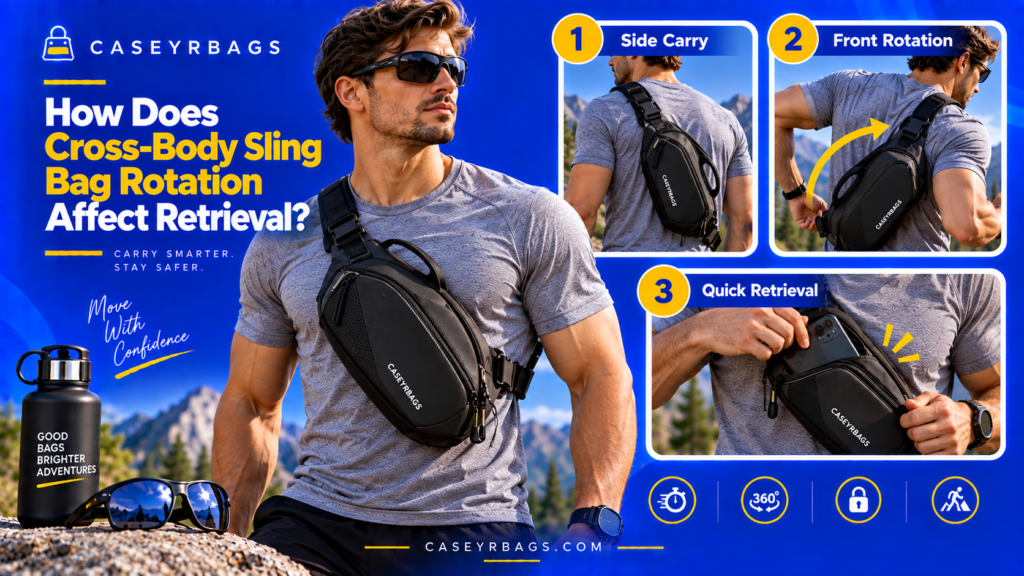
How Does Cross-Body Sling Bag Rotation Affect Retrieval?
Cross-Body Sling Bag rotation affects retrieval by determining how easily the worn bag moves from a rear or side resting position into a front or front-side access position. Strap geometry, anchor placement, adjustment, bag depth, and body contact determine whether that movement feels deliberate and predictable or loose, obstructed, and difficult to stop at a useful endpoint.
Rotation improves retrieval only when the final position places the intended opening, closure, and storage zone within a practical hand path. A bag can rotate smoothly yet still retrieve poorly if the zipper faces away, the compartment is buried, the load tilts the bag, or the endpoint remains unstable. Effective retrieval also requires the bag to reclose normally and return to its resting position without repeated correction.
What Does Rotational Retrieval Mean in a Cross-Body Sling Bag?
A Cross-Body Sling Bag usually rests at the rear, rear-side, side, front-side, or front depending on its design and strap adjustment. Rotational retrieval occurs when the wearer deliberately moves the still-worn bag around the torso toward a more accessible front or front-side position while the diagonal strap remains engaged.
Successful rotation does not end merely when the bag reaches the front. The intended compartment must also become visible or identifiable, the closure must fall within a practical hand path, and the bag must remain stable enough for the wearer to retrieve or return an item without unnecessary searching, twisting, or repeated stabilization.
Rotational retrieval should therefore be evaluated as a complete sequence: carry position → rotation → access position → opening → retrieval → reclosure → return. The movement is useful only when every stage supports the next one predictably. For the broader parent mechanism, see Sling Bag.
Which features most directly affect rotational retrieval?
Most directly affect rotational retrieval should be judged through the observable movement, endpoint, opening orientation, and return behavior. In this part of Cross-Body Sling rotational retrieval, the important question is how the observed condition changes the bag’s movement path, angle, or final access position. The useful outcome is deliberate, predictable movement rather than unrestricted motion.
Evaluate this factor under load, because empty or static behavior may hide the actual rotation-to-retrieval relationship. Judge the result by whether the loaded bag reaches the intended access state without repeated correction. If the same step repeatedly requires extra twisting, stabilization, searching, overshoot correction, or strap readjustment, adjust the variable identified here.
Why is intentional rotation different from uncontrolled swing?
Intentional rotation different from uncontrolled swing should be judged through leads to wearer initiates movement, leads to bag follows predictable path, leads to bag stops at usable endpoint, leads to movement occurs without deliberate access intent. In this part of Cross-Body Sling rotational retrieval, the important question is how the observed condition changes the bag’s movement path, angle, or final access position. The useful outcome is deliberate, predictable movement rather than unrestricted motion.
Evaluate this factor under load, because empty or static behavior may hide the actual rotation-to-retrieval relationship. Rotational access ≠ uncontrolled swing. If the same step repeatedly requires extra twisting, stabilization, searching, overshoot correction, or strap readjustment, adjust the variable identified here.
What defines a successful rotational retrieval sequence?
A successful rotational retrieval sequence should be judged through The bag rotates predictably, reaches a stable access position, exposes the intended opening, permits retrieval, recloses normally, and returns to its carry position. In this part of Cross-Body Sling rotational retrieval, the important question is how the observed condition changes the bag’s movement path, angle, or final access position. The useful outcome is deliberate, predictable movement rather than unrestricted motion.
Evaluate this factor under load, because empty or static behavior may hide the actual rotation-to-retrieval relationship. A useful setup preserves deliberate movement while keeping the endpoint, opening, and return path predictable. If the same step repeatedly requires extra twisting, stabilization, searching, overshoot correction, or strap readjustment, adjust the variable identified here.
How Does Resting Carry Position Affect Rotation Distance?
Explain how the starting position determines how far the bag must travel before retrieval begins. This section evaluates the factor with the normal loaded bag and connects the observed movement directly to endpoint control, opening usability, retrieval, and return.
How does rear carry change the rotational path?
Rear carry change the rotational path should be judged through longer travel around the torso, movement through side position, progressive opening-orientation change. In this part of Cross-Body Sling rotational retrieval, the important question is how the observed condition changes the bag’s movement path, angle, or final access position. The useful outcome is deliberate, predictable movement rather than unrestricted motion.
Evaluate this factor under load, because empty or static behavior may hide the actual rotation-to-retrieval relationship. The mechanism should solve the observed retrieval problem without creating a new movement problem elsewhere. If the same step repeatedly requires extra twisting, stabilization, searching, overshoot correction, or strap readjustment, adjust the variable identified here.
How does side or rear-side carry change rotation distance?
Side or rear-side carry change rotation distance should be judged through shorter path to front-side access, less torso travel, easier transition for some designs. In this part of Cross-Body Sling rotational retrieval, the important question is how the observed condition changes the bag’s movement path, angle, or final access position. The useful outcome is deliberate, predictable movement rather than unrestricted motion.
Evaluate this factor under load, because empty or static behavior may hide the actual rotation-to-retrieval relationship. Judge the result by whether the loaded bag reaches the intended access state without repeated correction. If the same step repeatedly requires extra twisting, stabilization, searching, overshoot correction, or strap readjustment, adjust the variable identified here.
Why is the shortest rotation distance not automatically best?
The shortest rotation distance not automatically best should be judged through Shorter rotation ≠ automatically better retrieval. In this part of Cross-Body Sling rotational retrieval, the important question is how the observed condition changes the bag’s movement path, angle, or final access position. The useful outcome is deliberate, predictable movement with the normal carried load rather than unrestricted motion.
Evaluate this factor while the bag is worn and loaded, because empty or static behavior may hide the actual rotation-to-retrieval relationship. Shorter rotation ≠ automatically better retrieval. If the same step repeatedly requires extra twisting, stabilization, searching, overshoot correction, or strap readjustment, adjust the variable identified here before changing unrelated parts of the system.
How Does the Diagonal Strap Path Create Rotation?
Explain how cross-body suspension supports carrying while still permitting intentional movement. This section evaluates the factor with the normal loaded bag and connects the observed movement directly to endpoint control, opening usability, retrieval, and return. For the sibling retrieval condition, see Front-Rotation Retrieval.
How does the strap remain supportive while the bag changes position?
The strap remain supportive while the bag changes position should be judged through Bag remains attached to diagonal strap while bag body moves around torso. In this part of Cross-Body Sling rotational retrieval, the important question is how the observed condition changes the bag’s movement path, angle, or final access position. The useful outcome is deliberate, predictable movement rather than unrestricted motion.
Evaluate this factor under load, because empty or static behavior may hide the actual rotation-to-retrieval relationship. A useful setup preserves deliberate movement while keeping the endpoint, opening, and return path predictable. If the same step repeatedly requires extra twisting, stabilization, searching, overshoot correction, or strap readjustment, adjust the variable identified here.
How does strap routing guide the movement path?
Strap routing guide the movement path should be judged through drops during rotation. In this part of Cross-Body Sling rotational retrieval, the important question is how the observed condition changes the bag’s movement path, angle, or final access position. The useful outcome is deliberate, predictable movement with the normal carried load rather than unrestricted motion.
Evaluate this factor while the bag is worn and loaded, because empty or static behavior may hide the actual rotation-to-retrieval relationship. The mechanism should solve the observed retrieval problem without creating a new movement problem elsewhere. If the same step repeatedly requires extra twisting, stabilization, searching, overshoot correction, or strap readjustment, adjust the variable identified here before changing unrelated parts of the system.
Why does cross-body suspension not guarantee smooth rotation?
Cross-body suspension not guarantee smooth rotation should be judged through loaded bag profile, Cross-body strap routing enables rotation; it does not guarantee efficient rotational retrieval. In this part of Cross-Body Sling rotational retrieval, the important question is how the observed condition changes the bag’s movement path, angle, or final access position. The useful outcome is deliberate, predictable movement rather than unrestricted motion.
Evaluate this factor under load, because empty or static behavior may hide the actual rotation-to-retrieval relationship. Cross-body strap routing enables rotation; it does not guarantee efficient rotational retrieval. If the same step repeatedly requires extra twisting, stabilization, searching, overshoot correction, or strap readjustment, adjust the variable identified here.
How Does Strap Length Affect Rotational Retrieval?
Explain how strap length controls both movement freedom and final access position. This section evaluates the factor with the normal loaded bag and connects the observed movement directly to endpoint control, opening usability, retrieval, and return.
What happens when the strap is too short?
The strap is too short should be judged through rotational path becomes restricted, bag binds against torso, access endpoint becomes difficult to reach. In this part of Cross-Body Sling rotational retrieval, the important question is how the observed condition changes the bag’s movement path, angle, or final access position. The useful outcome is deliberate, predictable movement rather than unrestricted motion.
Evaluate this factor under load, because empty or static behavior may hide the actual rotation-to-retrieval relationship. The relevant test is practical worn retrieval, not an isolated empty-bag movement. If the same step repeatedly requires extra twisting, stabilization, searching, overshoot correction, or strap readjustment, adjust the variable identified here.
What happens when the strap is too long?
The strap is too long should be judged through rotation becomes easy but less controlled, bag drops lower, endpoint becomes inconsistent. In this part of Cross-Body Sling rotational retrieval, the important question is how the observed condition changes the bag’s movement path, angle, or final access position. The useful outcome is deliberate, predictable movement rather than unrestricted motion.
Evaluate this factor under load, because empty or static behavior may hide the actual rotation-to-retrieval relationship. A useful setup preserves deliberate movement while keeping the endpoint, opening, and return path predictable. If the same step repeatedly requires extra twisting, stabilization, searching, overshoot correction, or strap readjustment, adjust the variable identified here.
What defines functional rotational strap length?
Functional rotational strap length should be judged through The strap should allow intentional rotation without creating excessive free movement during normal carry or retrieval, Longer strap ≠ automatically better rotational access. In this part of Cross-Body Sling rotational retrieval, the important question is how the observed condition changes the bag’s movement path, angle, or final access position. The useful outcome is deliberate, predictable movement rather than unrestricted motion.
Evaluate this factor under load, because empty or static behavior may hide the actual rotation-to-retrieval relationship. The strap should allow intentional rotation without creating excessive free movement during normal carry or retrieval. If the same step repeatedly requires extra twisting, stabilization, searching, overshoot correction, or strap readjustment, adjust the variable identified here.
| Strap State | Rotation Freedom | Endpoint Control | Main Tradeoff |
|---|---|---|---|
| Very short | Low | High potential | Restricted rotation |
| Controlled | Functional | Predictable | Balanced |
| Long | High | Variable | More movement |
| Very long | Excessive | Low | Swing / poor endpoint |
How Does Strap Tension Affect Rotation Control?
Separate useful movement control from excessive restriction. This section evaluates the factor with the normal loaded bag and connects the observed movement directly to endpoint control, opening usability, retrieval, and return.
How does appropriate tension stabilize the rotational path?
Appropriate tension stabilize the rotational path should be judged through Controlled strap tension leads to bag remains close while moving around torso. In this part of Cross-Body Sling rotational retrieval, the important question is how the observed condition changes the bag’s movement path, angle, or final access position. The useful outcome is deliberate, predictable movement rather than unrestricted motion.
Evaluate this factor under load, because empty or static behavior may hide the actual rotation-to-retrieval relationship. Judge the result by whether the loaded bag reaches the intended access state without repeated correction. If the same step repeatedly requires extra twisting, stabilization, searching, overshoot correction, or strap readjustment, adjust the variable identified here.
How can excessive tension obstruct retrieval?
Excessive tension obstruct retrieval should be judged through bag cannot slide, wearer must lift the strap manually, access endpoint becomes difficult to reach. In this part of Cross-Body Sling rotational retrieval, the important question is how the observed condition changes the bag’s movement path, angle, or final access position. The useful outcome is deliberate, predictable movement rather than unrestricted motion.
Evaluate this factor under load, because empty or static behavior may hide the actual rotation-to-retrieval relationship. The relevant test is practical worn retrieval, not an isolated empty-bag movement. If the same step repeatedly requires extra twisting, stabilization, searching, overshoot correction, or strap readjustment, adjust the variable identified here.
How can insufficient tension weaken retrieval control?
Insufficient tension weaken retrieval control should be judged through bag swings after reaching front, opening position becomes unstable, Useful rotation requires controlled mobility—not maximum tightness or maximum looseness. In this part of Cross-Body Sling rotational retrieval, the important question is how the observed condition changes the bag’s movement path, angle, or final access position. The useful outcome is deliberate, predictable movement rather than unrestricted motion.
Evaluate this factor under load, because empty or static behavior may hide the actual rotation-to-retrieval relationship. A useful setup preserves deliberate movement while keeping the endpoint, opening, and return path predictable. If the same step repeatedly requires extra twisting, stabilization, searching, overshoot correction, or strap readjustment, adjust the variable identified here.
How Does Anchor Geometry Affect the Rotation Path?
Explain how strap attachment points influence bag angle and orientation during movement. This section evaluates the factor with the normal loaded bag and connects the observed movement directly to endpoint control, opening usability, retrieval, and return.
How do separated anchors control bag orientation?
How do separated anchors control bag orientation should be judged through Effective anchor separation leads to stronger control over bag-body angle during movement. In this part of Cross-Body Sling rotational retrieval, the important question is how the observed condition changes the bag’s movement path, angle, or final access position. The useful outcome is deliberate, predictable movement rather than unrestricted motion.
Evaluate this factor under load, because empty or static behavior may hide the actual rotation-to-retrieval relationship. The mechanism should solve the observed retrieval problem without creating a new movement problem elsewhere. If the same step repeatedly requires extra twisting, stabilization, searching, overshoot correction, or strap readjustment, adjust the variable identified here.
How can narrow or poorly placed anchors affect rotation?
Narrow or poorly placed anchors affect rotation should be judged through one end rises, opening rotates away. In this part of Cross-Body Sling rotational retrieval, the important question is how the observed condition changes the bag’s movement path, angle, or final access position. The useful outcome is deliberate, predictable movement rather than unrestricted motion.
Evaluate this factor under load, because empty or static behavior may hide the actual rotation-to-retrieval relationship. Judge the result by whether the loaded bag reaches the intended access state without repeated correction. If the same step repeatedly requires extra twisting, stabilization, searching, overshoot correction, or strap readjustment, adjust the variable identified here.
Why is strong anchor construction not enough?
Strong anchor construction not enough should be judged through Anchor strength ≠ effective rotational geometry, remain structurally sound, guide the bag predictably. In this part of Cross-Body Sling rotational retrieval, the important question is how the observed condition changes the bag’s movement path, angle, or final access position. The useful outcome is deliberate, predictable movement with the normal carried load rather than unrestricted motion.
Evaluate this factor while the bag is worn and loaded, because empty or static behavior may hide the actual rotation-to-retrieval relationship. Anchor strength ≠ effective rotational geometry. If the same step repeatedly requires extra twisting, stabilization, searching, overshoot correction, or strap readjustment, adjust the variable identified here before changing unrelated parts of the system.
How Does Body-Facing Friction Affect Rotation?
Explain how bag surface, clothing, and torso interaction can guide or obstruct movement. This section evaluates the factor with the normal loaded bag and connects the observed movement directly to endpoint control, opening usability, retrieval, and return.
How can moderate body contact help rotation?
Moderate body contact help rotation should be judged through keeps movement close to torso, limits outward swing, provides predictable movement surface. In this part of Cross-Body Sling rotational retrieval, the important question is how the observed condition changes the bag’s movement path, angle, or final access position. The useful outcome is deliberate, predictable movement rather than unrestricted motion.
Evaluate this factor under load, because empty or static behavior may hide the actual rotation-to-retrieval relationship. A useful setup preserves deliberate movement while keeping the endpoint, opening, and return path predictable. If the same step repeatedly requires extra twisting, stabilization, searching, overshoot correction, or strap readjustment, adjust the variable identified here.
How can excessive friction make retrieval harder?
Excessive friction make retrieval harder should be judged through bag catches on clothing, strap tension increases, wearer must pull or lift bag away. In this part of Cross-Body Sling rotational retrieval, the important question is how the observed condition changes the bag’s movement path, angle, or final access position. The useful outcome is deliberate, predictable movement rather than unrestricted motion.
Evaluate this factor under load, because empty or static behavior may hide the actual rotation-to-retrieval relationship. The mechanism should solve the observed retrieval problem without creating a new movement problem elsewhere. If the same step repeatedly requires extra twisting, stabilization, searching, overshoot correction, or strap readjustment, adjust the variable identified here.
How can too little friction weaken endpoint control?
Too little friction weaken endpoint control should be judged through bag moves too freely, bag continues swinging after reaching access position, Useful body interaction balances guided movement with sufficient rotational freedom. In this part of Cross-Body Sling rotational retrieval, the important question is how the observed condition changes the bag’s movement path, angle, or final access position. The useful outcome is deliberate, predictable movement rather than unrestricted motion.
Evaluate this factor under load, because empty or static behavior may hide the actual rotation-to-retrieval relationship. Judge the result by whether the loaded bag reaches the intended access state without repeated correction. If the same step repeatedly requires extra twisting, stabilization, searching, overshoot correction, or strap readjustment, adjust the variable identified here.
| Body Interaction | Rotation Behavior | Retrieval Effect |
|---|---|---|
| Very high friction | Restricted | Difficult transition |
| Controlled contact | Guided | Predictable |
| Low friction | Fast | Lower endpoint control |
| Very loose / outward | Swinging | Unstable |
How Does Bag Shape Affect Rotational Retrieval?
Explain how external geometry changes movement around the torso. This section evaluates the factor with the normal loaded bag and connects the observed movement directly to endpoint control, opening usability, retrieval, and return.
How does a compact bag shape support rotation?
A compact bag shape support rotation should be judged through smaller movement envelope, lower arm interference, easier side-to-front transition. In this part of Cross-Body Sling rotational retrieval, the important question is how the observed condition changes the bag’s movement path, angle, or final access position. The useful outcome is deliberate, predictable movement rather than unrestricted motion.
Evaluate this factor under load, because empty or static behavior may hide the actual rotation-to-retrieval relationship. The relevant test is practical worn retrieval, not an isolated empty-bag movement. If the same step repeatedly requires extra twisting, stabilization, searching, overshoot correction, or strap readjustment, adjust the variable identified here.
How can projecting pockets or hardware disrupt rotation?
Projecting pockets or hardware disrupt rotation should be judged through change bag angle. In this part of Cross-Body Sling rotational retrieval, the important question is how the observed condition changes the bag’s movement path, angle, or final access position. The useful outcome is deliberate, predictable movement with the normal carried load rather than unrestricted motion.
Evaluate this factor while the bag is worn and loaded, because empty or static behavior may hide the actual rotation-to-retrieval relationship. A useful setup preserves deliberate movement while keeping the endpoint, opening, and return path predictable. If the same step repeatedly requires extra twisting, stabilization, searching, overshoot correction, or strap readjustment, adjust the variable identified here before changing unrelated parts of the system.
Why does bag shape need to be evaluated when loaded?
Bag shape need to be evaluated when loaded should be judged through Empty exterior shape ≠ loaded rotational profile, Contents can alter. In this part of Cross-Body Sling rotational retrieval, the important question is how the observed condition changes the bag’s movement path, angle, or final access position. The useful outcome is deliberate, predictable movement with the normal carried load rather than unrestricted motion.
Evaluate this factor while the bag is worn and loaded, because empty or static behavior may hide the actual rotation-to-retrieval relationship. Empty exterior shape ≠ loaded rotational profile. If the same step repeatedly requires extra twisting, stabilization, searching, overshoot correction, or strap readjustment, adjust the variable identified here before changing unrelated parts of the system.
How Does Loaded Depth Affect Rotation?
Explain how outward projection affects torso clearance and movement control. This section evaluates the factor with the normal loaded bag and connects the observed movement directly to endpoint control, opening usability, retrieval, and return.
How does shallow loaded depth affect rotation?
Shallow loaded depth affect rotation should be judged through bag stays closer, rotational envelope remains smaller, side clearance improves. In this part of Cross-Body Sling rotational retrieval, the important question is how the observed condition changes the bag’s movement path, angle, or final access position. The useful outcome is deliberate, predictable movement rather than unrestricted motion.
Evaluate this factor under load, because empty or static behavior may hide the actual rotation-to-retrieval relationship. Judge the result by whether the loaded bag reaches the intended access state without repeated correction. If the same step repeatedly requires extra twisting, stabilization, searching, overshoot correction, or strap readjustment, adjust the variable identified here.
How does greater depth change the movement path?
Greater depth change the movement path should be judged through arm/torso interference increases, outward swing increases, rotational inertia increases. In this part of Cross-Body Sling rotational retrieval, the important question is how the observed condition changes the bag’s movement path, angle, or final access position. The useful outcome is deliberate, predictable movement rather than unrestricted motion.
Evaluate this factor under load, because empty or static behavior may hide the actual rotation-to-retrieval relationship. The relevant test is practical worn retrieval, not an isolated empty-bag movement. If the same step repeatedly requires extra twisting, stabilization, searching, overshoot correction, or strap readjustment, adjust the variable identified here.
When does loaded depth become a retrieval problem?
Loaded depth become a retrieval problem should be judged through bag repeatedly catches, wearer must pull it outward, front endpoint remains unstable, Available volume ≠ rotation-compatible loaded depth. In this part of Cross-Body Sling rotational retrieval, the important question is how the observed condition changes the bag’s movement path, angle, or final access position. The useful outcome is deliberate, predictable movement rather than unrestricted motion.
Evaluate this factor under load, because empty or static behavior may hide the actual rotation-to-retrieval relationship. Available volume ≠ rotation-compatible loaded depth. If the same step repeatedly requires extra twisting, stabilization, searching, overshoot correction, or strap readjustment, adjust the variable identified here.
How Does Main-Opening Orientation Affect Retrieval After Rotation?
Explain why reaching the front or front-side does not automatically create usable retrieval. This section evaluates the factor with the normal loaded bag and connects the observed movement directly to endpoint control, opening usability, retrieval, and return.
What should happen to the main opening after rotation?
Happen to the main opening after rotation should be judged through positioned so contents remain controlled. In this part of Cross-Body Sling rotational retrieval, the important question is how the observed condition changes the bag’s movement path, angle, or final access position. The useful outcome is deliberate, predictable movement rather than unrestricted motion.
Evaluate this factor under load, because empty or static behavior may hide the actual rotation-to-retrieval relationship. The mechanism should solve the observed retrieval problem without creating a new movement problem elsewhere. If the same step repeatedly requires extra twisting, stabilization, searching, overshoot correction, or strap readjustment, adjust the variable identified here.
What happens when the opening still faces away?
The opening still faces away should be judged through awkward wrist angle, second repositioning step. In this part of Cross-Body Sling rotational retrieval, the important question is how the observed condition changes the bag’s movement path, angle, or final access position. The useful outcome is deliberate, predictable movement rather than unrestricted motion.
Evaluate this factor under load, because empty or static behavior may hide the actual rotation-to-retrieval relationship. Judge the result by whether the loaded bag reaches the intended access state without repeated correction. If the same step repeatedly requires extra twisting, stabilization, searching, overshoot correction, or strap readjustment, adjust the variable identified here.
Why is the rotation endpoint only useful when opening orientation works?
The rotation endpoint only useful when opening orientation works should be judged through Correct rotation endpoint ≠ correct opening orientation, Front position ≠ automatic retrieval position. In this part of Cross-Body Sling rotational retrieval, the important question is how the observed condition changes the bag’s movement path, angle, or final access position. The useful outcome is deliberate, predictable movement with the normal carried load rather than unrestricted motion.
Evaluate this factor while the bag is worn and loaded, because empty or static behavior may hide the actual rotation-to-retrieval relationship. Correct rotation endpoint ≠ correct opening orientation. If the same step repeatedly requires extra twisting, stabilization, searching, overshoot correction, or strap readjustment, adjust the variable identified here before changing unrelated parts of the system.
Direct retrieval potential
Another repositioning step
How Does Zipper Direction Affect Rotational Retrieval?
Explain how closure travel interacts with the front-access position. This section evaluates the factor with the normal loaded bag and connects the observed movement directly to endpoint control, opening usability, retrieval, and return.
How can zipper direction support the retrieval hand path?
Zipper direction support the retrieval hand path should be judged through pull becomes visible, zipper travel follows natural hand movement, compartment opens without another rotation. In this part of Cross-Body Sling rotational retrieval, the important question is how the observed condition changes the bag’s movement path, angle, or final access position. The useful outcome is deliberate, predictable movement rather than unrestricted motion.
Evaluate this factor under load, because empty or static behavior may hide the actual rotation-to-retrieval relationship. A useful setup preserves deliberate movement while keeping the endpoint, opening, and return path predictable. If the same step repeatedly requires extra twisting, stabilization, searching, overshoot correction, or strap readjustment, adjust the variable identified here.
How can an unsuitable zipper direction add retrieval steps?
An unsuitable zipper direction add retrieval steps should be judged through pull remains on far side, hand crosses bag, second hand stabilizes bag, bag twists again. In this part of Cross-Body Sling rotational retrieval, the important question is how the observed condition changes the bag’s movement path, angle, or final access position. The useful outcome is deliberate, predictable movement rather than unrestricted motion.
Evaluate this factor under load, because empty or static behavior may hide the actual rotation-to-retrieval relationship. The mechanism should solve the observed retrieval problem without creating a new movement problem elsewhere. If the same step repeatedly requires extra twisting, stabilization, searching, overshoot correction, or strap readjustment, adjust the variable identified here.
Why should zipper behavior be evaluated while worn?
Zipper behavior be evaluated while worn should be judged through Tabletop zipper access ≠ rotational worn access. In this part of Cross-Body Sling rotational retrieval, the important question is how the observed condition changes the bag’s movement path, angle, or final access position. The useful outcome is deliberate, predictable movement with the normal carried load rather than unrestricted motion.
Evaluate this factor while the bag is worn and loaded, because empty or static behavior may hide the actual rotation-to-retrieval relationship. Tabletop zipper access ≠ rotational worn access. If the same step repeatedly requires extra twisting, stabilization, searching, overshoot correction, or strap readjustment, adjust the variable identified here before changing unrelated parts of the system.
How Do Pocket Positions Affect Rotational Retrieval?
Explain why storage zones should match the access position created by rotation. This section evaluates the factor with the normal loaded bag and connects the observed movement directly to endpoint control, opening usability, retrieval, and return.
Which pockets should become accessible after rotation?
Should become accessible after rotation should be judged through easy to open. In this part of Cross-Body Sling rotational retrieval, the important question is how the observed condition changes the bag’s movement path, angle, or final access position. The useful outcome is deliberate, predictable movement with the normal carried load rather than unrestricted motion.
Evaluate this factor while the bag is worn and loaded, because empty or static behavior may hide the actual rotation-to-retrieval relationship. Frequent-use zones should ideally become. If the same step repeatedly requires extra twisting, stabilization, searching, overshoot correction, or strap readjustment, adjust the variable identified here before changing unrelated parts of the system.
Which pockets can remain secondary?
Can remain secondary should be judged through deep internal pockets, rear or hidden zones. In this part of Cross-Body Sling rotational retrieval, the important question is how the observed condition changes the bag’s movement path, angle, or final access position. The useful outcome is deliberate, predictable movement with the normal carried load rather than unrestricted motion.
Evaluate this factor while the bag is worn and loaded, because empty or static behavior may hide the actual rotation-to-retrieval relationship. A useful setup preserves deliberate movement while keeping the endpoint, opening, and return path predictable. If the same step repeatedly requires extra twisting, stabilization, searching, overshoot correction, or strap readjustment, adjust the variable identified here before changing unrelated parts of the system.
Why does more pocket count not automatically improve retrieval?
More pocket count not automatically improve retrieval should be judged through too many similar zones, Pocket role matters more than pocket quantity. In this part of Cross-Body Sling rotational retrieval, the important question is how the observed condition changes the bag’s movement path, angle, or final access position. The useful outcome is deliberate, predictable movement rather than unrestricted motion.
Evaluate this factor under load, because empty or static behavior may hide the actual rotation-to-retrieval relationship. The mechanism should solve the observed retrieval problem without creating a new movement problem elsewhere. If the same step repeatedly requires extra twisting, stabilization, searching, overshoot correction, or strap readjustment, adjust the variable identified here.
| Pocket Role | Ideal After Rotation | Retrieval Priority |
|---|---|---|
| Frequent-use | Directly reachable | High |
| Routine | Main access zone | Moderate–high |
| Low-frequency | Secondary / internal | Lower |
| Hidden / deep | Deliberate access | Specialized |
How Does Internal Load Placement Affect Rotation?
Explain how dense or uneven contents change bag angle and rotational behavior. This section evaluates the factor with the normal loaded bag and connects the observed movement directly to endpoint control, opening usability, retrieval, and return.
How does centered loading support predictable rotation?
Centered loading support predictable rotation should be judged through Controlled load center leads to more consistent bag orientation during movement. In this part of Cross-Body Sling rotational retrieval, the important question is how the observed condition changes the bag’s movement path, angle, or final access position. The useful outcome is deliberate, predictable movement rather than unrestricted motion.
Evaluate this factor under load, because empty or static behavior may hide the actual rotation-to-retrieval relationship. Judge the result by whether the loaded bag reaches the intended access state without repeated correction. If the same step repeatedly requires extra twisting, stabilization, searching, overshoot correction, or strap readjustment, adjust the variable identified here.
What happens when one end carries most of the dense load?
One end carries most of the dense load should be judged through one end drops, opening orientation changes. In this part of Cross-Body Sling rotational retrieval, the important question is how the observed condition changes the bag’s movement path, angle, or final access position. The useful outcome is deliberate, predictable movement with the normal carried load rather than unrestricted motion.
Evaluate this factor while the bag is worn and loaded, because empty or static behavior may hide the actual rotation-to-retrieval relationship. The relevant test is practical worn retrieval, not an isolated empty-bag movement. If the same step repeatedly requires extra twisting, stabilization, searching, overshoot correction, or strap readjustment, adjust the variable identified here before changing unrelated parts of the system.
How does outward-heavy packing affect retrieval?
Outward-heavy packing affect retrieval should be judged through greater rotational inertia, front endpoint becomes harder to stabilize, Bag geometry cannot fully compensate for unstable internal load placement. In this part of Cross-Body Sling rotational retrieval, the important question is how the observed condition changes the bag’s movement path, angle, or final access position. The useful outcome is deliberate, predictable movement rather than unrestricted motion.
Evaluate this factor under load, because empty or static behavior may hide the actual rotation-to-retrieval relationship. A useful setup preserves deliberate movement while keeping the endpoint, opening, and return path predictable. If the same step repeatedly requires extra twisting, stabilization, searching, overshoot correction, or strap readjustment, adjust the variable identified here.
How Does the Access Endpoint Affect Item Retrieval?
Define what makes the final rotational position genuinely usable. This section evaluates the factor with the normal loaded bag and connects the observed movement directly to endpoint control, opening usability, retrieval, and return.
What makes a front-side endpoint functional?
A front-side endpoint functional should be judged through stable bag body, visible or known opening, direct hand path, adequate zipper clearance. In this part of Cross-Body Sling rotational retrieval, the important question is how the observed condition changes the bag’s movement path, angle, or final access position. The useful outcome is deliberate, predictable movement rather than unrestricted motion.
Evaluate this factor under load, because empty or static behavior may hide the actual rotation-to-retrieval relationship. The mechanism should solve the observed retrieval problem without creating a new movement problem elsewhere. If the same step repeatedly requires extra twisting, stabilization, searching, overshoot correction, or strap readjustment, adjust the variable identified here.
When is the endpoint too far across the torso?
The endpoint too far across the torso should be judged through excessive hand crossing, bag rotates past useful position. In this part of Cross-Body Sling rotational retrieval, the important question is how the observed condition changes the bag’s movement path, angle, or final access position. The useful outcome is deliberate, predictable movement rather than unrestricted motion.
Evaluate this factor under load, because empty or static behavior may hide the actual rotation-to-retrieval relationship. Judge the result by whether the loaded bag reaches the intended access state without repeated correction. If the same step repeatedly requires extra twisting, stabilization, searching, overshoot correction, or strap readjustment, adjust the variable identified here.
When is the endpoint not far enough forward?
The endpoint not far enough forward should be judged through opening remains out of sight, far-side compartment remains unreachable, shoulder or arm blocks access. In this part of Cross-Body Sling rotational retrieval, the important question is how the observed condition changes the bag’s movement path, angle, or final access position. The useful outcome is deliberate, predictable movement with the normal carried load rather than unrestricted motion.
Evaluate this factor while the bag is worn and loaded, because empty or static behavior may hide the actual rotation-to-retrieval relationship. shoulder or arm blocks access. If the same step repeatedly requires extra twisting, stabilization, searching, overshoot correction, or strap readjustment, adjust the variable identified here before changing unrelated parts of the system.
How Does Dominant-Hand Reach Affect Rotational Retrieval?
Explain how preferred access-hand direction interacts with final position and opening layout. This section evaluates the factor with the normal loaded bag and connects the observed movement directly to endpoint control, opening usability, retrieval, and return.
How can rotation shorten the access-hand path?
Rotation shorten the access-hand path should be judged through the observable movement, endpoint, opening orientation, and return behavior. In this part of Cross-Body Sling rotational retrieval, the important question is how the observed condition changes the bag’s movement path, angle, or final access position. The useful outcome is deliberate, predictable movement rather than unrestricted motion.
Evaluate this factor under load, because empty or static behavior may hide the actual rotation-to-retrieval relationship. A useful setup preserves deliberate movement while keeping the endpoint, opening, and return path predictable. If the same step repeatedly requires extra twisting, stabilization, searching, overshoot correction, or strap readjustment, adjust the variable identified here.
Why does dominant-hand preference not determine rotation by itself?
Dominant-hand preference not determine rotation by itself should be judged through the observable movement, endpoint, opening orientation, and return behavior. In this part of Cross-Body Sling rotational retrieval, the important question is how the observed condition changes the bag’s movement path, angle, or final access position. The useful outcome is deliberate, predictable movement rather than unrestricted motion.
Evaluate this factor under load, because empty or static behavior may hide the actual rotation-to-retrieval relationship. The mechanism should solve the observed retrieval problem without creating a new movement problem elsewhere. If the same step repeatedly requires extra twisting, stabilization, searching, overshoot correction, or strap readjustment, adjust the variable identified here.
What defines a useful hand-to-bag relationship?
A useful hand-to-bag relationship should be judged through The bag should rotate until the intended opening meets a practical hand path without creating unnecessary twist or instability. In this part of Cross-Body Sling rotational retrieval, the important question is how the observed condition changes the bag’s movement path, angle, or final access position. The useful outcome is deliberate, predictable movement rather than unrestricted motion.
Evaluate this factor under load, because empty or static behavior may hide the actual rotation-to-retrieval relationship. The bag should rotate until the intended opening meets a practical hand path without creating unnecessary twist or instability. If the same step repeatedly requires extra twisting, stabilization, searching, overshoot correction, or strap readjustment, adjust the variable identified here.
How Does Rotational Speed Affect Retrieval?
Separate fast movement from effective access. This section evaluates the factor with the normal loaded bag and connects the observed movement directly to endpoint control, opening usability, retrieval, and return.
Why can very fast rotation reduce endpoint control?
Why can very fast rotation reduce endpoint control should be judged through zipper position becomes inconsistent. In this part of Cross-Body Sling rotational retrieval, the important question is how the observed condition changes the bag’s movement path, angle, or final access position. The useful outcome is deliberate, predictable movement with the normal carried load rather than unrestricted motion.
Evaluate this factor while the bag is worn and loaded, because empty or static behavior may hide the actual rotation-to-retrieval relationship. The relevant test is practical worn retrieval, not an isolated empty-bag movement. If the same step repeatedly requires extra twisting, stabilization, searching, overshoot correction, or strap readjustment, adjust the variable identified here before changing unrelated parts of the system.
Why can overly restricted rotation also slow retrieval?
Why can overly restricted rotation also slow retrieval should be judged through wearer must lift or pull it, multiple repositioning steps occur. In this part of Cross-Body Sling rotational retrieval, the important question is how the observed condition changes the bag’s movement path, angle, or final access position. The useful outcome is deliberate, predictable movement rather than unrestricted motion.
Evaluate this factor under load, because empty or static behavior may hide the actual rotation-to-retrieval relationship. A useful setup preserves deliberate movement while keeping the endpoint, opening, and return path predictable. If the same step repeatedly requires extra twisting, stabilization, searching, overshoot correction, or strap readjustment, adjust the variable identified here.
What defines useful rotational movement?
Useful rotational movement should be judged through Smooth, deliberate, stoppable rotation is more useful than maximum rotational speed, Fast rotation ≠ fast retrieval. In this part of Cross-Body Sling rotational retrieval, the important question is how the observed condition changes the bag’s movement path, angle, or final access position. The useful outcome is deliberate, predictable movement with the normal carried load rather than unrestricted motion.
Evaluate this factor while the bag is worn and loaded, because empty or static behavior may hide the actual rotation-to-retrieval relationship. Fast rotation ≠ fast retrieval. If the same step repeatedly requires extra twisting, stabilization, searching, overshoot correction, or strap readjustment, adjust the variable identified here before changing unrelated parts of the system.
What Happens After an Item Is Retrieved?
Explain why retrieval remains incomplete until reclosure and return are completed. This section evaluates the factor with the normal loaded bag and connects the observed movement directly to endpoint control, opening usability, retrieval, and return.
Why should the compartment be reclosed before return rotation?
The compartment be reclosed before return rotation should be judged through contents remain controlled, closure state stays predictable, reverse movement does not unnecessarily expose contents. In this part of Cross-Body Sling rotational retrieval, the important question is how the observed condition changes the bag’s movement path, angle, or final access position. The useful outcome is deliberate, predictable movement rather than unrestricted motion.
Evaluate this factor under load, because empty or static behavior may hide the actual rotation-to-retrieval relationship. reverse movement does not unnecessarily expose contents. If the same step repeatedly requires extra twisting, stabilization, searching, overshoot correction, or strap readjustment, adjust the variable identified here.
How should the bag return to its carry position?
How should the bag return to its carry position should be judged through Access Position leads to Closure leads to Controlled Reverse Rotation leads to Resting Position. In this part of Cross-Body Sling rotational retrieval, the important question is how the observed condition changes the bag’s movement path, angle, or final access position. The useful outcome is deliberate, predictable movement rather than unrestricted motion.
Evaluate this factor under load, because empty or static behavior may hide the actual rotation-to-retrieval relationship. The relevant test is practical worn retrieval, not an isolated empty-bag movement. If the same step repeatedly requires extra twisting, stabilization, searching, overshoot correction, or strap readjustment, adjust the variable identified here.
What indicates poor return-path design?
Poor return-path design should be judged through bag fails to return naturally, closure ends in another orientation, wearer manually resets bag, Efficient rotational retrieval includes a predictable return path. In this part of Cross-Body Sling rotational retrieval, the important question is how the observed condition changes the bag’s movement path, angle, or final access position. The useful outcome is deliberate, predictable movement rather than unrestricted motion.
Evaluate this factor under load, because empty or static behavior may hide the actual rotation-to-retrieval relationship. A useful setup preserves deliberate movement while keeping the endpoint, opening, and return path predictable. If the same step repeatedly requires extra twisting, stabilization, searching, overshoot correction, or strap readjustment, adjust the variable identified here.
When Does Cross-Body Sling Bag Rotation Become Difficult?
Identify structural and adjustment variables that create rotation friction. This section evaluates the factor with the normal loaded bag and connects the observed movement directly to endpoint control, opening usability, retrieval, and return.
What does restricted rotation suggest?
Restricted rotation suggest should be judged through strap too short or tight, high body-facing friction, excessive loaded depth, projecting external features. In this part of Cross-Body Sling rotational retrieval, the important question is how the observed condition changes the bag’s movement path, angle, or final access position. The useful outcome is deliberate, predictable movement rather than unrestricted motion.
Evaluate this factor under load, because empty or static behavior may hide the actual rotation-to-retrieval relationship. The mechanism should solve the observed retrieval problem without creating a new movement problem elsewhere. If the same step repeatedly requires extra twisting, stabilization, searching, overshoot correction, or strap readjustment, adjust the variable identified here.
What does excessive free rotation suggest?
Excessive free rotation suggest should be judged through strap too loose, weak body contact, unstable anchor geometry. In this part of Cross-Body Sling rotational retrieval, the important question is how the observed condition changes the bag’s movement path, angle, or final access position. The useful outcome is deliberate, predictable movement rather than unrestricted motion.
Evaluate this factor under load, because empty or static behavior may hide the actual rotation-to-retrieval relationship. Judge the result by whether the loaded bag reaches the intended access state without repeated correction. If the same step repeatedly requires extra twisting, stabilization, searching, overshoot correction, or strap readjustment, adjust the variable identified here.
What does poor access after smooth rotation suggest?
Poor access after smooth rotation suggest should be judged through Smooth rotation alone does not prove good retrieval. In this part of Cross-Body Sling rotational retrieval, the important question is how the observed condition changes the bag’s movement path, angle, or final access position. The useful outcome is deliberate, predictable movement with the normal carried load rather than unrestricted motion.
Evaluate this factor while the bag is worn and loaded, because empty or static behavior may hide the actual rotation-to-retrieval relationship. Smooth rotation alone does not prove good retrieval. If the same step repeatedly requires extra twisting, stabilization, searching, overshoot correction, or strap readjustment, adjust the variable identified here before changing unrelated parts of the system.
How Can Poor Rotational Retrieval Be Diagnosed?
Identify whether retrieval friction comes from movement, endpoint, opening, or internal organization. This section evaluates the factor with the normal loaded bag and connects the observed movement directly to endpoint control, opening usability, retrieval, and return.
What does repeated bag repositioning suggest?
Repeated bag repositioning suggest should be judged through the observable movement, endpoint, opening orientation, and return behavior. In this part of Cross-Body Sling rotational retrieval, the important question is how the observed condition changes the bag’s movement path, angle, or final access position. The useful outcome is deliberate, predictable movement rather than unrestricted motion.
Evaluate this factor under load, because empty or static behavior may hide the actual rotation-to-retrieval relationship. A useful setup preserves deliberate movement while keeping the endpoint, opening, and return path predictable. If the same step repeatedly requires extra twisting, stabilization, searching, overshoot correction, or strap readjustment, adjust the variable identified here.
What does difficult opening after rotation suggest?
Difficult opening after rotation suggest should be judged through excessive loaded depth. In this part of Cross-Body Sling rotational retrieval, the important question is how the observed condition changes the bag’s movement path, angle, or final access position. The useful outcome is deliberate, predictable movement with the normal carried load rather than unrestricted motion.
Evaluate this factor while the bag is worn and loaded, because empty or static behavior may hide the actual rotation-to-retrieval relationship. The mechanism should solve the observed retrieval problem without creating a new movement problem elsewhere. If the same step repeatedly requires extra twisting, stabilization, searching, overshoot correction, or strap readjustment, adjust the variable identified here before changing unrelated parts of the system.
What does repeated searching after successful rotation suggest?
Repeated searching after successful rotation suggest should be judged through inconsistent item placement, too many similar pockets, Rotation solves positioning; organization still determines item location. In this part of Cross-Body Sling rotational retrieval, the important question is how the observed condition changes the bag’s movement path, angle, or final access position. The useful outcome is deliberate, predictable movement rather than unrestricted motion.
Evaluate this factor under load, because empty or static behavior may hide the actual rotation-to-retrieval relationship. Judge the result by whether the loaded bag reaches the intended access state without repeated correction. If the same step repeatedly requires extra twisting, stabilization, searching, overshoot correction, or strap readjustment, adjust the variable identified here.
How Should Cross-Body Sling Bag Rotational Retrieval Be Evaluated?
Provide a repeatable loaded test for the complete rotation-to-retrieval sequence. This section evaluates the factor with the normal loaded bag and connects the observed movement directly to endpoint control, opening usability, retrieval, and return.
What should be checked before loading?
Be checked before loading should be judged through the observable movement, endpoint, opening orientation, and return behavior. In this part of Cross-Body Sling rotational retrieval, the important question is how the observed condition changes the bag’s movement path, angle, or final access position. The useful outcome is deliberate, predictable movement with the normal carried load rather than unrestricted motion.
Evaluate this factor while the bag is worn and loaded, because empty or static behavior may hide the actual rotation-to-retrieval relationship. The relevant test is practical worn retrieval, not an isolated empty-bag movement. If the same step repeatedly requires extra twisting, stabilization, searching, overshoot correction, or strap readjustment, adjust the variable identified here before changing unrelated parts of the system.
What should be checked after loading?
Be checked after loading should be judged through internal load distribution. In this part of Cross-Body Sling rotational retrieval, the important question is how the observed condition changes the bag’s movement path, angle, or final access position. The useful outcome is deliberate, predictable movement with the normal carried load rather than unrestricted motion.
Evaluate this factor while the bag is worn and loaded, because empty or static behavior may hide the actual rotation-to-retrieval relationship. A useful setup preserves deliberate movement while keeping the endpoint, opening, and return path predictable. If the same step repeatedly requires extra twisting, stabilization, searching, overshoot correction, or strap readjustment, adjust the variable identified here before changing unrelated parts of the system.
Which sequence should determine rotational retrieval fit?
Which sequence should determine rotational retrieval fit should be judged through Load the Sling Bag with normal contents, Place frequently used items in their intended zones, Close all compartments, Wear the bag in its normal resting position. In this part of Cross-Body Sling rotational retrieval, the important question is how the observed condition changes the bag’s movement path, angle, or final access position. The useful outcome is deliberate, predictable movement rather than unrestricted motion.
- Load the Sling Bag with normal contents.
- Place frequently used items in their intended zones.
- Close all compartments.
- Wear the bag in its normal resting position.
- Adjust strap length normally.
- Walk briefly to confirm resting stability.
- Initiate deliberate rotation.
- Observe whether the bag follows a predictable torso path.
- Stop at the intended front or front-side position.
- Confirm the bag remains stable.
- Locate the intended closure.
- Open the compartment.
- Retrieve a routine-use item.
- Return the item.
- Reclose the compartment.
- Rotate the bag back.
- Confirm the strap does not twist excessively.
- Confirm the bag returns to its original resting orientation.
- Correct the specific movement or retrieval problem if any step repeatedly fails.
Evaluate this factor under load, because empty or static behavior may hide the actual rotation-to-retrieval relationship. Confirm the strap does not twist excessively. If the same step repeatedly requires extra twisting, stabilization, searching, overshoot correction, or strap readjustment, adjust the variable identified here.
How Can Cross-Body Sling Bag Rotational-Retrieval Mismatches Be Avoided?
Prevent maximum rotational freedom from being mistaken for efficient retrieval. This section evaluates the factor with the normal loaded bag and connects the observed movement directly to endpoint control, opening usability, retrieval, and return.
Why is “make the strap loose so the bag rotates easily” a weak rule?
“make the strap loose so the bag rotates easily” a weak rule should be judged through Excessive looseness can, weaken endpoint control, change bag height, reduce opening predictability. In this part of Cross-Body Sling rotational retrieval, the important question is how the observed condition changes the bag’s movement path, angle, or final access position. The useful outcome is deliberate, predictable movement rather than unrestricted motion.
Evaluate this factor under load, because empty or static behavior may hide the actual rotation-to-retrieval relationship. Easy rotation ≠ controlled retrieval. If the same step repeatedly requires extra twisting, stabilization, searching, overshoot correction, or strap readjustment, adjust the variable identified here.
Why is “rotate the bag fully to the front” also incomplete?
“rotate the bag fully to the front” also incomplete should be judged through practical hand path. In this part of Cross-Body Sling rotational retrieval, the important question is how the observed condition changes the bag’s movement path, angle, or final access position. The useful outcome is deliberate, predictable movement with the normal carried load rather than unrestricted motion.
Evaluate this factor while the bag is worn and loaded, because empty or static behavior may hide the actual rotation-to-retrieval relationship. The relevant test is practical worn retrieval, not an isolated empty-bag movement. If the same step repeatedly requires extra twisting, stabilization, searching, overshoot correction, or strap readjustment, adjust the variable identified here before changing unrelated parts of the system.
What should be verified before treating rotational retrieval as effective?
Be verified before treating rotational retrieval as effective should be judged through normal carry position remains stable, strap permits intentional rotation, strap does not create excessive free movement, anchors preserve predictable bag angle. In this part of Cross-Body Sling rotational retrieval, the important question is how the observed condition changes the bag’s movement path, angle, or final access position. The useful outcome is deliberate, predictable movement rather than unrestricted motion.
Evaluate this factor under load, because empty or static behavior may hide the actual rotation-to-retrieval relationship. strap does not create excessive free movement. If the same step repeatedly requires extra twisting, stabilization, searching, overshoot correction, or strap readjustment, adjust the variable identified here.
- Normal resting position is clearly defined.
- Rotation is intentional rather than uncontrolled.
- Rotational access is not confused with free swinging.
- Primary strap supports a predictable rotation path.
- Strap length permits useful movement.
- Strap is not excessively short.
- Strap is not excessively long.
- Strap tension controls the bag without locking it in place.
- Anchors maintain predictable bag orientation.
- Anchor strength is not confused with effective anchor geometry.
- Body-facing contact guides rather than blocks rotation.
- Excessive friction does not repeatedly interrupt movement.
- Too little friction does not create uncontrolled overshoot.
- Loaded bag shape remains compact enough for torso clearance.
- Empty-bag rotation is not used as the only test.
- Loaded depth does not create excessive arm or torso interference.
- Dense contents remain predictably positioned.
- End-heavy loading does not distort the bag angle.
- Rotation reaches a stable access endpoint.
- Maximum possible rotation is not treated as the goal.
- Correct endpoint is not confused with correct opening orientation.
- Main opening becomes practically reachable.
- Zipper direction works in the worn access position.
- Frequent-use pockets become accessible after rotation.
- More pockets are not automatically treated as better retrieval.
- Dominant-hand reach remains practical.
- Fast rotation is not confused with fast retrieval.
- Bag can be stabilized while opened.
- Retrieved item can be returned predictably.
- Compartment can be fully reclosed.
- Reverse rotation remains controlled.
- Strap does not repeatedly twist during return.
- Bag returns to its intended carry position.
- Rotational retrieval is evaluated with the normal load.
- Complete retrieval quality is judged through rotation, endpoint, opening, item location, reclosure, and return together.
Conclusion
Cross-Body Sling Bag rotation affects retrieval by determining whether the worn bag can move predictably from its normal carry position into a stable front or front-side access position. Strap length, tension, anchor geometry, body contact, bag shape, and loaded depth determine how smoothly that movement occurs and whether the bag can stop where the wearer needs it. Rotation alone does not make retrieval efficient. The access endpoint must orient the main opening and frequent-use pockets toward a practical hand path, while internal loading keeps the bag stable enough to open, retrieve, reclose, and return without repeated repositioning. Effective rotational retrieval therefore depends on deliberate movement, a usable endpoint, predictable storage, and a controlled return rather than maximum rotation speed or freedom.
FAQs
There is no universal rotation distance. The bag only needs to move far enough for the intended opening or pocket to reach a stable position that the wearer can use naturally.
If the bag overshoots, twists the strap, or leaves the opening awkwardly oriented, more rotation is not helping. Stop where endpoint stability, opening direction, and hand reach work together.
Not excessively. Some movement freedom is necessary, but excessive looseness can increase swing, lower the bag, and make the front or front-side endpoint less predictable.
A useful strap setting allows deliberate rotation while preserving normal carry control. If the bag overshoots or keeps moving after reaching the access point, the setup has too much free movement.
Rotation only changes the bag’s position. Retrieval can still fail if the opening faces away, the zipper path is awkward, the useful pocket is poorly zoned, or the loaded bag tilts.
The endpoint also has to remain stable enough to open, retrieve, reclose, and return. Smooth rotation is therefore only one part of the complete retrieval sequence.