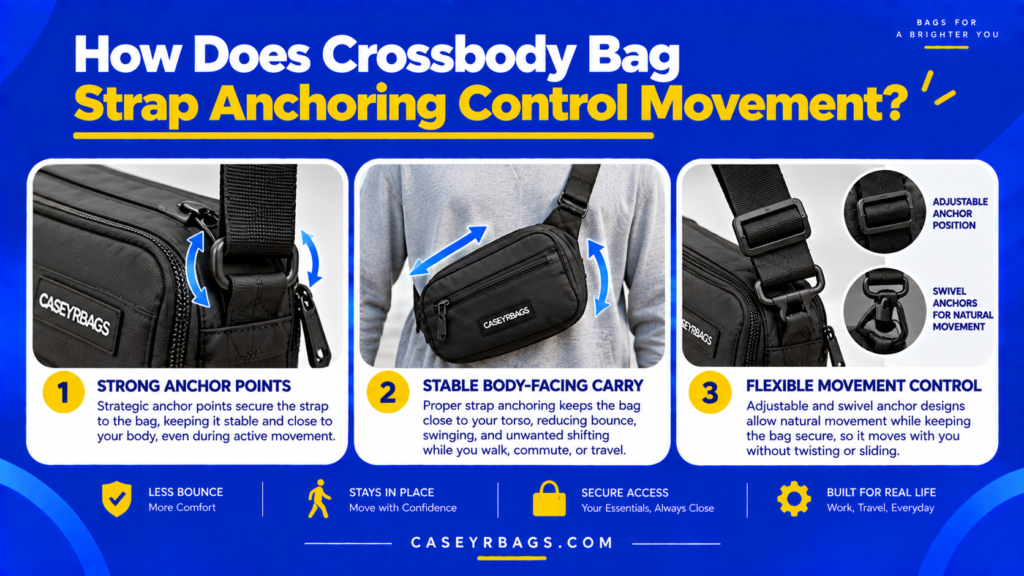
How Does Crossbody Bag Strap Anchoring Control Movement?
Crossbody Bag strap anchoring controls movement by defining where the diagonal strap connects to the bag and how strap tension enters the bag body. Anchor spacing, height, attachment position, and hardware geometry influence whether the bag stays relatively flat, tilts, rotates, or swings during normal movement.
The anchors work together with strap length, bag dimensions, body contact, and internal load placement. Well-integrated anchor geometry can improve orientation control, but it cannot completely eliminate movement or compensate for a poorly balanced load. Anchor stability ≠ zero movement, and strong attachment ≠ effective anchor geometry.
What Does Strap Anchoring Mean for Crossbody Bag Movement?
A Crossbody Bag strap usually connects to the bag body at one or more defined attachment points. These anchors determine where strap tension enters the bag and therefore influence the bag’s orientation relative to the torso, side, or hip.
When two anchors are separated across the bag body, they can create a broader control relationship than a single concentrated attachment point. The geometry may resist some unwanted rotation because the strap is connected to more than one structural position.
Anchor geometry does not work in isolation. Within the broader Crossbody Bag system, strap length, bag depth, internal weight, hardware movement, and body position all change how the same anchor layout behaves during walking or repositioning.
Which Parts Make Up a Crossbody Strap-Anchor System?
The system includes the strap, left and right anchor points, anchor tabs, rings or clips, reinforcement zones, bag side panels, and strap-adjustment hardware. Each component influences either where tension enters the bag or how much movement occurs between the strap and the body structure.
Component → anchor role → movement consequence. Stable attachment tabs hold geometry, rings or clips transmit tension, side panels preserve anchor position, and adjustment hardware changes the effective strap path. No single component determines orientation by itself.
How Does Strap Tension Enter the Bag Through the Anchors?
Diagonal strap tension reaches the bag through the attachment points and then spreads into the surrounding panels. Movement control begins at that force-transfer zone because the direction of tension influences how the bag body hangs, tilts, or rotates.
Diagonal strap tension → anchor points → bag body → bag orientation. If the anchors remain predictably located, the strap path stays more consistent; if the attachment zone deforms, the force direction can change while the user is moving.
Why Can the Same Anchor Layout Behave Differently With Different Loads?
Item density, left-right imbalance, bag depth, strap length, and body position can all change the demand placed on identical anchors. A centered light load may keep both sides comparatively balanced, while one dense side can pull one anchor more strongly.
Anchor geometry creates control potential; the actual load determines how that control behaves. Symmetrical anchors ≠ automatically symmetrical load behavior, so the loaded bag must be observed rather than judging geometry from the empty bag alone.
How Does Anchor Spacing Affect Crossbody Bag Rotation?
Anchor spacing changes how broadly the strap connects across the bag body and therefore how much pivoting or rotational freedom the attachment geometry allows.
How Can Wider Anchor Separation Improve Orientation Control?
Separated anchors create a broader attachment geometry that can distribute directional control across more of the bag body. Compared with a highly concentrated connection, this may reduce some pivoting by giving the strap system two more distinct control points.
Separated anchors → broader attachment geometry → greater orientation-control potential. Wider spacing is not always better because the result still depends on bag width, side-panel support, strap angle, hardware articulation, and the packed load.
How Can Narrowly Spaced Anchors Change Movement Behavior?
Narrow spacing can make the bag behave more like it is suspended from a concentrated zone, increasing the potential for pivoting around that area. The effect becomes more noticeable when the bag is wide, deep, flexible, or unevenly loaded.
Narrow anchor spacing → concentrated support zone → greater pivot potential. The actual result must be judged with bag rigidity, hardware behavior, load position, and strap path rather than spacing alone.
Why Is Anchor Spacing Relative to Bag Width More Important Than Spacing Alone?
The same physical distance between anchors can create different geometry on a narrow bag and a wide bag. On one body it may span much of the width; on another it may function as a concentrated central attachment zone.
Anchor spacing should be evaluated relative to the bag body it controls. Effective spacing depends on the proportion between attachment points and the structure they are expected to stabilize, not on a universal measurement.
| Anchor Pattern | Orientation Control | Rotation Potential | Main Variable |
|---|---|---|---|
| Closely spaced | More concentrated | Potentially higher | Bag width |
| Moderately separated | Broader control | Potentially lower | Strap angle |
| Widely separated | Broad control path | Design-dependent | Bag structure |
| Single concentrated point | Pivot-focused | Greater freedom to rotate | Hardware + load |
How Does Anchor Height Change Strap Angle & Bag Position?
Anchor height changes the direction of diagonal strap tension, which can alter bag angle, body contact, and the final carry position created by the same strap length.
How Do Higher Side Anchors Affect Bag Orientation?
Anchors positioned near the upper side of the bag direct strap tension through a higher structural zone. This can suspend the bag from closer to its upper edge and change how strongly the body-facing panel stays aligned with the intended carry plane.
Higher anchor → changed strap angle → changed bag orientation. Higher placement is not automatically more stable because bag depth, strap length, hardware movement, and load position still determine the finished behavior.
How Do Lower or Offset Anchors Change the Movement Path?
Lower or offset attachment points change the direction from which the strap pulls the bag. Depending on body shape and load, this can alter tilt, bag angle, rotational behavior, and the amount of panel contact against the torso or hip.
Offset anchor → changed pull direction → altered tilt or rotation. The effect is design-dependent rather than universally positive or negative, so the loaded bag should be observed through normal movement.
Why Should Anchor Height Be Evaluated With Strap Length?
Anchor height and strap length combine to determine the final bag position. A useful anchor layout can still behave poorly if a very long strap places the bag far below the position where its geometry was intended to maintain control.
Anchor height + strap length → final bag position. That final position also shapes Body Access, so adjustment should complement anchor geometry rather than mask poor attachment behavior.
How Does Anchor Position Affect Body-Facing Orientation?
Front, side, rearward, or edge placement changes the direction in which strap tension acts on the bag and therefore which panel naturally stays closest to the body.
How Do Side Anchors Help Maintain a Flat Body-Facing Panel?
Left and right side anchors can pull across opposite sides of the bag and help preserve a flatter body-facing plane when the bag structure resists deformation. This distributes orientation control across the body instead of concentrating it around one pivot point.
Left/right attachment → controlled body-facing plane. The benefit depends on the anchors being integrated into panels that remain stable under the intended load and on the contents not pulling strongly away from that plane.
How Can Forward or Rearward Anchor Placement Rotate the Bag?
Attachment points positioned ahead of or behind the bag centerline change the direction in which tension enters the structure. That offset can encourage forward tilt, outward rotation, or rearward rotation depending on strap path and packed geometry.
Anchor position changes the direction of pull, not just the location of the hardware. Rotation therefore needs to be evaluated as a relationship among attachment position, bag centerline, strap angle, and load center.
Why Does Bag Depth Influence Anchor-Position Effectiveness?
Greater bag depth moves part of the load farther away from the body-facing panel and can increase rotational potential around the anchor system. A shallow bag may respond differently to the same attachment geometry because its load center sits closer to the supporting plane.
Greater bag depth → load farther from body-facing panel → greater rotational potential. Anchor position becomes more important as the bag’s three-dimensional shape changes, but depth alone does not determine stability.
How Does Anchor Hardware Affect Crossbody Bag Movement?
Fixed, pivoting, and rotating hardware change the amount of angular freedom between the strap and bag, affecting twisting, repositioning, and local movement at the attachment point.
How Do Fixed Attachment Points Control Strap Orientation?
Fixed or minimally rotating connections preserve a more consistent strap-to-bag relationship because the hardware allows less independent angular movement. This can make the strap path easier to predict when the bag structure and load are already well aligned.
Less articulation → more predictable orientation. Fixed hardware is not universally superior because reduced angular freedom can also make the strap less adaptable when the user repositions the bag or when the intended strap angle changes.
How Do D-Rings, Swivel Clips, or Similar Hardware Change Movement?
D-rings, pivoting rings, and swivel clips can help the strap adapt its angle, reduce twisting, and move more freely during repositioning. That articulation can keep the strap from binding when the bag changes position.
Articulating hardware → more angular freedom → adaptation plus greater local movement potential. The useful amount of movement is the amount that prevents binding without allowing the bag body to rotate unnecessarily.
When Does Too Much Hardware Freedom Reduce Stability?
Highly mobile clips, long flexible anchor tabs, loose connection zones, or a heavy bag body can create enough local movement that the bag repeatedly changes orientation before the main strap path can control it.
Useful articulation should prevent binding without allowing unnecessary bag rotation. Excessive freedom becomes a mismatch when it repeatedly produces swing or tilt rather than simply allowing the strap to follow the intended carry angle.
| Hardware Behavior | Main Benefit | Movement Effect | Potential Trade-Off |
|---|---|---|---|
| Fixed | Predictable geometry | Lower local articulation | Less adaptive angle |
| Pivoting ring | Strap-angle adaptation | Moderate articulation | Some rotation |
| Swivel connection | Reduces strap twisting | High articulation | More movement potential |
| Long flexible tab | Flexible connection | Increased local movement | Less precise control |
How Does Bag-Body Structure Support Strap Anchoring?
Anchor geometry can control movement only when the surrounding bag structure holds attachment points in a sufficiently predictable position under load.
How Does a Structured Side Panel Improve Anchor Control?
A structured side panel resists collapse around the attachment zone and helps keep the anchor located where the design intends. When the panel maintains its shape, the strap enters the bag through a more stable geometric point.
Stable panel → stable anchor position → predictable strap geometry. The benefit is positional consistency, not a guarantee of zero movement, because hardware articulation and internal load still affect the final response.
How Does a Flexible Bag Body Change Anchor Behavior?
A highly flexible body can allow anchor tabs to pull inward, side panels to collapse, strap angle to change, or the bag to twist under load. This means the effective anchor position can shift even when the attachment itself remains intact.
Deformable panel → changing anchor orientation → changing strap path. Stable anchor points require a sufficiently stable attachment zone, especially when the packed load creates strong directional demand.
Why Does Reinforcement Matter Without Determining Movement by Itself?
Reinforcement can help preserve anchor position, attachment integrity, and surrounding panel shape. It supports the geometry by keeping the connection zone from deforming excessively under normal load.
Reinforcement strength ≠ movement-control geometry. Strong reinforcement can hold an anchor securely while unsuitable spacing, height, position, or hardware articulation still produces poor orientation behavior.
How Does Internal Load Placement Affect Anchor Movement Control?
Internal load placement changes anchor demand because one-sided, outward, or shifting contents alter how much tension each attachment point must resist.
How Does One-Sided Loading Change Anchor Demand?
A dense load concentrated toward one side can increase demand on the anchor nearest that side and pull the bag into tilt or rotation. The bag may remain structurally intact while its orientation becomes less predictable.
Dense load toward one side → uneven anchor tension → bag tilt or rotation. Internal imbalance becomes external anchor imbalance, so anchor geometry cannot be evaluated independently from the packed load.
Why Should Dense Items Remain Close to the Body-Facing Region?
Dense items positioned closer to the main body-facing structural region can reduce outward pull and help keep the load center nearer the plane the strap system is trying to control. This is a mechanical packing relationship rather than a medical rule.
Dense body-side placement can support more controlled geometry, especially when the item also remains reasonably centered left to right. A one-sided dense item can still create unequal anchor demand even when it sits close to the body-facing panel.
How Do Loose Contents Change Movement During Walking?
Loose contents can migrate as the user walks, causing the load center to move from one side or depth zone to another. Each shift changes how much tension the anchors experience and can create repeated small rotations or swings.
Moving contents → moving load center → changing anchor tension → repeated bag motion. Stable anchoring works best with stable contents, so retention becomes relevant when internal migration repeatedly changes bag orientation.
| Load Position | Anchor Effect | Bag Behavior |
|---|---|---|
| Centered | More comparable demand | More predictable orientation |
| Left-heavy | Higher left-side demand possible | Left tilt/rotation |
| Right-heavy | Higher right-side demand possible | Right tilt/rotation |
| Outward dense load | Greater rotational tendency | Bag pulls away from body |
| Shifting load | Variable tension | Repeated movement |
How Does Strap Length Interact With Anchor Geometry?
Strap length changes the leverage, bag height, and freedom of movement produced by the same anchor layout, so adjustment should refine rather than replace sound anchor geometry.
How Does a Shorter Strap Change Anchor Control?
A shorter strap can hold the bag closer to the body and reduce the free movement range available between the anchors and the user. This can reduce some swing when the bag geometry and load are already compatible.
Shorter strap → bag closer to body → reduced free movement range. Shortest ≠ best because excessive shortening can alter anchor angle, restrict repositioning, or hide an unresolved load or panel problem.
How Does a Longer Strap Increase Movement Potential?
A longer strap can place the bag lower, create a larger swing arc, and make rotation toward the front easier during access. The extra freedom can be useful for repositioning while increasing movement potential during walking.
Longer strap → greater movement freedom → larger swing potential. The effect depends on anchor spacing, bag depth, load center, and how much hardware articulation exists at the connection points.
Why Should Anchor Problems Not Be “Fixed” Only by Tightening the Strap?
Instability may come from poor load distribution, excessive bag depth, flexible anchor panels, loose hardware, or unsuitable attachment geometry. Tightening can reduce visible motion without correcting those causes.
Adjustment refines geometry; it does not replace sound geometry. Movement patterns should trigger inspection of load, anchors, hardware, and bag structure before strap shortening is treated as the complete solution.
How Can Anchor-Related Movement Problems Be Diagnosed?
Anchor-related diagnosis should separate geometry problems from load imbalance, strap adjustment, hardware movement, and bag-body deformation before changing any single feature.
What Does Repeated Bag Rotation Suggest?
Repeated rotation can be associated with narrow anchor spacing, highly articulating hardware, uneven internal load, greater bag depth, or a long strap setting. The same symptom can therefore come from several interacting causes.
Rotation alone should not be used to diagnose one failure. Observe when the movement appears, then compare load balance, hardware freedom, strap length, and anchor geometry before making a correction.
What Does Persistent One-Sided Tilt Suggest?
Persistent tilt can indicate load asymmetry, unequal anchor position, side-panel distortion, damaged hardware, or strap twisting. Each condition changes either the demand on one side or the direction in which strap tension enters the bag.
Tilt does not automatically indicate anchor failure. The useful check is whether the anchor remains intact while the load or geometry consistently pulls the bag to one side.
What Does Excessive Swing Suggest?
Excessive swing can reflect strap length, bag mass, anchor geometry, weak body contact, or internal movement. The bag may swing even with intact anchors if the whole system allows too much free movement.
Movement pattern → inspect multiple interacting causes before changing one feature. The correction should target the source that repeatedly creates swing rather than assuming strap length is always responsible.
How Should Crossbody Strap Anchoring Be Evaluated?
Final evaluation should compare unloaded attachment condition with the behavior of the normal packed bag during walking, repositioning, and return to the intended carry zone.
What Should Be Inspected Before Loading the Bag?
Inspect both anchor attachments, left-right placement, ring or clip condition, anchor-tab integrity, surrounding panel reinforcement, and whether the strap is twisted. These checks establish whether the geometry begins from a structurally intact condition.
An intact anchor is only the starting point. The inspection should note spacing, height, articulation, and panel support because strong stitching alone does not prove effective movement-control geometry.
What Should Be Observed After Loading?
After loading, observe bag orientation, left-right tilt, body contact, repeated rotation, swing, hardware movement, and any visible anchor deformation. The loaded bag reveals how the geometry behaves under the demand it is actually meant to control.
Also reposition the bag for normal access and return it to the carry zone. Useful anchor control should remain reasonably predictable through that transition instead of working only while the bag is held in one static position.
Which Sequence Should Determine Final Anchor Fit?
- Identify the normal load.
- Center dense items where practical.
- Inspect both anchor points.
- Adjust strap length.
- Position the bag at the intended carry zone.
- Walk normally.
- Observe swing and rotation.
- Reposition the bag for access.
- Return it to carry position.
- Reassess anchors if movement remains excessive.
Use the sequence in order so the test begins with the real load and intact anchor geometry before movement is judged. Centering dense items and inspecting both anchors prevents a load problem from being mistaken for an attachment problem.
After positioning the bag, normal walking, access repositioning, and return-to-carry behavior should be observed together. Reassess anchors only when excessive movement remains after load and strap conditions have already been checked.
How Can Crossbody Anchor-Control Mismatches Be Avoided?
Anchor-control mismatches are avoided by judging spacing, height, hardware freedom, side-panel support, strap length, and loaded behavior together instead of treating anchor strength as the result.
Why Is Anchor Strength Alone a Weak Stability Measure?
A strong attachment can still use poor spacing, excessive articulation, unstable surrounding panels, or unsuitable geometry. The anchor may remain physically secure while the bag repeatedly rotates or tilts.
Strong anchor ≠ stable anchor layout. Attachment integrity matters, but movement control comes from the geometry and structure that determine how force is transferred into the bag.
Why Is Maximum Anchor Spacing Not Automatically Better?
Very wide spacing can interact poorly with narrow bag bodies, opening geometry, strap angle, or panel shape. A broader control path is useful only when the surrounding architecture can support that relationship.
Anchor spacing must match the bag architecture. Wider spacing ≠ universally better control, just as narrow spacing is not automatically unstable in every compact or structured design.
What Should Be Verified Before Relying on Strap Anchoring for Movement Control?
Verify both anchors, anchor-tab condition, left-right placement, spacing relative to bag width, anchor height, strap twisting, hardware articulation, side-panel support, reinforcement, dense-item position, loose-content control, bag depth, and strap length.
Then observe tilt, rotation, swing, and response during normal walking with the intended load. Stable anchoring should mean predictable movement control rather than zero movement, and persistent symptoms should trigger a multi-factor load-and-geometry check.
- Both strap anchors are intact.
- Anchor tabs show no structural damage.
- Left-right anchor placement matches the intended design.
- Anchor spacing suits the bag width.
- Anchor height supports the intended bag position.
- Strap is not twisted.
- Hardware moves only as much as intended.
- Swivels or rings do not create excessive free rotation.
- Bag side panels support the anchor positions.
- Reinforcement remains secure.
- Dense contents are reasonably centered.
- Loose contents remain controlled.
- Bag depth does not create excessive outward rotation.
- Strap length supports body-facing carry.
- Bag does not repeatedly tilt to one side.
- Bag rotation remains controlled during walking.
- Swing remains manageable during normal movement.
- Persistent movement triggers a load and geometry check.
- Strong stitching is not treated as proof of good anchor geometry.
- Stable anchoring is not treated as zero-movement carry.
Conclusion
Crossbody Bag strap anchoring controls movement by determining where diagonal strap tension enters the bag and how that force influences bag orientation. Anchor spacing, height, side-panel position, hardware articulation, and integration with the bag body can reduce unwanted rotation, tilt, or swing when they work with the intended strap length and load.
Effective movement control depends on the whole system rather than anchor strength alone. Stable side panels should preserve attachment geometry, dense and loose contents should remain controlled, and strap adjustment should refine rather than mask poor anchoring behavior. Effective Crossbody Bag movement control comes from anchor geometry that matches the bag body, strap path, and internal load while preserving useful movement without requiring excessive strap tension.
FAQs
Two separated anchor points can provide broader orientation control than one concentrated connection because strap tension reaches the bag through more than one position.
Actual stability still depends on spacing, bag structure, strap length, hardware articulation, and load placement. Two anchors ≠ guaranteed stability.
No. Wider spacing can increase orientation-control potential in some designs by creating a broader attachment relationship across the bag body.
Useful spacing still depends on bag width, depth, strap geometry, panel support, and actual load behavior. Wider spacing ≠ universally better.
Not automatically. Swivel hardware can help the strap adapt its angle and reduce twisting as the bag changes position.
Greater articulation can also permit additional local movement, so effectiveness depends on anchor geometry, bag structure, strap path, and load. More articulation ≠ automatically less stable.