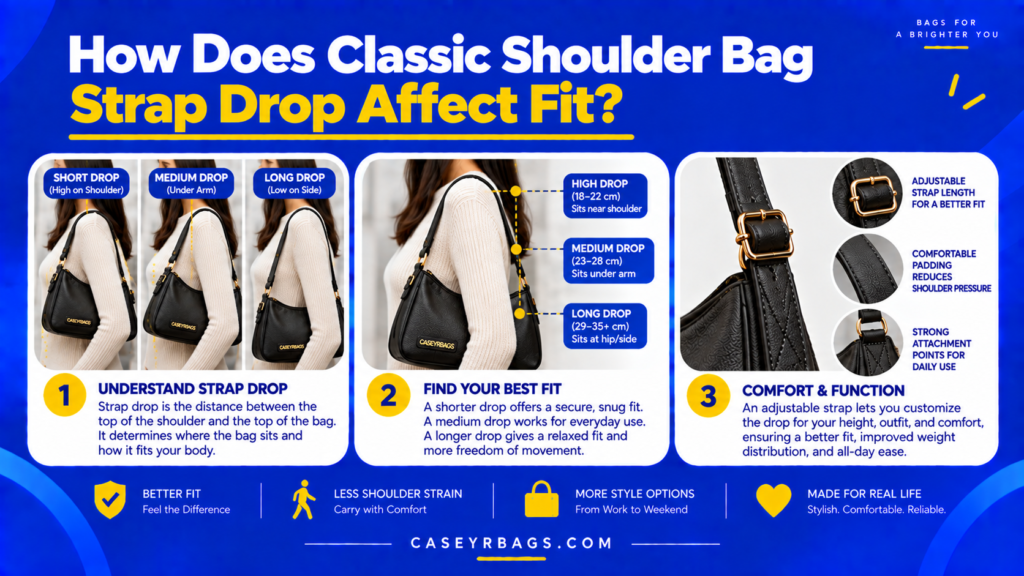
How Does Classic Shoulder Bag Strap Drop Affect Fit?
Classic Shoulder Bag strap drop affects fit by determining how much vertical space exists between the top of the bag and the highest point of the strap when carried. That space influences whether the bag clears the shoulder and upper arm, where it rests along the side, and how easily it can be accessed.
A shorter drop can keep the bag higher and closer to the underarm, while a longer drop can position it lower and create more clearance. Neither is automatically better because useful fit also depends on bag width, depth, strap anchors, clothing thickness, load, and intended carry position.
What Does Strap Drop Mean for Classic Shoulder Bag Fit?
Strap drop describes the vertical distance between the upper part of the bag and the highest point of the strap when positioned for carrying. It represents usable shoulder-clearance space rather than the complete length of the strap material.
In a Classic Shoulder Bag, that clearance determines whether the bag can pass over the shoulder and upper arm and where the bag body settles once suspended. A small change in drop can therefore move the bag noticeably higher or lower.
Strap drop should not be evaluated alone. Within the broader Shoulder Bag system, bag width, depth, anchor geometry, strap flexibility, clothing, and packed load all affect how the measured drop behaves in actual use.
How Is Strap Drop Different From Total Strap Length?
Total strap length measures the entire path along the strap material, while strap drop measures the vertical carrying clearance from the bag top to the highest point of the strap. They describe different aspects of the same geometry.
Two bags with similar total strap lengths can still create different usable drops because anchor placement, bag-top width, strap curvature, and attachment angle change the suspended shape.
Which Parts Determine Usable Strap Drop?
Usable drop comes from strap length, anchor location, strap curvature, bag-top width, attachment angle, and adjustment hardware where present. These variables determine the actual opening formed beneath the strap.
The measurement therefore works as one geometry system rather than an isolated number. Changes in one part can alter shoulder entry, vertical position, or the arc through which the bag hangs.
Why Should Strap Drop Be Evaluated on the Loaded Bag?
Loading can change soft bag shape, strap curvature, panel sag, and the final resting height. The same empty bag may settle differently after dense or bulky contents change the suspended geometry.
Listed drop and loaded carry position are related but not identical. Real fit should be judged from the bag in the condition in which it will normally be carried.
How Does Strap Drop Affect Shoulder & Arm Clearance?
The open space beneath the strap determines how easily the bag moves onto and off the shoulder and how much room remains for upper-arm movement.
What Happens When Strap Drop Provides Limited Clearance?
Limited clearance can keep the bag high near the underarm, reduce space around the upper arm, and make placement more difficult over bulky clothing. These effects do not automatically mean poor fit.
A short drop can still be functional when the bag is narrow or shallow and the intended carry position is high. The fit becomes poor only when clearance interferes with normal placement, movement, or access.
What Happens When Strap Drop Provides Greater Clearance?
Greater clearance can make shoulder entry easier, create more underarm space, lower the bag, and allow more repositioning freedom. The bag usually has more room to move around the side.
Additional clearance changes both fit and movement potential. More space is useful only while the bag remains at an intentional height with acceptable body contact and access.
When Is Additional Clearance No Longer Useful?
Extra drop stops helping when it pushes the bag lower than intended, increases movement range excessively, slows access, or reduces useful body contact. At that point the added space creates a new fit trade-off.
Useful clearance ends when additional drop stops improving functional fit. Longer drop ≠ automatically better fit.
How Does Strap Drop Determine Where the Shoulder Bag Rests?
Once the strap is on the shoulder, the vertical drop helps determine whether the bag sits high under the arm, along the side torso, or lower toward the side.
How Does a Shorter Drop Affect Resting Height?
A shorter drop usually places the bag body higher and closer to the underarm or upper side. This can reduce movement range and increase body contact while tightening the access space.
Shorter drop → higher resting position → reduced clearance and movement range. Shorter is not automatically more stable because width, depth, anchors, and access can still create a mismatch.
How Does a Longer Drop Affect Resting Height?
A longer drop usually lowers the bag body and creates more sideward clearance. This can make repositioning easier while increasing the swing range available to the bag.
Longer drop → lower resting position → greater clearance and movement potential. The useful amount depends on how the loaded bag behaves, not on maximizing drop.
Why Is the Lowest Possible Resting Position Not Automatically Best?
Lowering the bag too far can reduce stable body contact, increase movement, and move the opening away from the most convenient access zone. More clearance can therefore reduce overall function.
Resting height should match the intended carry behavior, not maximize drop. A useful position balances clearance, movement control, and access.
| Strap Drop | Likely Bag Position | Movement Potential | Main Fit Consideration |
|---|---|---|---|
| Shorter | Higher / underarm | Lower–moderate | Clearance |
| Moderate | Side torso | Moderate | Carry-access balance |
| Longer | Lower side | Greater potential | Movement control |
How Does Bag Width Change the Strap Drop Needed for Fit?
A wider bag top can consume more of the opening created by a given drop because the strap must span a larger attachment relationship before reaching the shoulder.
How Does Bag-Top Width Affect Shoulder Entry?
With the same nominal drop, a wider bag top can reduce the effective open space available for the shoulder and upper arm because the strap spans farther between its attachment points.
Wider bag + same nominal drop → less usable shoulder opening. The effect depends on strap curvature, anchor spacing, and panel flexibility rather than width alone.
Why Can Two Bags With the Same Listed Drop Fit Differently?
Bag width, anchor spacing, strap curvature, body structure, and panel flexibility can all change the opening beneath the strap. Equal listed drops can therefore produce different real shoulder clearance.
Numerical drop alone does not define usable clearance. The measurement must be interpreted with the geometry that creates the actual strap opening.
When Does Bag Width Create a Fit Mismatch?
A width mismatch may show up as difficult shoulder entry, a bag trapped tightly under the arm, steep strap angles, or difficult removal. These symptoms indicate that the nominal drop is being consumed by geometry.
The correction may involve a different drop setting where available, but the underlying issue can still be bag width or anchor spacing rather than the drop number itself.
How Does Bag Depth Affect the Way Strap Drop Feels?
Depth does not change the vertical drop measurement directly, but it changes how much three-dimensional space the bag occupies around the underarm and side.
How Does a Shallow Classic Shoulder Bag Interact With Shorter Drops?
A shallow bag can remain closer to the body and occupy less outward underarm space, allowing some shorter-drop designs to feel less crowded than deeper bags at the same vertical position.
Shallow geometry is not universally superior. Width, load, anchors, and access still determine whether the overall carry zone works.
How Can Greater Bag Depth Change Usable Clearance?
Greater depth makes the bag project farther outward and can increase upper-arm interaction. The same vertical drop may therefore feel more restricted because more physical volume occupies the carry zone.
Greater depth → more outward occupation → greater underarm interaction. Perceived fit can change even when the measured strap drop remains identical.
Why Should Depth and Drop Be Evaluated Together?
Strap drop controls vertical space, while bag depth controls how much three-dimensional space the bag occupies within that vertical zone. These variables combine to create the usable fit.
A fit that works for a slim bag may not behave the same way for a deeper bag using the same listed drop. Geometry should be evaluated as a system.
How Do Clothing Layers Change Effective Strap-Drop Fit?
Clothing occupies part of the shoulder and underarm opening, so the same bag can feel different over light clothing and thicker layers.
How Does Thicker Clothing Reduce Usable Shoulder Clearance?
More clothing volume leaves less remaining space within the same strap drop. Shoulder entry can become tighter even though the bag and strap dimensions have not changed.
Thicker clothing → less usable clearance → changed functional fit. The effect should be observed rather than converted into one universal seasonal measurement.
When Can a Fixed Strap Drop Become Restrictive?
A fixed drop can become restrictive over a coat, layered clothing, or larger sleeve volume when the remaining opening no longer clears the shoulder and upper arm comfortably enough for intended use.
This does not mean fixed straps are poor by design. Fixed geometry works when the bag, clothing conditions, and intended resting position remain compatible.
Why Should Expected Clothing Be Included in Fit Testing?
A bag that clears easily over light clothing may fit differently over thicker layers because the clothing occupies part of the same shoulder opening.
Useful strap drop should be tested in the carry conditions that matter. Empty space observed in one clothing condition does not guarantee identical clearance in another.
| Clothing Condition | Effective Clearance | Possible Fit Effect |
|---|---|---|
| Light layer | More available space | Higher bag position remains usable |
| Moderate layer | Reduced space | Fit becomes more sensitive |
| Bulky layer | Less available space | Short drop may restrict placement |
How Does Packed Load Change Strap-Drop Fit?
A loaded Classic Shoulder Bag can settle differently from an empty bag because soft structure, strap curvature, and internal mass can alter the final resting position.
How Can Load Make a Soft Bag Sit Lower?
Load increases tension through the bag and strap, allowing soft panels or flexible straps to sag or curve where the design permits. The loaded body may therefore settle below the empty-bag position.
Load → tension → structural sag or curvature → changed resting height. The amount is design-dependent and should not be predicted from the listed drop alone.
How Can Dense Contents Change the Perceived Fit?
Dense contents can pull the bag downward, change body contact, increase movement, and make a previously acceptable drop feel different. Where those contents sit also affects how the bag hangs.
Loaded fit ≠ empty-bag fit. Dense contents should be part of the evaluation because the carry geometry must work under the normal packed condition.
Why Should Extra Strap Drop Not Compensate for Excessive Loading?
Lengthening the drop does not solve excessive load, poor internal balance, or weak structure. It only changes where the loaded bag rests.
Load suitability and strap-drop fit are separate decisions. Extra drop should not be used as a substitute for correcting an overloaded or poorly balanced bag.
How Do Strap Anchors Affect Effective Drop?
Anchor height, spacing, and orientation shape the strap path, so the same nominal drop can produce different real shoulder openings and bag positions.
How Do Higher Bag-Side Anchors Affect Strap Geometry?
Higher anchors start the strap closer to the bag top and create a particular carry arc between the attachment points and the shoulder. This can change how the listed drop translates into usable space.
Higher anchor position → changed strap path → changed carry geometry. No anchor height is universally better because bag width and strap curvature still influence the result.
How Do Widely Spaced Anchors Change the Usable Strap Opening?
Bag width, anchor spacing, and strap curve all influence how much open space remains beneath the strap. Wider spacing can cause more of the strap path to span the bag before rising toward the shoulder.
That relationship can make two equal drop measurements behave differently. The usable opening depends on the whole attachment geometry.
Why Can Anchor Orientation Make the Same Nominal Drop Feel Different?
Anchor angle changes the direction in which the strap leaves the bag and therefore affects shoulder clearance, strap curvature, and bag orientation.
Anchor angle → strap path → usable clearance and bag position. Strap drop is a geometric system, not merely one isolated number.
How Do Fixed & Adjustable Strap Drops Affect Fit?
Adjustability changes the available fit range, but a fixed drop can work just as effectively when its geometry already matches the intended carry condition.
What Is the Fit Advantage of an Adjustable Drop?
An adjustable drop can accommodate changes in resting height, clothing thickness, access preference, and load behavior by allowing the strap opening to be made larger or smaller.
Adjustability expands the usable range rather than guaranteeing correct fit. The bag still needs compatible width, depth, anchors, and overall size.
When Can a Fixed Drop Work Well?
A fixed drop can work well when bag geometry matches the intended position, expected clothing conditions are consistent, and the available opening already provides useful shoulder clearance.
Fixed does not mean poor fit when the geometry is appropriate. Predictable fixed dimensions can be fully functional for the intended carry context.
Why Does Adjustment Range Not Guarantee Correct Fit?
An adjustable strap cannot fully correct excessive bag width, excessive depth, poor anchor geometry, or an unsuitable bag size. Adjustment changes the strap opening, not the entire bag architecture.
Adjustability ≠ guaranteed fit. It increases position options but cannot eliminate geometry mismatches elsewhere in the bag.
| Strap System | Main Fit Advantage | Main Limitation |
|---|---|---|
| Fixed drop | Simple predictable geometry | Limited position range |
| Adjustable drop | Variable clearance/resting height | Cannot fix every bag mismatch |
How Does Strap Drop Affect Shoulder Bag Movement?
Drop changes suspension distance and resting height, both of which influence how freely the bag can swing or rotate during normal movement.
Why Can a Longer Drop Increase Movement Range?
A longer suspension distance creates more freedom for forward-back and side movement because the bag hangs farther below the shoulder point. This can enlarge the available swing path.
Long-drop bags are not inherently unstable. Movement remains acceptable when the loaded bag stays predictable and does not require constant repositioning.
How Can a Shorter Drop Reduce Movement?
A shorter drop can increase body contact, shorten the swing arc, and keep the bag higher against the side. These effects can reduce some free movement.
Reduced movement ≠ automatically better access or fit. Excessive shortening can crowd the shoulder or make the opening harder to reach.
When Is Movement Evidence of Poor Strap-Drop Fit?
Persistent excessive swing, repeated repositioning, rotation away from the intended side position, or interference with walking can indicate that the resting height no longer matches the bag’s geometry and load.
Movement is one fit signal among several. It should be assessed with clearance, body contact, and access rather than used alone.
How Does Strap Drop Affect Access While the Bag Is Worn?
The bag’s vertical position changes the space available for opening, hand entry, zipper movement, and routine retrieval while the bag remains on the shoulder.
When Can a High Resting Position Restrict Access?
A high bag can compress the opening near the underarm, reduce visual access, restrict zipper movement, or limit hand entry. These effects can make routine retrieval harder even when shoulder clearance is technically sufficient.
Shoulder clearance ≠ automatic access quality. A fit can pass the shoulder but still place the opening in an inconvenient working position.
When Can a Lower Position Improve Access?
A lower position can improve visual reach, create more opening clearance, and make it easier to stabilize the bag by hand during retrieval.
The trade-off is more movement potential. Lower carry improves access only when swing and body contact remain manageable.
What Creates the Best Carry-Access Balance?
A useful carry-access position keeps the bag reasonably stable, leaves the opening reachable, allows normal hand entry, and avoids requiring full removal for routine access where the design intends worn use.
Good strap-drop fit supports both carry and retrieval. The goal is not maximum clearance or minimum movement but a functional balance between them.
How Can Poor Strap-Drop Fit Be Diagnosed?
Poor fit should be diagnosed through observable symptoms and a consistent check order rather than by comparing the bag with one universal drop measurement.
What Suggests the Strap Drop Is Too Short for the Intended Use?
Possible signs include difficult shoulder entry, excessive underarm crowding, the bag pressing into the upper arm, difficult access, or bulky clothing failing to clear the strap opening.
These symptoms indicate insufficient usable space for the intended condition, not a universal minimum measurement. Width, depth, clothing, and anchors can all contribute.
What Suggests the Strap Drop Is Longer Than Useful?
A bag resting much lower than intended, excessive swing, repeated repositioning, or weak body contact can indicate that the available drop exceeds what the carry task needs.
Longer-than-useful is a functional diagnosis, not a numerical threshold. The same drop can behave differently with a different bag geometry or load.
What Should Be Checked Before Changing Strap Drop?
- Bag load.
- Bag width.
- Bag depth.
- Clothing layers.
- Anchor geometry.
- Intended resting position.
- Access behavior.
Use the diagnosis order exactly so the bag load and physical geometry are checked before changing strap drop. Width, depth, clothing, and anchors can all create symptoms that look like a simple drop problem.
A fit problem may come from bag geometry rather than drop alone. Change the strap setting only after load, geometry, intended position, and access behavior have been considered.
How Should Classic Shoulder Bag Strap Drop Be Evaluated?
Final evaluation should use the normally loaded bag and test clearance, loaded resting height, walking behavior, body contact, and worn access together.
What Should Be Checked Before Wearing the Bag?
Identify the available strap-drop range, whether the strap is fixed or adjustable, bag width, bag depth, anchor placement, and normal contents before starting the fit test.
These variables define the geometry being evaluated. Testing without the normal load or without understanding the strap system can give an incomplete fit picture.
What Should Be Checked While the Bag Is Worn?
Observe shoulder entry, underarm clearance, resting height, body contact, swing, and access while the bag remains on the shoulder. These conditions show whether the measured drop works in actual use.
The loaded bag should stay in a deliberate position without excessive crowding or movement, and routine access should remain possible where intended.
Which Sequence Should Determine Final Strap-Drop Fit?
- Load the bag normally.
- Set the strap to its intended position.
- Place the bag onto the shoulder normally.
- Check shoulder and upper-arm clearance.
- Observe where the bag rests.
- Walk normally.
- Check swing and body contact.
- Open the main compartment while worn.
- Retrieve a routine item.
- Retest with expected thicker clothing if relevant.
- Adjust drop until clearance, positioning, and access remain functional.
Use the sequence in order so the bag is tested loaded, at the intended strap setting, and through normal shoulder entry before movement and access are judged. Walking then reveals whether body contact and swing remain functional.
Complete the worn-access and clothing retest before changing the final setting. Adjust drop only until clearance, position, movement, and access work together; do not convert the result into a universal ideal measurement.
How Can Classic Shoulder Bag Strap-Drop Mismatches Be Avoided?
Mismatches are avoided by judging the loaded bag as a complete geometry system instead of choosing the longest or shortest available drop from a listed number alone.
Why Is Choosing the Longest Possible Drop a Weak Strategy?
Maximum drop can place the bag unnecessarily low, increase swing, reduce body contact, and change the access path. More clearance is useful only when it improves the intended fit.
A longer setting should solve a real shoulder or access-clearance need rather than simply maximize empty space beneath the strap.
Why Is Choosing the Shortest Possible Drop Also a Weak Strategy?
Minimum drop can make shoulder placement difficult, restrict underarm space, reduce compatibility with thicker clothing, and make the opening harder to reach.
Shorter drop ≠ automatically more stable. Reduced movement is not useful when clearance or access becomes impractical.
What Should Be Verified Before Accepting the Final Strap-Drop Fit?
Verify that the bag is tested loaded, clears the shoulder and upper arm, rests at the intended height, works with its width and depth, accounts for clothing, and maintains manageable swing, body contact, and worn access.
Also confirm that longer drop is not treated as automatically better and shorter drop is not treated as automatically more stable. Once strap-drop fit is resolved, Strap Position becomes the next close positioning question.
- Strap drop is distinguished from total strap length.
- Measurement method is understood where provided.
- Bag is tested with its normal load.
- Bag clears the shoulder without excessive effort.
- Upper arm has usable movement space.
- Bag does not feel unnecessarily crowded under the arm.
- Resting height matches the intended carry position.
- Bag width works with the available strap opening.
- Bag depth does not create excessive underarm crowding.
- Strap anchors support the intended geometry.
- Loaded bag does not sag far below the intended position.
- Expected clothing layers are considered.
- Adjustable strap can reach the useful position where applicable.
- Fixed drop is evaluated by real fit rather than by adjustability alone.
- Swing remains manageable during normal walking.
- Bag remains reasonably body-facing.
- Main compartment remains accessible while worn where intended.
- Longer drop is not automatically treated as better.
- Shorter drop is not automatically treated as more stable.
- Final fit is based on clearance, position, movement, and access together.
Conclusion
Classic Shoulder Bag strap drop affects fit by controlling the vertical clearance between the shoulder and bag body. That clearance determines how easily the bag passes over the shoulder and upper arm, where it rests against the side, and how much freedom remains for movement and access.
Appropriate fit cannot be judged from one listed measurement. Bag width, depth, anchors, clothing, load sag, and strap adjustability all change how the measured drop behaves in real use. A Classic Shoulder Bag has appropriate strap-drop fit when the loaded bag clears the shoulder and upper arm, rests at the intended height, remains reasonably controlled during movement, and stays accessible without requiring unnecessary extra drop.
FAQs
Strap drop is the vertical carry clearance between the top area of the bag and the highest point of the shoulder strap.
It is not the total strap length itself. Anchor position, bag width, and strap curvature affect how that measured drop becomes usable shoulder space.
Greater drop can improve shoulder or clothing clearance and move the bag lower along the side.
Too much drop can also increase movement or place the bag below its intended access zone. Longer is not universally better; the loaded carry behavior matters.
Actual fit changes with bag width, depth, anchor spacing, strap shape, structural flexibility, clothing, and the packed load.
Those variables change usable clearance and loaded resting height, so the same nominal drop can produce different real carry geometry on different bags.