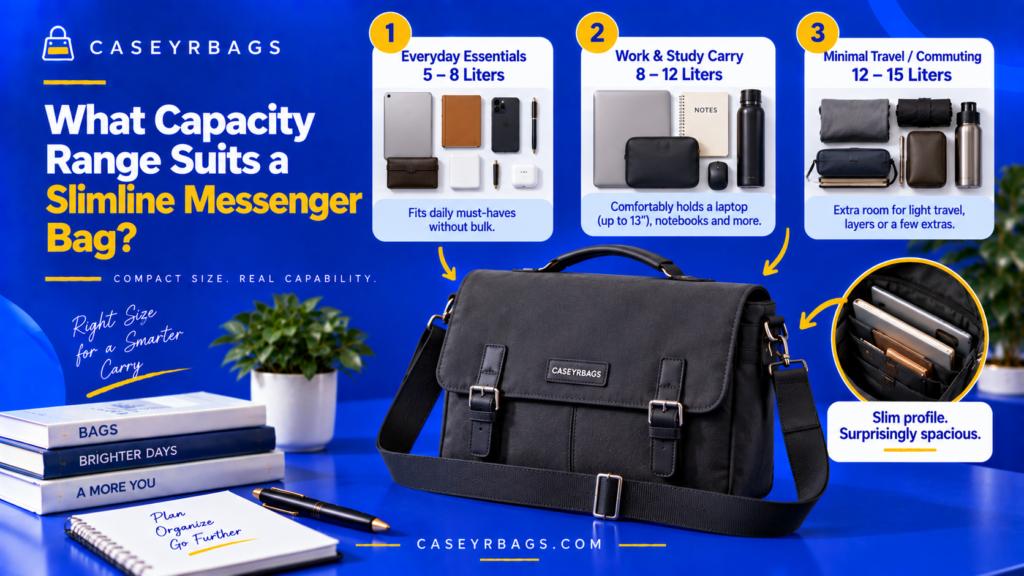
What Capacity Range Suits a Slimline Messenger Bag?
A Slimline Messenger Bag generally suits a lower-to-moderate capacity that can hold a focused work load—such as documents, a notebook, a compatible tablet or laptop, and a limited set of accessories—without requiring excessive front-to-back depth. The useful range is therefore determined less by one universal liter figure and more by whether the intended contents fit within a shallow, organized profile.
Capacity should be evaluated through usable internal dimensions, compartment loss, packed thickness, and actual work-item volume. A bag that technically offers more space may stop functioning as a slimline design if the extra capacity encourages bulky stacking or pushes the flap and side panels outward.
What Does Capacity Mean in a Slimline Messenger Bag?
Capacity describes how much internal space the bag can provide for its intended contents, but a Slimline Messenger Bag adds an important constraint: the volume must remain compatible with a relatively shallow front-to-back profile.
Two bags with similar nominal capacity can behave differently because one may gain volume through width and height while another gains it through depth. The second may carry substantially farther from the body even when both advertise comparable liters.
Useful Slimline capacity therefore combines sufficient work-item volume + shallow depth + organized internal geometry. The bag should carry the required load without depending on excessive bulging or closure tension within the broader Messenger Bag system.
Which Variables Determine Functional Capacity?
Internal width, internal height, internal depth, padding, dividers, pockets, opening geometry, and intended contents all change how much space can be used effectively.
Variable → space effect → capacity consequence. Functional capacity is the organized space that remains usable after the bag’s structure and intended work load are considered.
Why Are Liters Only One Part of the Answer?
A liter figure describes broad volume but does not reveal the bag’s shape, usable dimensions, compartment displacement, opening size, or how much of the volume comes from front-to-back depth.
Two equal liter labels can therefore produce different document fit, device fit, accessory space, and packed profile. Liters are a comparison signal rather than a complete fit test.
What Makes Capacity Specifically “Slimline”?
Slimline capacity provides useful work-item space while keeping front-to-back expansion controlled rather than relying on deep stacking.
The bag remains functionally slim when the normal load fits without persistent bulging, forced closure, or excessive outward projection.
Why Is Nominal Capacity Different From Usable Capacity?
Advertised or calculated volume includes spaces that may be reduced by shape, structure, internal organization, and access geometry.
How Does Bag Shape Reduce Usable Volume?
Tapered sides, rounded corners, flap geometry, and narrow upper openings can remove or restrict parts of the total interior envelope.
Nominal geometry can therefore exceed the item-compatible space available to folders, devices, notebooks, or pouches.
How Do Padding and Dividers Consume Internal Volume?
Padding and dividers occupy physical space inside the bag, so part of the interior envelope becomes structure rather than item storage.
Padding/dividers occupy physical space → less room remains for contents. Their organizational or protective roles can still justify that displacement.
Why Can Some Advertised Capacity Remain Impractical to Use?
Difficult corners, narrow pockets, inaccessible depth, or spaces incompatible with intended item shapes can remain technically present but functionally weak.
Nominal liters ≠ usable organized capacity. Capacity should be judged from the portions of space that can actually accept, retain, and release the intended load.
How Does Bag Depth Define Slimline Capacity?
Front-to-back depth is the most important capacity constraint because added volume through depth also increases outward projection and stacking opportunity.
Why Does Shallow Depth Support Slimline Messenger Bag Identity?
Shallow depth creates a flatter side profile, reduces outward projection, and naturally favors documents, notebooks, and compatible electronics arranged in flatter layers.
Controlled depth reinforces the slimline role because volume comes mainly from useful width and height rather than bulky front-to-back expansion.
How Does Greater Depth Increase Capacity?
More front-to-back space increases total volume and permits more layers, pouches, accessories, and thicker combinations of work items.
More front-to-back space → more volume, but also more stacking, outward projection, and movement opportunity inside the bag.
When Does Added Depth Weaken Slimline Identity?
Added depth weakens the slimline function when useful capacity increasingly depends on bulky layers, stacked pouches, or outward expansion.
More capacity can eventually conflict with the purpose of a slimline design. No universal numeric depth threshold defines the boundary.
How Much Capacity Do Documents Require?
Documents primarily demand usable width and height, while multiple paper-based layers gradually add thickness to the packed profile.
How Do Folders and Documents Use Messenger Bag Capacity?
Flat paper-based items depend mainly on internal width and height and usually require relatively little front-to-back depth when stored without bulky stacking.
Flat items → width/height dominant → relatively low depth demand. A slim body can therefore support meaningful document capacity.
How Do Multiple Notebooks Change the Volume Requirement?
Each additional notebook or document bundle adds thickness even when the footprint remains similar to the layers already inside the bag.
Multiple flat layers → accumulated thickness → increased packed depth. Slimline capacity should account for the combined stack rather than each item in isolation.
Why Should Document Fit Be Checked Using Internal Dimensions?
A capacity label in liters cannot confirm that a specific folder, paper format, or notebook can lie flat inside the usable chamber.
Internal width and height determine flat-item fit. Bag capacity in liters cannot confirm that a specific folder or document format lies flat.
How Does Device Carry Change Slimline Capacity Requirements?
Tablets and laptops consume both flat area and protected thickness, so their compartments must fit the actual device while leaving enough space for the rest of the work load.
How Does a Device Sleeve Affect Usable Space?
Sleeve walls, padding, divider construction, and the device itself all occupy part of the bag’s internal width, height, or depth.
Device zone structure → internal displacement → less remaining work-item space. The protective structure must be counted when judging capacity.
Why Does Device Fit Depend on More Than Liters?
Device width, height, and thickness must match the usable dimensions of the actual compartment and the opening path leading into it.
Device dimensions → compartment compatibility. A large nominal volume cannot compensate for a sleeve that is too narrow, too short, or too shallow; the narrower follow-up is Tablet Fit.
Why Is Physical Fit Different From Device Protection?
A device can physically fit a sleeve without proving impact protection, base protection, retention quality, or any certified protective performance.
Device fit ≠ device protection. Physical compatibility and protective capability are separate evaluations.
| Load Combination | Width/Height Need | Depth Need | Main Capacity Question |
|---|---|---|---|
| Documents only | High flat area | Low | Do they lie flat? |
| Tablet + papers | Moderate–high | Low–moderate | Do zones remain separate? |
| Laptop + documents | High | Moderate | Is sleeve fit verified? |
| Device + notebook + accessories | High | Moderate–higher | Does profile stay slim? |
How Much Capacity Do Accessories Add?
Small accessories can consume a disproportionate share of slimline depth because thickness matters more than footprint when the bag is already shallow.
Why Do Chargers Affect Slimline Capacity Strongly?
A compact charger can be small in width and height while remaining thick enough to create a strong local increase in packed depth.
Compact but thick object → local depth increase → bulging potential. Small footprint does not guarantee small profile impact.
How Do Cables and Small Accessories Behave Differently?
Cables and small accessories can be flexible, compressible, and able to occupy small pockets, but together they still consume real volume.
Flexible items can use irregular spaces more efficiently than rigid chargers, yet accumulated cable volume can still crowd slim compartments.
When Should Accessories Use a Dedicated Zone?
Use a separate accessory zone when mixed items would stack over documents, press into devices, or create uneven bulges in the main chamber.
Small item size does not always mean small depth demand. Separation helps keep local thickness predictable.
How Do Internal Compartments Change Available Capacity?
Internal organization can reduce raw open volume while making the remaining capacity more predictable and easier to use.
How Do Fixed Dividers Consume Space?
Divider panels, seams, attachment allowances, and supporting structure displace part of the interior that could otherwise remain open.
Divider + seam + structure → internal displacement → less raw volume available for contents.
Why Can Less Raw Volume Still Produce Better Usable Capacity?
Clear zones reduce item mixing, keep flat work items aligned, and give accessories or devices predictable locations.
Clear zones → less item mixing → more predictable use of available space. Usable capacity can improve even while raw open volume decreases.
When Do Too Many Compartments Reduce Capacity Efficiency?
Too many fixed zones can prevent intended items from fitting, duplicate pocket roles, or fragment the main chamber into awkward leftover spaces.
Organization quality ≠ maximum open volume, but excessive subdivision can also reduce functional capacity.
How Does Padding Change Slimline Capacity?
Padding adds protective structure while occupying part of the same width or depth envelope needed by the work load.
How Does Device Padding Consume Width or Depth?
Padding thickness occupies part of the compartment envelope around the device and therefore reduces the dimensions available for the item itself and adjacent contents.
More padding → more structural material ↔ less usable internal space.
How Can Padded Walls Affect the Overall Profile?
Padded walls can increase exterior thickness, reduce usable internal thickness, and help the compartment preserve a predictable shape.
The capacity effect is a trade-off between structural support and item space rather than free additional protection.
Why Should Padding Not Simply Be Removed From the Capacity Equation?
External bag dimensions include structural materials that cannot be counted as usable item space.
Padding is part of the bag’s geometry, so usable dimensions must be measured inside the padded envelope rather than inferred from exterior size.
How Does the Main Opening Limit Usable Capacity?
Interior volume is only functional when intended work items can pass through the actual opening without difficult insertion or removal.
Can an Item Fit Inside but Fail to Pass Through the Opening Easily?
Yes. The main chamber can have dimensions large enough for an item while the effective opening remains smaller or less accessible.
Interior dimensions > effective opening dimensions → difficult insertion/removal. Physical interior fit does not guarantee functional entry.
How Does Flap Architecture Affect Access to Full Capacity?
Fastener position, upper-edge structure, flap geometry, and opening width can reduce how much of the chamber is exposed during loading or retrieval.
Full interior volume cannot be treated as usable if the flap and upper structure make significant areas difficult to reach.
Why Should Opening Size Be Evaluated With Capacity?
Capacity is useful only when intended contents can enter, remain organized, and leave through the normal access path.
Storage space that cannot be accessed conveniently is not fully functional capacity.
How Does Packed Thickness Affect Slimline Messenger Bag Capacity?
Capacity should be judged after the normal load is inside because thin individual items can combine into a much thicker packed profile.
What Happens as Flat Items Accumulate?
Documents, notebooks, folders, and devices each add a layer, so their combined front-to-back thickness can become significant even when every item is individually slim.
Multiple thin layers → combined thickness increases → packed depth grows.
What Happens When Bulky Items Are Added Over Flat Items?
Bulky accessories can push the front panel outward, lift the flap, increase fastener tension, and shift the bag’s balance away from the body.
Flat stack + bulky local item → outward bulge → weaker closure alignment and less controlled profile.
When Has the Packed Load Exceeded Useful Slimline Capacity?
Persistent bulging, difficult flap alignment, compressed compartments, or accessories pressing strongly into other contents indicate that functional capacity has been exceeded.
Bag can physically hold the load ≠ load fits the slimline design.
| Profile State | Packed Behavior | Capacity Interpretation |
|---|---|---|
| Underfilled | Unused structure / loose space | Capacity exceeds normal need |
| Balanced Slim Load | Controlled depth / natural closure | Functional slimline capacity |
| Overfilled | Outward bulging / flap tension | Physical fill exceeds useful capacity |
What Functional Capacity Bands Make Sense for a Slimline Messenger Bag?
Capacity bands are best defined by the load profile they support rather than fixed liter thresholds.
What Suits a Compact Slimline Messenger Bag?
Low-capacity slimline use typically supports documents, a slim notebook, a tablet or other small compatible device, and minimal accessories.
The defining signal is a focused flat work load with very limited bulky thickness, not a universal liter number.
What Suits a Standard Work-Focused Slimline Messenger Bag?
Moderate-capacity slimline use can support documents or folders, a compatible laptop or tablet, a notebook, a charger, and limited accessories.
The bag remains work-focused slimline only when those items fit inside usable dimensions without excessive depth or forced closure.
When Does Higher Capacity Begin to Conflict With Slimline Design?
Capacity begins to conflict with the slimline purpose when substantial depth is required for multiple bulky pouches, clothing, large equipment, or many stacked accessories.
Slimline capacity should be classified by load profile first and liters second.
| Capacity Character | Typical Load Pattern | Slimline Behavior |
|---|---|---|
| Low | Flat documents + minimal device/accessories | Very slim |
| Low–moderate | Documents + tablet + notebook | Slim |
| Moderate | Laptop/device + papers + limited accessories | Work-focused slimline |
| Moderate–high | Multiple bulky accessories + stacked items | Slimline identity begins weakening |
Can Liters Still Be Used to Compare Slimline Messenger Bags?
Liters can provide a broad volume comparison, but they should never replace internal dimensions, depth, compartment layout, and real-load testing.
What Can a Liter Figure Tell the Reader?
A liter figure can indicate a broad volume class, show approximate differences between bags, and suggest whether one model is generally roomier.
That comparison is useful for context, but it does not reveal whether the volume is distributed in the dimensions the intended items require.
What Can Liters Not Tell the Reader?
Liters cannot confirm laptop fit, document orientation, opening size, bag depth, or pocket efficiency.
The same volume can be shaped into wide shallow geometry or narrower deeper geometry with very different slimline behavior.
How Should Liters Be Used Correctly?
Use the sequence: capacity label → check internal dimensions → check depth → check compartment layout → test actual contents.
Liters are a comparison signal, not a fit guarantee.
How Does Capacity Affect Messenger Bag Carry Behavior?
Packed volume changes how close the bag sits to the body and how much room contents have to move or stack inside.
How Does a Slim Load Support Close Side Carry?
Lower outward projection, less internal stacking, and a flatter load can help the bag remain more predictably oriented along the side.
Slim packed geometry supports compact side carry because the load stays closer to the bag’s body-facing plane.
How Does Increased Packed Depth Affect Carry?
Greater packed depth moves the bag farther outward, can increase rotation potential, and can make movement more pronounced during walking.
More capacity through depth changes carry behavior even when the total weight stays the same.
Why Is Capacity Different From Comfortable Weight?
Available volume ≠ comfortable weight capacity because a relatively small chamber can contain dense electronics, books, or power accessories.
Capacity describes space; carrying demand depends on mass, density, strap geometry, and duration.
How Does Load Density Affect the Right Capacity?
Volume requirements and carrying demand must be evaluated separately because a compact load can be heavy and a larger load can remain relatively light.
Why Can a Low-Volume Load Still Be Heavy?
Dense electronics, books, power banks, and chargers can occupy little space while adding substantial mass.
Low volume therefore does not imply low carrying demand. Dense loads should be evaluated separately from capacity.
Why Can a Higher-Volume Load Remain Comparatively Light?
Folders, papers, and some lightweight soft items can occupy more space without adding the same mass as dense electronics.
Higher volume can remain comparatively light even while it requires more chamber space.
Why Must Volume and Weight Be Evaluated Separately?
Capacity describes space, while load weight describes carrying demand; one metric cannot substitute for the other.
Available volume ≠ comfortable weight capacity, and structural load limit ≠ comfortable carry limit.
When Is a Slimline Messenger Bag Too Small?
A Slimline Messenger Bag is too small when the required load cannot fit functionally inside its usable dimensions, not merely when the nominal capacity looks low.
What Indicates Insufficient Internal Area?
Documents that cannot lie flat, a device compartment that is too small, or a notebook that blocks normal closure show that usable width or height is insufficient.
Flat-item or device footprint failure is a dimensional mismatch rather than a liter-label problem.
What Indicates Insufficient Depth?
Accessories pressing strongly against panels, a flap that no longer aligns naturally, or compressed compartments indicate that usable depth is inadequate.
Insufficient depth forces the load to distort the bag rather than remain within a controlled slim profile.
What Indicates Insufficient Organization Capacity?
Essential items competing for the same space or repeated unloading required for retrieval show that the chamber lacks enough usable organized capacity.
Too small means the required load cannot fit functionally—not merely that available volume is low.
When Is a Slimline Messenger Bag Too Large?
Excess capacity can weaken slimline work-item control when the larger geometry adds unnecessary depth, movement space, or overpacking opportunity.
How Can Too Much Internal Volume Affect Flat Items?
A larger unused chamber can allow papers, notebooks, or devices to move out of their intended position and make organization less predictable.
Excess open volume can reduce item control when the normal load does not occupy or stabilize the larger geometry.
How Can Unnecessary Depth Weaken Slimline Carry?
Greater depth increases outward projection, creates more space for bulky stacking, and produces a less compact side profile even when the extra volume is unused.
Unnecessary depth changes bag geometry before it provides any functional benefit.
Why Is Extra Capacity Not Automatically Better Future-Proofing?
Unused capacity still changes bag geometry even when the space is not needed and can encourage loading patterns that weaken slimline behavior.
Future flexibility is useful only when it does not materially compromise the bag’s intended work profile.
How Does Overfilling Change Slimline Capacity?
Overfilling converts designed functional capacity into forced physical fill by making the load distort the flap, compartments, and bag profile.
What Happens to the Flap When the Bag Is Overfilled?
Excess packed thickness can misalign the closure, increase fastener tension, and reduce normal flap overlap.
Overfilled profile → flap lifted outward → weaker closure geometry.
What Happens to Organization?
Dividers can compress, pockets can become blocked, and items can stack unpredictably as contents exceed the intended organized volume.
Overfilling reduces the value of the internal organization even while more physical contents are present.
Why Should Forced Closure Not Count as Usable Capacity?
A bag that closes only through compression or distorted geometry is physically full without remaining functionally fitted.
Physical fit ≠ functional fit, and maximum fill ≠ useful working capacity.
How Can Slimline Messenger Bag Capacity Be Evaluated?
Capacity should be tested with the actual work load after the bag’s usable dimensions and access geometry have been verified.
What Should Be Measured or Verified First?
Verify usable internal width, usable internal height, usable depth, device-sleeve dimensions, and opening geometry before the normal load is added.
These measurements establish whether the largest work items and device compartments are dimensionally compatible before volume labels are considered.
What Contents Should Be Used for the Test?
Use the normal documents, notebook, device, charger, cables, and essential accessories rather than adding hypothetical extra contents.
Normal test contents reveal the real packed profile and prevent unnecessary items from distorting the capacity decision.
Which Sequence Should Determine Capacity Fit?
- List the normal work-item load.
- Separate flat items from bulky accessories.
- Verify the largest flat item against internal width and height.
- Verify any device against its actual compartment.
- Load documents and notebooks.
- Add the device.
- Add only normal essential accessories.
- Close internal compartments.
- Lower and secure the flap.
- Observe packed depth.
- Carry the bag in its intended position.
- Retrieve a frequent-use item.
- Confirm that closure, organization, and slim profile remain functional.
Use the sequence in order so the work load is identified, flat and bulky items are separated, and the largest items are verified against actual internal dimensions before loading.
Then load only the normal contents, close the bag, observe packed depth, carry it, retrieve a frequent item, and confirm that closure, organization, and slim profile remain functional.
How Can Slimline Messenger Bag Capacity Mismatches Be Avoided?
Capacity mismatch is avoided by refusing both extremes: choosing maximum volume simply because it is available or choosing the smallest bag solely to appear compact.
Why Is “Choose the Highest Capacity Available” a Weak Rule?
Unnecessary depth adds geometry, extra volume, weaker slimline behavior, and greater opportunity to overpack items the normal work load does not need.
More capacity is useful only when it solves a real load-fit requirement without undermining the intended shallow profile.
Why Is “Choose the Smallest Bag Possible” Also Weak?
Too little space can create poor closure, compressed compartments, blocked retrieval, and inadequate device or document fit.
Compactness is not functional when the normal work load must be forced, stacked poorly, or partially removed for access.
What Should Be Verified Before Accepting the Capacity?
Verify the normal work load, largest flat item, internal width and height, usable depth, device-compartment dimensions, padding and divider displacement, opening compatibility, and document flatness.
Also confirm that bulky accessories do not dominate depth, frequent items remain accessible, the flap aligns naturally, closure does not require compression, dense loads are judged separately from volume, and the packed bag still behaves slimline.
- Normal work-item load is identified.
- Largest flat item is identified.
- Nominal liters are not treated as usable capacity.
- Internal width is checked.
- Internal height is checked.
- Usable depth is checked.
- External dimensions are not confused with internal dimensions.
- Device compartment dimensions are verified where relevant.
- Device fit is not confused with device protection.
- Padding displacement is considered.
- Divider thickness is considered.
- Main opening accommodates intended items.
- Documents can remain reasonably flat.
- Bulky accessories do not dominate the main chamber.
- Frequent items remain accessible.
- Bag does not need excessive outward bulging to hold the normal load.
- Flap aligns normally after loading.
- Closure does not require forced compression.
- Available volume is not confused with comfortable weight capacity.
- Dense items are evaluated separately from volume.
- Maximum physical fill is not treated as functional capacity.
- Packed bag still behaves like a slimline Messenger Bag.
- Final capacity is selected from actual load fit first and liter label second.
Conclusion
The capacity that best suits a Slimline Messenger Bag is a lower-to-moderate work-item volume that holds the required flat documents, compatible electronics, notebook, and essential accessories without relying on substantial front-to-back expansion. The correct capacity therefore depends on the intended load and usable internal dimensions rather than one universal liter number.
A Slimline Messenger Bag has the right capacity when its normal work load fits within the usable internal dimensions, compartments remain functional, the flap closes naturally, and the packed bag preserves a controlled shallow profile rather than depending on excessive depth or overfilling. Liters remain useful for broad comparison, but actual work-item fit, opening geometry, compartment displacement, and packed behavior determine functional capacity.
FAQs
No universal liter standard defines a Slimline Messenger Bag because similar volumes can be distributed through very different width, height, and depth geometry.
Liters can help compare broad volume, while usable dimensions, controlled depth, compartment structure, opening geometry, and the actual work load determine functional fit.
Many designs can carry both when the device and documents fit their actual assigned zones without excessive stacking or closure pressure.
Compatibility depends on device-compartment dimensions, document dimensions, padding thickness, opening geometry, and remaining usable depth rather than the bag’s liter rating alone.
Persistent panel bulging, compressed compartments, difficult flap alignment, forced closure, blocked retrieval, or bulky stacking indicate that the packed load is exceeding the intended slim profile.
These signs show that the bag may physically hold the contents while no longer providing functional Slimline Messenger capacity.