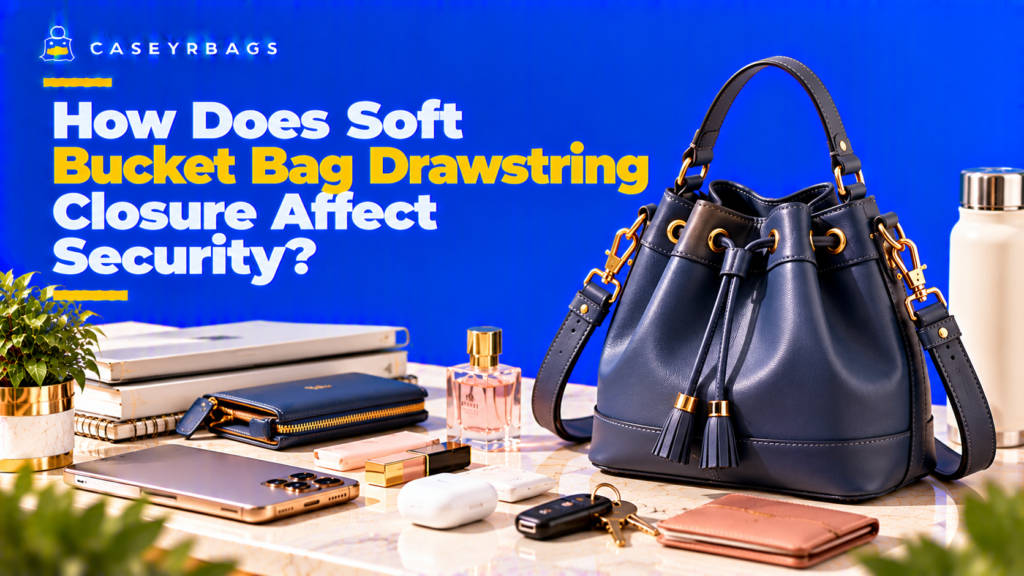
How Does Soft Bucket Bag Drawstring Closure Affect Security?
Soft Bucket Bag drawstring closure improves ordinary access control by reducing the main opening and requiring the cord to be loosened before the chamber can return to its broad access state. Pulling the drawstring gathers the flexible upper perimeter inward, which can limit content exposure, help retain larger items, and make immediate access less direct than with a fully open top.
Its security remains limited because soft gathered material can leave residual gaps, deform when handled, or reopen if the cord slips. The practical result depends on routing, material response, retained tension, hardware, load clearance, and movement, so the drawstring should be treated as an access-control and content-retention mechanism rather than a true lock.
What Security Does a Soft Bucket Bag Drawstring Actually Provide?
Practical access security in a Soft Bucket Bag means the drawstring reduces the main opening, helps retain contents during ordinary carrying, and requires a deliberate loosening step before the chamber returns to its broad access state.
The mechanism works through cord pull, perimeter tension, material gathering, residual aperture, and retained cord position. A smaller opening can reduce direct exposure and support content retention, but the result remains flexible rather than locked or sealed.
The practical threshold is evidence-safe: the closure should reduce the aperture meaningfully, keep the selected position reasonably stable under a normal load and ordinary movement, and reopen normally without being described as theft-proof security. For the wider structure, see Bucket Bag.
How Does the Drawstring Improve Ordinary Access Control?
The drawstring improves ordinary access control by contracting the upper perimeter from a broad opening into a smaller gathered aperture. Pulling the cord contracts the upper perimeter and changes a broad access opening into a smaller gathered aperture. Connect the smaller aperture to reduced direct chamber exposure and the need to loosen the cord before full access returns.
The condition: the improvement exists only when the perimeter gathers meaningfully and the selected cord position remains reasonably stable under the normal load. Describe the outcome as increased access friction, not prevention of access. The result should be judged under repeatable normal use and should not be expanded into a locking or theft-prevention claim.
How Does the Drawstring Support Content Retention?
The reduced upper aperture can help retain larger chamber contents by making direct movement through the top less likely during ordinary carrying. A reduced upper aperture can make it less likely for larger contents to move directly through the top during ordinary carrying. Keep the claim tied to the actual residual opening, item geometry, and load position.
The limit: small loose items may still approach or pass through localized gaps, especially when stored near the top. Main-opening reduction therefore supports retention but does not guarantee containment of every object. The result should be judged under repeatable normal use and should not be expanded into a locking or theft-prevention claim.
What Does the Drawstring Not Prove?
The drawstring does not prove theft resistance, tamper resistance, sealed construction, or unauthorized-access prevention. Directly that a flexible cord closure does not automatically prove theft resistance, tamper resistance, sealed construction, or unauthorized-access prevention. A person can usually loosen, manipulate, or deform the opening depending on its construction. The conclusion should remain tied to the actual cord route, material response, load state, and observed aperture rather than the appearance of a tightened drawstring.
Lock the article’s interpretation: Soft Bucket Bag drawstring security means ordinary opening control and content retention. Use that definition throughout; do not let “secure” expand into a claim that the structure or evidence cannot support. The result should be judged under repeatable normal use and should not be expanded into a locking or theft-prevention claim.
How Does Cord Pull Reduce the Main Opening?
Cord pull changes the opening through a mechanical sequence rather than by shrinking the chamber itself. Slack removal, route tension, fabric gathering, and the final retained aperture determine whether ordinary access becomes less direct.
What Happens When the Cord Is Pulled?
Pulling the cord begins a predictable chain from slack removal to route tension, upper-perimeter gathering, and a smaller central opening. The causal chain precisely: pull → slack removal → cord tension → tension transfer around the route → upper-perimeter gathering → smaller central opening. Explain that the cord acts through the surrounding material rather than shrinking the chamber independently.
Smooth, reasonably coordinated movement. If one section moves before another, the result may reflect route friction, guide-point geometry, asymmetry, or obstruction rather than insufficient pulling force. Keep this upper-opening mechanism connected to the complete Bucket Bag: Drawstring Access and Base-Stabilized Capacity structure, preserving the exact anchor and destination once. For the wider structure, see Bucket Bag.
Why Does a Smaller Aperture Change Access?
A smaller aperture reduces immediate hand entry and visibility and usually requires a deliberate loosening action before broad access returns. A smaller practical aperture can reduce direct hand entry, lower visibility into the chamber, and require a deliberate loosening action before the broad access state returns. Keep these as ordinary-use effects. The conclusion should remain tied to the actual cord route, material response, load state, and observed aperture rather than the appearance of a tightened drawstring.
Judge the actual opening, not cord extension or appearance. Tight-looking cords can coexist with a large central gap, localized side gap, or manually deformable fold pattern. The result should be judged under repeatable normal use and should not be expanded into a locking or theft-prevention claim.
Does the Smallest Possible Opening Work Best?
The smallest possible opening is not automatically the best state because useful closure depends on normal force, retained operation, and practical reopening. The useful closed state is the smallest practical retained aperture that the design reaches with normal force while keeping the cord, guide points, material, and hardware within normal operation. The conclusion should remain tied to the actual cord route, material response, load state, and observed aperture rather than the appearance of a tightened drawstring.
The trade-off: additional pulling can increase bunching, friction, eyelet or channel stress, and reopening difficulty without eliminating residual gaps. Maximum tension is not the performance target. The result should be judged under repeatable normal use and should not be expanded into a locking or theft-prevention claim. For the sibling pocket decision, see Internal Zip Pocket.
How Do Gathering, Softness, and Stiffness Shape the Closed Aperture?
Gathering quality depends strongly on how the upper material folds around the cord route. Softness can improve contraction, stiffness can resist or stabilize folds, and both extremes can leave localized residual gaps.
How Does Soft Material Help the Opening Contract?
Soft material bends into folds with less resistance, allowing the upper perimeter to shorten more easily around the cord path. Soft upper material bends into folds with less resistance, allowing the perimeter to shorten around the cord path. This gatherability can make closing and reopening efficient when the folds distribute predictably. The conclusion should remain tied to the actual cord route, material response, load state, and observed aperture rather than the appearance of a tightened drawstring.
The trade-off: highly soft material can form irregular folds, collapse around contents, or deform when handled. Softness supports contraction but does not create a rigidly protected aperture. The result should be judged under repeatable normal use and should not be expanded into a locking or theft-prevention claim.
How Does Stiffer Material Change Gathering?
Stiffer material resists folding more strongly and can create larger fold intervals or localized gaps where panels do not converge. Greater stiffness can resist folding, produce larger fold intervals, or preserve localized openings where panels do not converge. The user may feel higher resistance before the aperture becomes meaningfully smaller. The conclusion should remain tied to the actual cord route, material response, load state, and observed aperture rather than the appearance of a tightened drawstring.
The gray zone: moderate stiffness may help the opening retain a recognizable closed shape, but stiffness alone does not prove better access control. Judge contraction, residual gaps, retained position, and reopening together. The result should be judged under repeatable normal use and should not be expanded into a locking or theft-prevention claim.
Why Can Gathered Fabric Leave Gaps?
Gathered fabric closes in three dimensions rather than forming a rigid seal, so residual spaces can remain between folds or near cord exits. Folded material converges in three dimensions rather than forming a uniform rigid seal. Gaps may remain between folds, near cord exits, beside stiffer transitions, or around contents that enter the gather zone.
The evidence boundary: gathered opening does not mean sealed opening. The practical question is whether the remaining aperture and localized gaps are limited enough for the intended ordinary retention task. The result should be judged under repeatable normal use and should not be expanded into a locking or theft-prevention claim.
How Do Cord Tension and Friction Control Closure Retention?
Cord tension and friction control two different stages: initial closing and retained closing. Useful performance needs enough normal tension to reduce the aperture and enough controlled friction or hardware resistance to keep that state without making reopening impractical.
What Happens With Too Little or Too Much Tension?
Too little tension leaves slack and a broad exposed aperture, while excessive tension can raise friction and strain without removing the last residual gaps. Insufficient tension leaves slack in the route, shallow folds, and a broader exposed opening. The cord may appear engaged while the upper perimeter has not reached its intended reduced state.
Excessive tension can compress folds unnecessarily, raise friction, strain guide points, and make reopening difficult. Define useful tension as enough normal force to reach and retain the functional aperture without forcing the system. The result should be judged under repeatable normal use and should not be expanded into a locking or theft-prevention claim.
How Does Cord Friction Affect Stability?
Controlled friction helps preserve cord position, but very low friction can allow slippage and excessive friction can make adjustment uneven or difficult. Controlled friction can limit unintended cord travel and help preserve the gathered position. Very low friction can allow cords to slide and the opening to relax, especially during movement. The conclusion should remain tied to the actual cord route, material response, load state, and observed aperture rather than the appearance of a tightened drawstring.
The opposite extreme: excessive friction can make closing and reopening slow or uneven and may conceal a routing problem. The functional range balances position retention with practical adjustment. The result should be judged under repeatable normal use and should not be expanded into a locking or theft-prevention claim.
Why Is Initial Tightening Not Enough?
Initial tightening proves only that the system can contract; retained closure must be judged after the bag has moved under the same load. Distinguish the closed state immediately after pulling from the retained state after carrying. Initial contraction proves that the system can move; it does not prove that friction or hardware will hold that position.
A close → move → inspect comparison with the same load and placement. Classify closure retention from the post-movement aperture and cord position, not from the first tightened appearance. The result should be judged under repeatable normal use and should not be expanded into a locking or theft-prevention claim.
| Friction State | Cord Movement | Opening Stability | Adjustment | Reopening Consequence |
|---|---|---|---|---|
| Low friction | Moves easily | May relax during movement | Fast | Easy but less stable |
| Controlled friction | Predictable | Better retained position | Practical | Normal repeatable opening |
| Excessive friction | Binding / uneven | Can mask routing problems | Slow or difficult | Harder reopening |
How Do Hardware and Routing Points Affect the Closure?
Hardware and routing points guide the cord and help preserve selected tension, but each component has a limited function. Sliders, knots, channels, eyelets, and loops should be judged as parts of the closure system rather than as security locks.
What Does a Slider or Cord Lock Actually Do?
A slider or cord lock helps resist cord travel back toward the open position and can preserve selected tension depending on its design. A slider or cord lock can mechanically resist the cord moving back toward the open position, helping retain selected tension and stabilize opening size. Describe only the position-retention function supported by the design.
The boundary plainly: a cord lock is not necessarily a security lock, tamper-resistant device, or theft-prevention mechanism. Its presence does not eliminate gaps or prevent manual opening. The result should be judged under repeatable normal use and should not be expanded into a locking or theft-prevention claim.
How Does a Knot Change Cord Retention?
A knot can restrict slippage and hold a selected cord length, but its effectiveness and ease of release depend on the cord and knot itself. A knot can restrict rapid slippage and hold the cord at a selected length, depending on the knot, cord surface, and user consistency. It may add another reopening action.
The disadvantages and boundary: knots can tangle, vary in tightness, slow routine access, or become difficult to release. Knot retention must not be described as tamper-resistant locking. The result should be judged under repeatable normal use and should not be expanded into a locking or theft-prevention claim.
How Do Channels, Eyelets, or Loops Distribute Tension?
Channels, eyelets, and loops guide the route and determine where tension enters the upper perimeter, influencing fold coordination and localized gaps. Routing points guide cord position and determine where tension enters the upper perimeter. Consistent geometry can support coordinated folds; uneven spacing, binding, or damaged guides can concentrate tension and leave localized gaps.
Quantity as a proxy for performance. More eyelets do not guarantee better closure, and thicker cords do not guarantee better retention; the complete route, friction, material response, and loaded state determine the outcome. The result should be judged under repeatable normal use and should not be expanded into a locking or theft-prevention claim.
| Component | Function | Benefit | Limitation | Evidence-Safe Description |
|---|---|---|---|---|
| Channel | Guides cord around perimeter | Continuous tension path | Can bind or create friction | Routing structure |
| Eyelet / loop | Changes or fixes cord direction | Controls gather points | Spacing alone does not prove performance | Guide point |
| Slider / cord lock | Resists reverse cord travel | Helps retain selected tension | Not a security lock | Position-retention hardware |
| Knot | Restricts cord slippage | Adds a reopening action | Variable tightness / tangling | Manual retention method |
How Should Residual Gaps Be Evaluated?
Residual gaps should be judged directly after normal closing rather than inferred from how tight the cords look. Their size, location, relationship to contents, and stability during movement determine the practical meaning.
Where Do Residual Gaps Commonly Remain?
Residual gaps commonly remain between folds, beside cord exits, near channel endpoints, at stiff transitions, or around contents that enter the gather zone. Likely locations: between converging folds, beside cord exits, at channel endpoints, near stiff panel or seam transitions, and around contents that occupy the closure zone. Treat these as observable construction-dependent areas.
Inspection from above and around the upper perimeter under the normal load. Do not infer the central aperture from one front-facing view or from an empty-bag photograph. The result should be judged under repeatable normal use and should not be expanded into a locking or theft-prevention claim.
Why Do Gap Size and Location Matter?
Gap size and location matter because a broad central aperture affects direct access differently from a small localized opening near loose contents. A broad central aperture can preserve easy direct access, while a smaller localized gap may still expose or release small items positioned near it. Security meaning depends on both the opening geometry and the objects carried.
Avoid universal safe-gap thresholds. Compare the closed aperture with the intended contents, their storage location, normal movement, and whether enclosed pockets control items too small for the main chamber. The result should be judged under repeatable normal use and should not be expanded into a locking or theft-prevention claim.
What Is the Correct Pass Condition?
A practical pass requires meaningful repeatable aperture reduction, controlled localized gaps, retained cord position, and normal reopening. A practical pass as meaningful, repeatable opening reduction with controlled localized gaps, reasonably retained cord position, and normal reopening. The closure should improve ordinary retention relative to its broad-open state. The conclusion should remain tied to the actual cord route, material response, load state, and observed aperture rather than the appearance of a tightened drawstring.
Failure without overclaim: the closure is insufficient when a large aperture remains, gaps expose intended contents, the cord cannot hold position, or normal movement materially reopens the bag. A pass still does not establish theft resistance. The result should be judged under repeatable normal use and should not be expanded into a locking or theft-prevention claim.
How Do Load Height and Overfilling Affect Drawstring Security?
Load height directly affects drawstring security because the gather zone needs unused material and clearance to fold inward. When contents rise into that zone, the closure can lose aperture reduction even when the user pulls harder.
What Happens When Contents Stay Below the Gather Zone?
Keeping contents below the gather zone leaves fabric free to fold inward and lets the cord path contract with less obstruction. Keeping the normal load below the main gather zone leaves material available to fold inward and lets the cord route contract with less obstruction. The upper perimeter can approach its intended closed geometry.
Available internal height is not fully usable closure-compatible height. A bag may physically hold taller contents while losing the clearance required for predictable contraction and reopening. The result should be judged under repeatable normal use and should not be expanded into a locking or theft-prevention claim.
What Happens When Contents Enter the Closure Zone?
Contents in the closure zone reduce fold clearance, resist perimeter convergence, and can leave a wider or uneven residual aperture. The mechanism: upper contents press against the walls → folding space decreases → the perimeter resists convergence → cord force rises → the residual aperture remains wider or uneven. Name the load position as the limiting variable.
A controlled correction: lower or redistribute the upper contents while keeping the same bag and cord system, then retest. If the aperture improves, the first failure was load-height mismatch rather than proof of defective cords. The result should be judged under repeatable normal use and should not be expanded into a locking or theft-prevention claim.
When Does Overfilling Become a Security Mismatch?
Overfilling becomes a closure-security mismatch when the normal load prevents the drawstring from reaching its intended retained state without force. Functional overfilling when normal contents prevent the drawstring from reaching its intended retained position, leave broad exposure, push small items near gaps, or make the opening expand during movement. The conclusion should remain tied to the actual cord route, material response, load state, and observed aperture rather than the appearance of a tightened drawstring.
Force as the solution. Pulling harder can increase wear and bunching without restoring clearance; practical capacity has already been exceeded for this closure task when the normal closed state cannot be reached without forcing it. The result should be judged under repeatable normal use and should not be expanded into a locking or theft-prevention claim.
How Does the Closure Affect Accidental Item Retention?
A reduced main opening can improve ordinary retention of larger contents, but small-item containment is a separate problem. Item geometry, pockets, location, and movement determine whether small objects remain controlled.
Which Contents Can the Reduced Opening Help Retain?
Larger contents positioned below a meaningfully reduced aperture are less likely to move directly through the top during ordinary carrying. Larger or broader items positioned below a meaningfully reduced aperture are less able to move directly through the top during ordinary carrying. Connect the benefit to object geometry and actual aperture size.
The condition: the bag must retain the opening during movement and the contents must remain below the closure zone. Do not claim protection from every orientation, impact, inversion, or forced manipulation. The result should be judged under repeatable normal use and should not be expanded into a locking or theft-prevention claim.
Which Items Remain More Vulnerable?
Small loose objects remain more vulnerable because they can migrate upward or approach localized gaps even when the central opening is reduced. Cards, keys, earbuds, coins, or other small loose objects may migrate upward or approach localized gaps as contents shift. A reduced central opening can coexist with a small-item retention problem.
The variables separate: main-aperture control describes the bag’s upper opening, while small-item containment depends on item size, position, pocket design, and movement. One cannot automatically prove the other. The result should be judged under repeatable normal use and should not be expanded into a locking or theft-prevention claim.
How Do Internal Pockets Complement the Drawstring?
Internal pockets create a separate storage boundary for small or frequent-use items and therefore solve a different retention problem from the main drawstring opening. An enclosed or appropriately retained pocket can create a second storage boundary for small, frequent, or valuable items. It solves a different problem from contracting the main chamber.
The trade-off: pockets can improve predictable retrieval and retention but may reduce open chamber space or become difficult to reach when poorly positioned. Evaluate pocket opening, height, retention, and access separately from the drawstring, then continue the sibling question through When does a Soft Bucket Bag need an internal zip pocket. Preserve the exact anchor and destination once. For the sibling pocket decision, see Internal Zip Pocket.
How Do Carrying Movement and Cord Slippage Change the Result?
Closure performance must be validated during ordinary movement because cord position, folds, and content pressure can change after the bag is lifted, carried, or set down. Static tightening alone does not prove retained closure.
What Can Ordinary Movement Do to the Closed Opening?
Ordinary movement can settle folds, shift contents, alter upper-wall pressure, and move cords through their route after the initial closure. Walking, lifting, setting the bag down, and normal body movement can shift contents, alter upper-wall pressure, settle folds, and move cords through their route. These changes can affect aperture size even when the initial closure looked stable.
Reasonable stability conditionally: minor fold adjustment may be acceptable, but repeated or material opening expansion indicates that the retained closure is weaker than the initial state suggested. The result should be judged under repeatable normal use and should not be expanded into a locking or theft-prevention claim.
What Causes Cord Slippage?
Cord slippage can result from low friction, smooth cord-channel pairing, weak slider retention, inconsistent knot position, route asymmetry, wear, or load pressure. Possible causes such as low friction, a smooth cord-channel pairing, weak slider retention, inconsistent knot position, route asymmetry, worn components, or pressure from contents near the top. The conclusion should remain tied to the actual cord route, material response, load state, and observed aperture rather than the appearance of a tightened drawstring.
Do not diagnose from the larger post-movement opening alone. Mark the cord position before movement where practical, preserve the same load, and determine whether the cord moved, the folds settled, or the load entered the closure zone. The result should be judged under repeatable normal use and should not be expanded into a locking or theft-prevention claim.
Which Dynamic Test Shows Retained Closure?
Retained closure is best shown by a repeated close, move, inspect, reopen, and reclose sequence under the same ordinary load. One controlled sequence: close normally → record the aperture and cord position → carry or move the bag in an ordinary repeatable way → inspect the same variables again → reopen and close once more.
Classify the result from repeatability. A closure passes ordinary retention when it repeatedly stays near its intended reduced state without maximum force and remains normally operable; repeated expansion becomes Movement-Retention or Cord-Slippage Mismatch. The result should be judged under repeatable normal use and should not be expanded into a locking or theft-prevention claim.
How Does Drawstring Access Compare With Other Access Layers?
Drawstring access adds a deliberate opening step compared with an unrestricted open top, while secondary closures can add another layer. These structures should be compared only on practical access and retention—not treated as a universal security ranking.
How Does Drawstring Access Differ From an Open Top?
Compared with an unrestricted open top, a drawstring can reduce the aperture and add a deliberate loosening step before full access returns. An open top normally offers immediate broad access and greater chamber exposure, while the drawstring can reduce the aperture and require a loosening step. Compare the two only on practical access and retention.
The evidence boundary: improvement relative to an unrestricted open top does not make the drawstring theft-proof or superior to every closure system. The result remains dependent on gaps, retained position, load, and movement. The result should be judged under repeatable normal use and should not be expanded into a locking or theft-prevention claim.
Does a Drawstring Prevent Unauthorized Access?
No. A drawstring may add time or steps in ordinary use, but flexible gathered material and manually releasable retention remain operable. The closure may require cord loosening, material expansion, or opening manipulation before full access, thereby adding time or steps in ordinary use. The conclusion should remain tied to the actual cord route, material response, load state, and observed aperture rather than the appearance of a tightened drawstring.
Soft gathered material can often be handled or deformed and a cord-retention device can usually be released. Describe the result as increased access friction, never guaranteed prevention of unauthorized entry. The result should be judged under repeatable normal use and should not be expanded into a locking or theft-prevention claim.
When Can a Secondary Closure Add Control?
A secondary closure can add another access step or smaller internal boundary when its exact design supports that function. A zipper, snap, internal tab, hook, or comparable feature may add another access step or create a smaller internal boundary, depending on the exact design. State its separate function rather than crediting the drawstring with it.
Pair the benefit with limits: another layer can improve ordinary control but may reduce opening speed, add hardware dependence, or still leave design-specific vulnerabilities. It does not automatically create a theft-proof bag. The result should be judged under repeatable normal use and should not be expanded into a locking or theft-prevention claim.
| Access Layer | Practical Opening | Access Step | Retention Role | Remaining Limitation |
|---|---|---|---|---|
| Open top | Broad | Immediate | Minimal opening control | Highest direct exposure |
| Drawstring | Reduced / variable | Loosen cord | Ordinary access control and larger-item retention | Flexible gaps and manual release remain |
| Secondary closure | Design-dependent | Additional release step | Adds another boundary or access layer | Does not automatically create theft-proof security |
How Can Drawstring-Closure Problems Be Diagnosed?
Drawstring-closure problems should be diagnosed by the first failed variable. Aperture size, gathering, retained cord position, residual gaps, load clearance, movement, and reopening each point to different likely causes and corrections.
What Indicates a Closure That Is Too Loose?
A too-loose closure shows itself through a broad residual opening, shallow gathering, excess slack, uneven contraction, or cords that relax easily after release. Visible signs such as a broad central aperture, shallow gathering, substantial cord slack, uneven perimeter contraction, or cords that move back easily after release. Add functional signs such as high chamber exposure or reduced retention.
Check variables in order: normal cord travel, complete routing, friction or hardware retention, material obstruction, and load height. Do not prescribe stronger pulling until the cause of the loose state is isolated. The result should be judged under repeatable normal use and should not be expanded into a locking or theft-prevention claim.
What Indicates Over-Tightening?
Over-tightening appears when pulling effort, bunching, binding, hardware stress, and reopening difficulty increase without meaningful additional aperture reduction. Extreme bunching, high pulling effort, binding, difficult reopening, stressed eyelets or channels, distorted cord exits, and little further aperture improvement despite additional force. The conclusion should remain tied to the actual cord route, material response, load state, and observed aperture rather than the appearance of a tightened drawstring.
Correct to the smallest practical retained position reached with normal force. If easing tension preserves nearly the same aperture while improving operation, the extra force was not providing meaningful access-control value. The result should be judged under repeatable normal use and should not be expanded into a locking or theft-prevention claim.
How Is the Limiting Mechanism Identified?
The limiting mechanism is identified by separating load clearance, routing, material response, cord retention, residual gaps, and movement rather than calling the whole bag insecure. Route “will not close” through load clearance, stiffness, routing, and obstruction; route “closes but will not stay” through friction, slider, knot, slippage, and movement; route “cords are tight but gaps remain” through folds, geometry, and overfill.
Test one hypothesis at a time with fixed contents and placement. Name the final limiting variable and outcome rather than judging the entire bag with a vague statement such as “not secure.”. The result should be judged under repeatable normal use and should not be expanded into a locking or theft-prevention claim.
How Should Soft Bucket Bag Drawstring Security Be Evaluated?
The final evaluation should use the same bag, normal load, placement, cord state, movement sequence, and inspection points from start to finish. The result should identify a mechanically supported outcome without expanding ordinary access control into a theft-prevention claim.
What Should Be Inspected Before Loading?
Before loading, inspect the full cord path, guide points, retention hardware, broad-open aperture, gather zone, material response, pockets, and visible asymmetry. Inspect cord condition, routing continuity, channels, eyelets or loops, slider or cord lock where present, knot use, upper-material response, seam transitions, broad-open aperture, gather zone, pockets, and visible asymmetry. The conclusion should remain tied to the actual cord route, material response, load state, and observed aperture rather than the appearance of a tightened drawstring.
Fix the controls: same bag, same normal contents, same placement, same initial cord state, same observation points, same movement sequence, and normal—not maximum—cord force. Record any empty-state binding before contents can influence the result. The result should be judged under repeatable normal use and should not be expanded into a locking or theft-prevention claim.
What Should Be Observed After Loading and Movement?
After loading and movement, compare fold distribution, aperture, localized gaps, cord position, content exposure, hardware retention, and reopening effort with the starting state. Observe closure clearance, fold distribution, central and localized gaps, final cord position, content exposure, slider or knot retention, reopening effort, and whether the load presses into the gather zone.
Move the bag normally and inspect the same aperture, gap, and cord-position variables again. Reopen it, retrieve one routine item, and close it once more to confirm that the result is usable and repeatable rather than a one-time forced state. The result should be judged under repeatable normal use and should not be expanded into a locking or theft-prevention claim.
Which 20-Step Sequence Determines the Final Outcome?
The final outcome should come from one fixed empty-to-loaded-to-movement sequence that preserves the same bag, contents, placement, cord method, movement, and observation points. The test exactly: 1) empty the bag; 2) loosen the drawstring completely; 3) observe the full practical opening; 4) inspect the cord; 5) trace the complete route; 6) inspect eyelets, loops, or channel; 7) inspect any slider, cord lock, or intended knot method; 8) observe upper-material flexibility; 9) add the normal intended load; 10) keep contents below the main gather zone; 11) pull the drawstring with normal force; 12) observe gathering symmetry; 13) inspect the central aperture; 14) inspect localized gaps; 15) record cord and hardware position; 16) carry or move the bag in one ordinary repeatable sequence; 17) inspect aperture, gaps, and cord position again; 18) reopen and retrieve one normal-use item; 19) close the bag again using the same method; 20) assign the outcome from the complete repeatable result.
Select Functionally Effective Closure when the opening reduces, remains reasonably stable, controls intended contents, and reopens normally; select Conditionally Effective when ordinary retention improves but design-dependent gaps or use limits remain; otherwise select the named gathering, retention, gap, load, movement, or expectation mismatch. Reject false passes based on empty appearance, maximum force, a small central gap alone, or theft-proof language.
- empty the bag
- loosen the drawstring completely
- observe the full practical opening
- inspect the cord
- trace the complete route
- inspect eyelets, loops, or channel
- inspect any slider, cord lock, or intended knot method
- observe upper-material flexibility
- add the normal intended load
- keep contents below the main gather zone
- pull the drawstring with normal force
- observe gathering symmetry
- inspect the central aperture
- inspect localized gaps
- record cord and hardware position
- carry or move the bag in one ordinary repeatable sequence
- inspect aperture, gaps, and cord position again
- reopen and retrieve one normal-use item
- close the bag again using the same method
- assign the outcome from the complete repeatable result
- The H1 asks the exact Soft Bucket Bag drawstring-security question.
- The H1 introduction contains exactly two paragraphs and one disclaimer.
- Practical access security and content retention remain the central outcome.
- Security is defined narrowly before its limits are discussed.
- Cord pull is traced through tension, gathering, and aperture reduction.
- Opening reduction is not presented as theft-proof security.
- Content-retention benefits are tied to item geometry and opening size.
- Small-item retention is separated from main-opening control.
- Material softness includes both gatherability and deformation risk.
- Material stiffness is not treated as automatic security improvement.
- Gathered opening is not described as sealed.
- Residual gaps are located and evaluated.
- Actual aperture behavior is prioritized over tightened-cord appearance.
- Insufficient and excessive tension are both explained.
- Maximum cord force is not treated as the objective.
- Low, controlled, and excessive friction states are distinguished.
- Initial tightening is separated from post-movement retention.
- Slider or cord-lock retention is separated from security locking.
- Knot retention is separated from tamper resistance.
- Routing quality is prioritized over eyelet quantity.
- Cord thickness is not used as a performance proxy.
- Closure clearance is included in practical capacity.
- Load height is connected causally to gathering.
- Overfilling is recognized as a closure-security mismatch.
- Movement is included in closure validation.
- Cord slippage is tested independently.
- Drawstring access is compared carefully with open-top access.
- Unauthorized-access prevention is not guaranteed.
- Secondary closures are treated as separate access-control layers.
- Loose and over-tightened states are both diagnosable.
- Corrections change one variable at a time.
- The final protocol retains fixed controls and a normal load.
- Outcomes are explicit and mechanically justified.
- Exactly nine proof assets are specified and only four are SVGs.
- Both approved internal links appear once with exact anchors and destinations; no unapproved reader-facing link is inserted.
- The conclusion answers how security improves and why the result remains limited.
Conclusion
Soft Bucket Bag drawstring closure affects practical security by using cord tension to gather the flexible upper perimeter, reduce the exposed aperture, and create a deliberate loosening step before broad chamber access returns. When routing, material response, retained tension, hardware, load clearance, and movement work together, the closure can improve ordinary content retention and make immediate access less direct than an unrestricted open top.
The limitation remains structural: the opening stays flexible rather than locked. Residual gaps, manual deformation, cord slippage, high load position, and movement can weaken the retained state, while sliders or knots preserve cord position without becoming theft-resistant locks. The evidence-safe conclusion is controlled access and retention—not guaranteed prevention of unauthorized access.
FAQs
Is a Soft Bucket Bag Drawstring Closure Secure?
It can improve ordinary access control by reducing the opening, limiting content exposure, and requiring a loosening step before the chamber reaches its broad-open state. It can also help retain larger contents during normal carrying.
“secure” must remain qualified: the flexible gathered opening may leave gaps, deform, or loosen. The drawstring should not be described as theft-proof, tamper-proof, sealed, or equivalent to a lock.
Does Pulling the Drawstring Tighter Make the Bag More Secure?
Enough tension is needed to remove slack and reach the intended reduced opening, but improvement stops when added force no longer meaningfully reduces the practical aperture or stabilizes the cord position.
Over-tightening can increase bunching, friction, hardware stress, and reopening difficulty without eliminating residual gaps. The goal is normal, repeatable retained closure rather than maximum force.
Can a Cord Lock Make a Soft Bucket Bag Theft-Proof?
A cord lock or slider can resist cord movement, hold selected tension, and reduce unintended loosening depending on its construction and condition.
Position retention is not theft resistance. The device does not automatically eliminate gaps, prevent manual release, or protect against unauthorized access, so it must be described as closure hardware rather than a security lock.