How Does Handbag-Style Bag Structure Affect Retrieval?
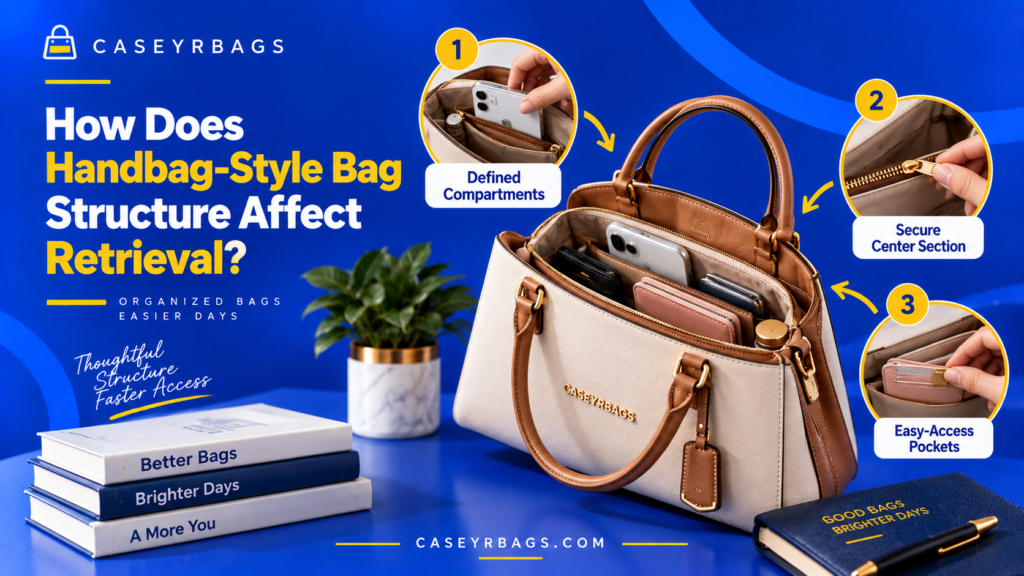
How Does Handbag-Style Bag Structure Affect Retrieval? Handbag-Style Bag structure affects retrieval by determining how consistently the bag holds its shape, how widely the opening exposes the interior, and how predictably items remain positioned inside. A stable body can make the opening and compartment layout easier to use, while poor geometry can still create hidden or difficult-to-reach zones. Retrieval also depends on bag depth, closure design, internal pockets, base stability, handle placement, and where frequently used items are stored. The strongest structure is therefore not necessarily the best; the most useful structure is the one that creates a clear path from opening the bag to locating and removing the intended item. KEY TAKEAWAY Handbag retrieval works best when structure keeps the opening and storage zones predictable while depth, visibility, compartments, handles, and item placement preserve a clear path from seeing an item to physically reaching and removing it. Handbag Retrieval Signal Key STRUCTURE SIGNALThe opening, pockets, base, and body stay predictably positioned during repeated use. VISIBILITY SIGNALThe opening exposes enough of the interior to locate intended items without blind searching. REACH SIGNALVisible items remain physically reachable through a clear hand path. GRAY ZONEA bag may be highly structured yet still create deep, narrow, fragmented, or obstructed retrieval paths. What Does Handbag Structure Mean for Item Retrieval? A Handbag-Style Bag usually has a more shape-controlled body than a highly collapsible open bag. This can keep the opening, side panels, base, and internal pockets in more predictable positions during use. Predictable structure can improve retrieval because the user learns where specific zones remain even when the bag is moved or set down. However, rigid or structured geometry can also create narrow corners, deep compartments, or fixed barriers that make some contents harder to reach. Retrieval quality therefore depends on whether the structure supports visibility, predictable item placement, and a clear hand path rather than simply how rigid the bag feels. Within the broader Handbag-Style Bag system, structural access only helps when the retrieval path remains usable. Which Structural Features Most Directly Affect Retrieval? Body panels, the upper edge, main opening, closure, bag depth, base, compartments, pockets, and short handles all shape the retrieval path. Each feature changes either opening behavior, interior visibility, item position, or physical reach. Structure → access effect → retrieval consequence. The strongest retrieval system is the one in which these features reinforce a predictable path rather than create competing barriers. Why Can Shape Retention Improve Retrieval Predictability? Stable bag geometry keeps the opening, pockets, and internal zones in more consistent locations, making repeated retrieval easier to learn and repeat. Stable bag geometry → stable pocket/opening positions → easier repeated retrieval. Predictability reduces search, but only when items are also assigned to sensible zones. Why Does More Structure Not Automatically Mean Easier Retrieval? Highly rigid geometry can create narrow openings, fixed internal barriers, deep corners, or limited hand movement even while the bag itself remains perfectly shape-stable. Retrieval depends on usable structure, not maximum rigidity. A well-structured bag can still create friction if reach and visibility are constrained. Handbag Retrieval Anatomy SVG Handbag Retrieval Anatomy SVG Structure, visibility, reach, and item location work together to determine retrieval quality. Handbag Retrieval Anatomy SVG Structure, visibility, reach, and item location work together to determine retrieval quality. STRUCTURE Main OpeningUpper EdgeMain ChamberInternal Pocket RETRIEVAL ZONES Quick-Access ZoneDeep Retrieval ZoneBaseShort Handles Structure → visibility → reach → retrieval. Figure 1.0: Structure → visibility → reach → retrieval. CASEYRBAGS.COM • Handbag retrieval How Does Body Shape Retention Affect Retrieval? Shape retention changes how consistently the opening, side panels, pockets, and base remain positioned from one retrieval cycle to the next. How Does a Stable Body Keep the Opening Predictable? A shape-retaining body keeps the opening in a known location and reduces the amount of collapse that must be corrected before hand entry. Shape retention → opening remains in a known location → more repeatable access. The benefit is consistency rather than guaranteed speed. How Does a Collapsing Body Make Retrieval Less Predictable? A collapsing body can fold the opening inward, let side panels cover contents, shift pocket positions, and allow items to stack unpredictably. Changing geometry forces the user to re-establish the access path during each search. That reduces repeatability even when the chamber is not especially deep. When Can Excessive Rigidity Reduce Retrieval Flexibility? Excessive rigidity can make corners difficult to reach, preserve fixed narrow geometry, or prevent the bag from reshaping around the hand during access. Useful shape retention should stabilize access without unnecessarily restricting reach. More rigidity is not automatically better. Body Structure → Retrieval Matrix Body Structure Shape Retention Retrieval Effect Main Tradeoff Highly structured High Predictable geometry Less flexible reach Semi-structured Moderate–high Stable + adaptable Balanced Soft-structured Moderate Flexible access More item movement Highly collapsible Low Variable geometry Less predictable retrieval How Does Main Opening Geometry Affect Retrieval? Opening width, length, and orientation determine how much of the interior becomes visible and how directly the hand can move toward the intended item. How Does a Wider Opening Improve Retrieval Visibility? A broader controlled opening exposes more of the interior and can make visual scanning faster by reducing the amount of blind searching. More exposed interior → easier visual scanning → faster location potential. Visibility improves location, but it does not guarantee physical reach. Why Can a Large Opening Still Produce Difficult Retrieval? A large opening can still lead into a deep, poorly organized, overfilled, or compartmentalized chamber where items remain hidden beneath or behind other contents. Large opening ≠ easy item location. Opening size solves only one part of the retrieval path. How Does Opening Orientation Change the Retrieval Path? Top openings, framed openings, zipper tracks, and flap-covered openings each create different hand paths and visibility patterns around the main chamber. Opening orientation → hand path → item visibility. The best geometry is the one that remains compatible with depth, organization, and intended retrieval behavior. Opening Geometry → Visibility Map Opening Geometry → Visibility Map Opening size and
What Defines a Handbag-Style Bag Through Structured Access & Short-Handle Carry?

What Defines a Handbag-Style Bag Through Structured Access & Short-Handle Carry? A Handbag-Style Bag is typically defined by a relatively shape-controlled body, a deliberate main opening, and short handles designed primarily for hand or forearm carry. These features create a compact personal-item container whose opening, contents, and carry position remain more structurally defined than those of many open or long-strap bag formats. Its identity does not depend on decoration, price, or small size alone. The strongest definition comes from the combination of structured access, short-handle carry, predictable bag shape, and organized personal-item storage working as one system. KEY TAKEAWAY Handbag-Style identity is strongest when shape-retaining structure, controlled personal-item access, and short-handle hand/forearm carry operate as one dominant functional system. No single handle, closure, size, or decorative feature defines the category by itself. Handbag-Style Identity Signal Key BODY SIGNALThe bag retains enough shape to keep its opening and compartments predictably positioned. ACCESS SIGNALThe main opening has a defined boundary and supports deliberate personal-item retrieval. CARRY SIGNALShort handles remain the primary structural carry path for hand or forearm use. GRAY ZONEOptional straps or styling details exist, but the dominant body-access-carry system determines identity. What Structurally Defines a Handbag-Style Bag? A Handbag-Style Bag generally combines a compact personal-item carrying body with enough structure to preserve a recognizable shape when opened, carried, or set down. The body may be soft-structured, semi-structured, or highly structured rather than completely rigid. Its opening is usually more deliberate than a continuously open carry chamber. Zippers, framed openings, flaps, snaps, or other closure systems create a defined access boundary and help keep the bag’s internal storage organized around personal-item retrieval. Short handles complete the primary carry identity. Within Everyday Carry, their geometry normally positions the bag in the hand, at the forearm, or close to the upper side rather than creating the long suspension path associated with dedicated shoulder or crossbody formats. Which Features Create the Strongest Handbag-Style Identity? A shape-retaining body, controlled main opening, short handles, integrated handle anchors, a compact personal-item chamber, and purposeful internal organization all reinforce the same structural identity. Each feature contributes either to body control, access control, or the primary carry path. Feature → functional role → identity signal. The strongest classification appears when these features work together rather than when one isolated characteristic dominates the judgment. Which Features Are Secondary Rather Than Defining? Decorative hardware, color, ornamentation, brand identity, detachable long straps, and exterior styling can change appearance or versatility without necessarily changing the bag’s core structural function. Visual styling can modify the bag without defining its structural category. Secondary features matter only when they begin to alter the dominant body-access-carry system. Why Must the Features Be Evaluated Together? Short handles alone can appear on totes, briefcase-style bags, and utility formats, while a structured body can appear on many shoulder or travel bags. Neither signal independently establishes Handbag-Style identity. Handbag-Style identity comes from a coherent body-access-carry system. Structure, access, organization, and primary carry geometry should all point in the same direction. Handbag-Style Bag Structural Anatomy SVG Handbag-Style Bag Structural Anatomy SVGA coherent structure-access-carry system creates the strongest Handbag-Style identity.Handbag-Style Bag Structural Anatomy SVGA coherent structure-access-carry system creates the strongest Handbag-Style identity.STRUCTURE & ACCESSStructured Upper EdgeMain Opening / ClosureMain CompartmentInternal PocketSHORT-HANDLE CARRYShort HandlesHandle DropHandle AnchorsShape-Retaining BaseStructure + access + short carry = Handbag-Style identity.Figure 1.0:Structure + access + short carry = Handbag-Style identity.CASEYRBAGS.COM • Handbag-Style Bag taxonomy How Does Body Structure Define a Handbag-Style Bag? Body structure creates the stable geometry that lets the opening, compartments, handles, and base behave predictably during personal-item use. What Does a Structured Handbag Body Actually Mean? Structure can come from material stiffness, layered panels, reinforcement, edge construction, base support, or internal shaping. These features help the bag retain a recognizable form rather than collapse completely around its contents. Structured ≠ hard-shell. A Handbag-Style Bag can remain soft-structured or semi-structured as long as enough shape retention supports its intended access and carry geometry. Why Does Shape Retention Matter for Access? Stable body geometry keeps the main opening in a more predictable position and helps internal compartments remain where the user expects them during retrieval. Stable body geometry → predictable opening position → predictable compartment access. Shape retention therefore reinforces structured access without requiring maximum rigidity. When Can a Softer Bag Still Remain Handbag-Style? Flexible panels can coexist with a defined main opening, short-handle geometry, a stable upper edge, and organized personal-item storage. Softness does not automatically erase category identity. Structure exists on a spectrum rather than as a rigid/soft binary. The relevant question is whether the overall form remains sufficiently controlled for predictable access and short-handle carry. Structured vs Flexible Body Matrix Body Character Shape Retention Access Predictability Handbag-Style Potential Highly structured High High Strong Semi-structured Moderate–high High Strong Soft-structured Moderate Context-dependent Possible Fully collapsible/open Low Lower Weaker identity signal What Does Structured Access Mean in a Handbag-Style Bag? Structured access means that the main entry point, surrounding body panels, and compartment system keep retrieval deliberate and predictable rather than simply making the bag difficult to open. How Does a Defined Main Opening Create Structured Access? A known opening boundary gives the user a predictable entry point and limits where the compartment expands during retrieval. The opening can be narrow, broad, framed, zipped, or covered depending on design. Known opening boundary → predictable entry point → controlled retrieval. Structured access refers to repeatable access behavior, not one mandatory closure format. How Does Body Shape Support Opening Control? Stable surrounding panels can help prevent the opening from collapsing, twisting, becoming difficult to locate, or changing shape excessively while the bag is handled. Body structure supports opening control by preserving geometry around the access zone. The closure still works as part of the system rather than as the sole source of structure. Why Is Structured Access Different From Maximum Closure Security? Structured access means the opening remains predictable and controlled during normal use; it does not mean the bag must be difficult or slow to open. Controlled access ≠
Why Can a Heavily Loaded Shoulder Bag Strain One Side?
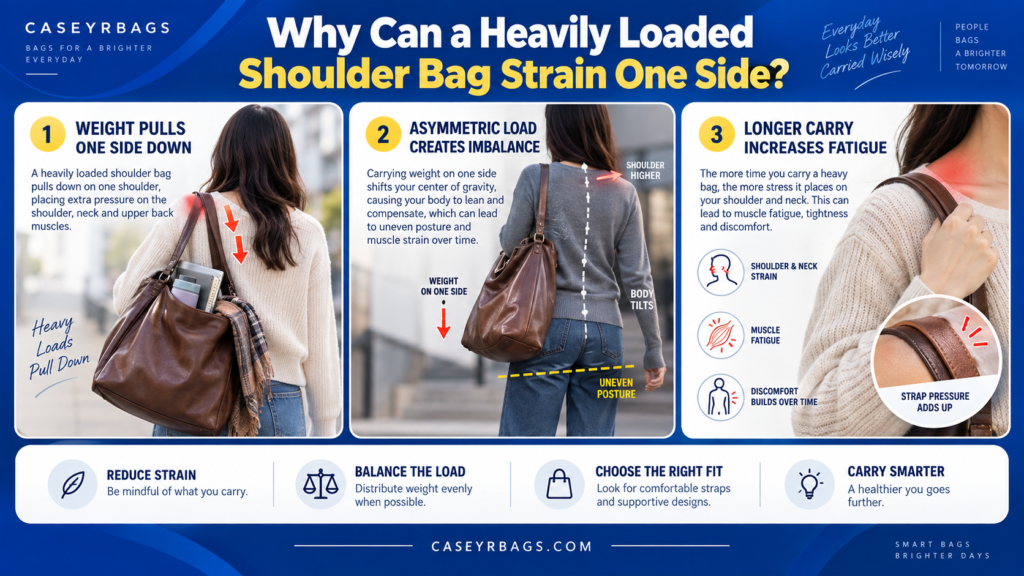
Why Can a Heavily Loaded Shoulder Bag Strain One Side? A heavily loaded Shoulder Bag can strain one side because most of the suspended load travels through a single strap and one shoulder-side support path rather than being divided across two shoulder straps. As the load increases, that one-sided strap path must manage more downward weight, bag movement, and positional control. The effect can become stronger when dense contents sit far from the body, the bag hangs low, the strap has a small contact area, contents shift, or the bag is carried for longer periods. The issue is therefore not simply that the bag is heavy, but how that load is positioned and controlled. KEY TAKEAWAY A heavy Shoulder Bag becomes most demanding when substantial weight, outward load distance, unstable movement, and sustained duration combine within one one-sided support path. Reducing and stabilizing the actual load addresses the source more directly than padding or strap adjustment alone. Heavy Shoulder Bag Load-Control Signal Key LOAD SIGNALTotal weight and dense contents determine how much demand enters the single-strap system. DISTANCE SIGNALDeep or outer-heavy loading moves the effective load center farther from the body-facing side. MOVEMENT SIGNALSwing, rotation, and shifting contents make a heavy load less predictable to control. GRAY ZONEOrdinary strain can indicate excessive carrying demand but does not diagnose injury or a medical condition. Why Does a Heavy Shoulder Bag Create One-Sided Carrying Demand? A Shoulder Bag normally uses one primary strap supported by one shoulder side at a time. This means the bag’s suspended load enters the carrying system through an asymmetric support path rather than being divided across both shoulders. As the packed load becomes heavier, the same one-sided pathway must support greater demand. The strap, anchors, bag body, and wearer all interact with the increased load, while bag movement can add further variation during walking. Heavy loading therefore becomes more demanding when total weight, load distance, movement, and duration combine. Within the broader Shoulder Bag system, the bag may remain structurally intact while still becoming impractical or uncomfortable to carry. How Does the Single Strap Carry a Heavy Shoulder Bag Load? Packed contents load the bag body and base, which transfer force into the strap anchors. The anchors then feed that demand into one continuous strap supported primarily by one shoulder side. Contents → bag body/base → anchors → strap → one shoulder-side support path. One strap creates one primary suspension path even when two attachment points help control the bag body. Why Does Increasing Bag Weight Increase One-Sided Demand? Greater packed load increases the demand passing through the same asymmetric support system. More total mass must be supported, positioned, and controlled during both still carry and movement. Greater packed load → greater demand through the same one-sided path. The amount that feels tolerable varies, so the relationship should not be converted into one universal safe-weight threshold. Why Is a Structurally Strong Bag Not Necessarily Comfortable When Heavily Loaded? Strong stitching, anchors, panels, and materials can keep the bag structurally intact under a substantial load. That structural capacity answers what the bag may withstand. Bag strength does not establish what a person can comfortably carry. Structural load capacity ≠ comfortable carry capacity. Heavy Shoulder Bag Load-Path SVG Heavy Shoulder Bag Load-Path SVG Packed load travels through the bag structure into a single one-sided support path. Heavy Shoulder Bag Load-Path SVG Packed load travels through the bag structure into a single one-sided support path. LOAD PATH Packed ContentsBag Base / BodyStrap AnchorsSingle Strap CARRY RESPONSE One-Sided SupportLoad CenterBag DepthSwing Direction Packed load → bag body → anchors → strap → one-sided support. Figure 1.0: Packed load → bag body → anchors → strap → one-sided support. CASEYRBAGS.COM • Heavy Shoulder Bag load control How Does Increasing Load Change Shoulder Bag Carry Behavior? More load strengthens the same one-sided support demand and can make strap tension, bag movement, and repositioning more noticeable. How Does Greater Load Change Strap Tension? As packed load increases, more demand enters the strap-and-anchor system. The same strap must support a greater suspended load through the one-sided path. More load → greater strap and anchor demand. The article keeps this relationship qualitative rather than converting it into exact biomechanical calculations. How Can Heavier Loading Make Bag Movement More Noticeable? A heavier bag can develop more noticeable swing momentum, stronger downward pull, and greater resistance to repositioning. Shifting contents can also create larger changes in how the bag behaves. The heavier the packed system becomes, the more important predictable movement and stable internal loading become. Movement adds variability to an already demanding load. Why Can a Dense Small Load Feel More Demanding Than a Bulky Light Load? A compact dense object can add substantial weight without making the bag look especially full, while bulky lightweight items may occupy more volume with less actual mass. Volume ≠ weight. Carrying demand follows the packed load and its position, not the visual size of the contents alone. Load Amount → One-Sided Demand Matrix Load Character Bag Appearance Carrying Demand Light + bulky Large volume Lower weight demand Dense + compact Small volume Higher potential demand Heavy + stable Controlled shape High one-sided support demand Heavy + shifting Variable shape High + unstable demand How Does Strap Width Affect Heavy-Load Strain? Strap width changes the contact area through which the same heavy bag load is applied, but it does not reduce the actual packed weight. Why Can a Narrow Strap Feel More Concentrated Under a Heavy Load? With the same packed load, a narrower strap applies the carrying demand through a smaller contact area. The interface can therefore feel more concentrated. Same load + smaller contact area → more concentrated strap contact. This is a mechanical interface explanation rather than a medical pressure calculation. How Does a Wider Strap Change the Carrying Interface? A wider strap distributes the same packed load across a broader strap surface and can make the contact interface less concentrated. Wider strap ≠ lighter bag. Actual
When Does Shoulder Bag Asymmetry Create Discomfort?
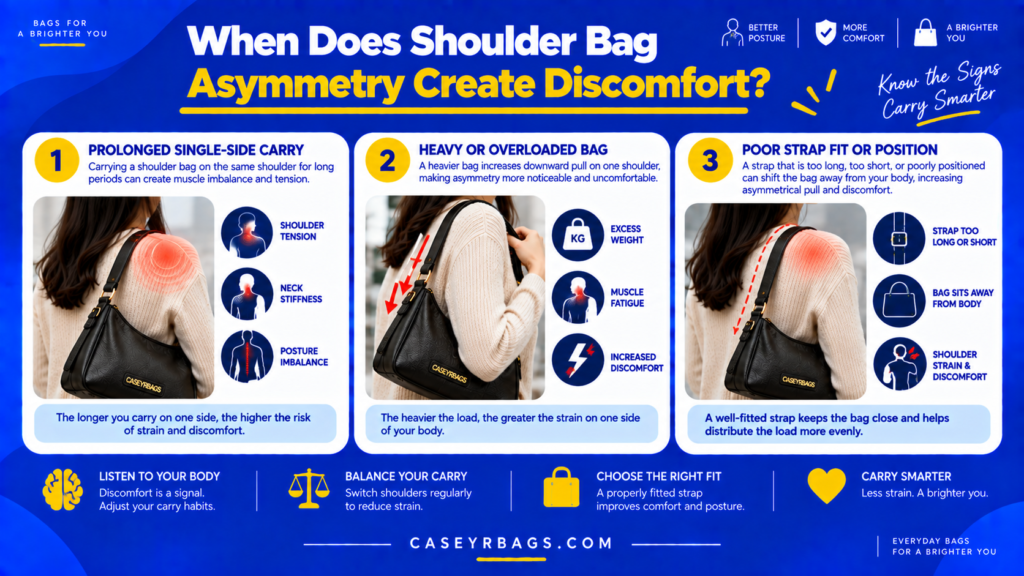
When Does Shoulder Bag Asymmetry Create Discomfort? Shoulder Bag asymmetry can create discomfort when a one-sided strap carries enough load for long enough, or with enough movement and concentrated contact, that the carrying setup becomes difficult to tolerate. The effect depends not only on bag weight but also on strap geometry, bag position, depth, and how the contents are distributed. A light, stable Shoulder Bag may remain comfortable for one use pattern while a denser, lower-hanging, or poorly balanced load can become uncomfortable sooner. The relevant question is when the complete one-sided carrying system begins producing repeated pressure, pulling, adjustment, or fatigue. KEY TAKEAWAY Asymmetry itself does not automatically create discomfort. The practical mismatch appears when load, duration, strap contact, geometry, movement, or internal loading makes the one-sided carrying system repeatedly difficult to tolerate or control. Shoulder Bag Asymmetry Signal Key LOAD SIGNALOne-sided demand increases as total load, density, or outward load distance increases. DURATION SIGNALThe same setup may become more noticeable as one-sided exposure lasts longer. CONTROL SIGNALStable position, controlled contents, and predictable movement reduce unnecessary demand. GRAY ZONEOrdinary discomfort suggests a carry mismatch but does not diagnose injury or a medical condition. What Does Shoulder Bag Asymmetry Mean for Carrying Comfort? A Shoulder Bag typically suspends its load from one shoulder-supported strap path at a time. This means the carrying geometry is asymmetric by design rather than evenly divided across both sides of the body. Asymmetry alone does not establish discomfort. A relatively light, stable load carried briefly may create little noticeable difficulty, while the same geometry can become more demanding as load, duration, bag movement, or contact concentration increases. Comfort therefore depends on the complete system. Within the broader Shoulder Bag system, load amount, carry duration, strap contact, bag position, and content stability all shape how demanding the one-sided support path becomes. Which Factors Make Asymmetric Shoulder Bag Carry More Demanding? Load amount, carry duration, strap width, strap padding, strap drop, bag depth, internal load position, and movement all change one-sided demand. Each can increase either the force, contact concentration, duration, or instability experienced through the single support path. Factor → one-sided demand → possible discomfort effect. No one variable proves a mismatch by itself; the practical result comes from how the complete system behaves during the intended carrying situation. Why Does Asymmetry Not Automatically Create Discomfort? A light, stable bag carried briefly can remain manageable, while a denser load, longer exposure, outward position, or shifting contents can make the same one-sided geometry more demanding. Asymmetry ≠ automatic discomfort. The support path is inherently one-sided, but whether discomfort appears depends on load, duration, contact quality, geometry, movement, and the individual use situation. When Should Discomfort Be Treated as a Carry Mismatch? Repeated pressure, pulling, fatigue, strap adjustment, bag repositioning, or a recurring desire to remove or switch the bag can show that the carrying setup no longer feels sustainable or controlled. Discomfort becomes meaningful when the carry setup repeatedly stops feeling manageable. That signal should prompt load or geometry adjustment, not a medical diagnosis from bag-fit behavior alone. Shoulder Bag Asymmetric Load SVG Shoulder Bag Asymmetric Load SVG Single-strap support creates one-sided demand that changes with load, duration, geometry, and movement. Shoulder Bag Asymmetric Load SVG Single-strap support creates one-sided demand that changes with load, duration, geometry, and movement. SUPPORT PATH Single StrapStrap Contact ZoneOne-Sided SupportBag Resting Position LOAD BEHAVIOR Load CenterOutward DistanceMovement DirectionCarry Demand Load + duration + geometry → carrying demand. Figure 1.0: Load + duration + geometry → carrying demand. CASEYRBAGS.COM • Shoulder Bag asymmetry How Does Load Amount Change Asymmetric Shoulder Bag Comfort? Increasing load increases the demand transferred through the one-sided strap-and-anchor system, but no single weight threshold predicts comfort for every use situation. Why Does a Denser Load Make Asymmetry More Noticeable? Greater load increases demand at the strap, anchors, and bag structure, making the one-sided support path more noticeable during carrying. The effect can become stronger when dense contents sit far from the body-facing side. Greater load → greater strap and anchor demand → stronger one-sided carrying effect. This is a mechanical relationship, not a diagnosis of injury or a universal safe-weight limit. Why Can a Small Bag Still Become Uncomfortable? Small external size does not prevent dense contents, concentrated strap loading, or substantial weight in an outer pocket. A compact bag can therefore create meaningful one-sided demand despite its dimensions. Bag size ≠ carried load demand. The practical concern is what the bag actually carries and how that load is positioned. Why Should Structural Capacity Not Be Confused With Comfortable Carry? A bag can remain structurally intact at a load that the user does not find comfortable to carry. Stitching, anchors, and materials answer a durability question, not a comfort threshold. Structural load limit ≠ comfortable carry limit. Comfort must be judged from real use rather than from the maximum load the bag can physically hold. How Does Carry Duration Change the Effect of Shoulder Bag Asymmetry? Duration changes how long the same one-sided load, contact pattern, and movement are experienced, so a manageable brief carry can become more noticeable over sustained use. Why Can Short-Duration Carry Feel Different From Sustained Carry? The same bag carried briefly creates a shorter period of one-sided exposure. Carrying it for longer gives pressure, pulling, movement, and stabilization demand more time to become noticeable. Same bag + longer exposure to one-sided support → greater opportunity for discomfort to develop. There is no universal time threshold because load, fit, movement, and individual tolerance vary. Why Does Walking Duration Matter More Than a Brief Lift? A brief transfer involves short exposure, while sustained walking adds repeated one-sided support plus movement, swing, and changing strap demand. The mechanical task therefore becomes more repetitive. Brief transfer and sustained carry should not be treated as equivalent tests. The longer task reveals how well the system remains tolerable when movement continues. Why Is Short-Term Tolerance a Poor Predictor of Longer Comfort? A bag can feel acceptable during a
Which Classic Shoulder Bag Strap Position Keeps the Load Close?
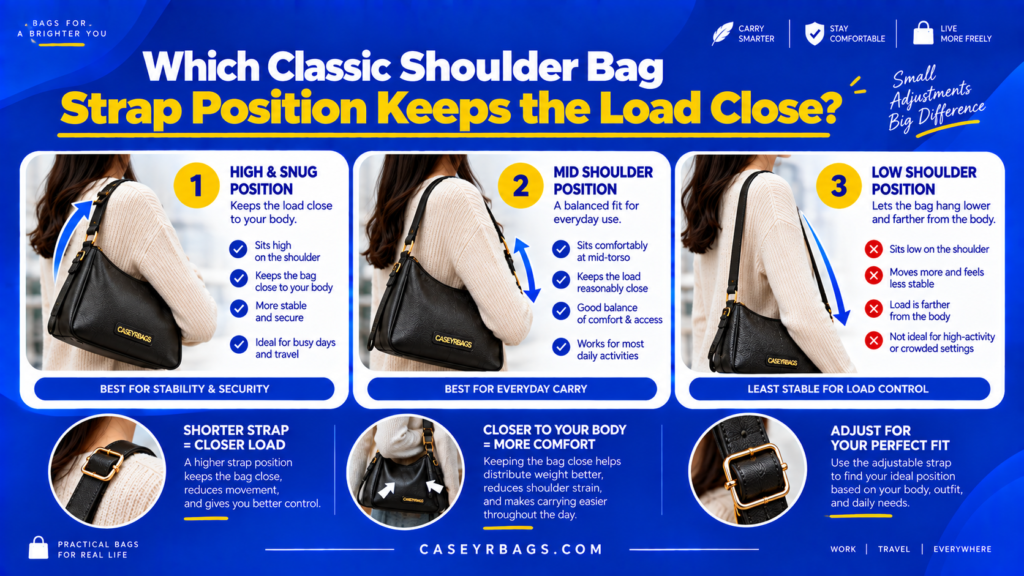
Which Classic Shoulder Bag Strap Position Keeps the Load Close? A Classic Shoulder Bag generally keeps its load closer when the strap positions the bag relatively high along the side of the torso, where the bag body can maintain consistent contact without excessive outward swing. This usually requires enough strap drop for shoulder clearance but not so much that the bag hangs far below its intended side position. The best position still depends on bag depth, width, anchor geometry, packed weight, and where dense items sit inside the bag. A slightly lower position may provide better overall fit if an excessively short strap crowds the upper arm or makes the bag difficult to access. KEY TAKEAWAY The best close-load position is the highest practical side position that keeps the actual loaded mass predictably near the body while preserving shoulder clearance, manageable movement, and routine access. Classic Shoulder Bag Close-Load Signal Key POSITION SIGNALThe loaded bag rests high enough for controlled body contact without severe crowding. LOAD SIGNALDense contents stay near the body-facing or central zone rather than the outermost pocket. MOVEMENT SIGNALOutward swing, tilt, and rotation remain predictable during walking and access. GRAY ZONEThe bag shell touches the body, but deep geometry or outer-heavy packing keeps the true load center far outward. What Does “Keeping the Load Close” Mean in a Classic Shoulder Bag? Keeping the load close means positioning the loaded Shoulder Bag so its mass remains reasonably near the body-facing side rather than projecting strongly outward or swinging through a large movement range. The bag does not need to be pressed tightly against the body. Strap position determines where the bag body rests, but the internal contents determine where the effective load center actually sits. A shallow bag positioned close can still become outward-heavy if dense items are placed in an exterior pocket. Useful close carry therefore combines appropriate strap position, controlled bag depth, and stable internal loading. Within the broader Shoulder Bag system, the strap positions the container while the contents determine where much of the load actually acts. Which Features Determine How Close the Shoulder Bag Carries? Strap drop, resting height, bag depth, bag width, anchor position, the body-facing panel, and internal load placement all affect the load’s proximity to the body. Each changes either the bag’s position or where the effective load center sits within that position. Feature → load-proximity effect → carry consequence. Strap drop sets height, depth changes front-to-back distance, anchors influence orientation, and internal loading determines whether the actual mass stays near the body-facing plane. Why Is Bag Contact Different From Load-Center Proximity? The bag shell can touch the body while dense contents remain concentrated toward the outer side. In that case, exterior contact is close but the effective load center is still farther away. Bag contact ≠ close load center. True close-load control depends on both where the container sits and where dense contents act inside it. What Indicates That the Load Is Being Carried Close? Useful signs include a predictable body-facing position, limited outward pull, manageable swing, limited rotation, and dense items that stay in a stable internal zone rather than migrating outward. Close-load carry is a relationship between bag position and internal load position. The goal is controlled proximity, not maximum compression against the body. Classic Shoulder Bag Close-Load Anatomy SVG Classic Shoulder Bag Close-Load Anatomy SVGStrap position sets bag height while internal load position determines the effective load distance. Classic Shoulder Bag Close-Load Anatomy SVG Strap position sets bag height while internal load position determines the effective load distance. BAG POSITIONShoulderStrapStrap DropBag Body LOAD POSITIONBody-Facing PanelOuter PanelDense ItemLoad Center / Body Line Strap position → bag position; internal load position → effective load distance. Figure 1.0: Strap position → bag position; internal load position → effective load distance. CASEYRBAGS.COM • Classic Shoulder Bag strap position Which Strap Position Usually Keeps the Shoulder Bag Closest? A relatively high side position often reduces free movement and increases body-contact potential, but the useful target is a functional close-carry zone rather than the shortest possible setting. How Does a Higher Side Position Keep the Bag Closer? A higher side position shortens the effective suspension distance, keeps the bag higher against the torso, and reduces some free movement. This can increase body contact and shrink the available swing range. Higher side position → shorter effective suspension → reduced free movement potential. The benefit ends when shoulder or arm clearance becomes restricted. When Is a Mid-Side Position More Functional? A mid-side position can provide sufficient body contact while preserving better shoulder clearance, easier opening access, and manageable movement. It can be more functional when a very high setting becomes crowded. Mid-side position → usable clearance + controlled contact → carry-access balance. It is not universally ideal; it is one possible fit zone when the geometry and load support it. Why Can a Very Low Position Reduce Close-Load Control? A lower position can create a larger swing arc, more forward-back movement, and less continuous body contact because the bag hangs farther from the shoulder support point. Lower does not automatically mean unstable, but it can increase movement freedom. The position should be judged by actual loaded behavior rather than height alone. Strap Position → Bag Height Matrix Strap Position Typical Bag Height Body Proximity Movement Potential Higher side Upper-side / near underarm Higher potential Lower–moderate Mid-side Side torso Moderate–high Moderate Lower side Near hip / lower side Variable Greater potential How Does Strap Drop Change Load Proximity? Strap drop changes the bag’s vertical resting position and therefore the amount of body contact and movement freedom available at each setting. How Does Shorter Strap Drop Affect Close Carry? A shorter drop usually raises the bag and can increase body-contact potential. It may reduce free movement when the bag remains clear of the shoulder and upper arm. Too little drop can restrict arm clearance, compress underarm space, distort strap angle, or make the opening difficult to reach. Shorter ≠ automatically better fit. How Does Longer Strap
How Does Classic Shoulder Bag Strap Drop Affect Fit?
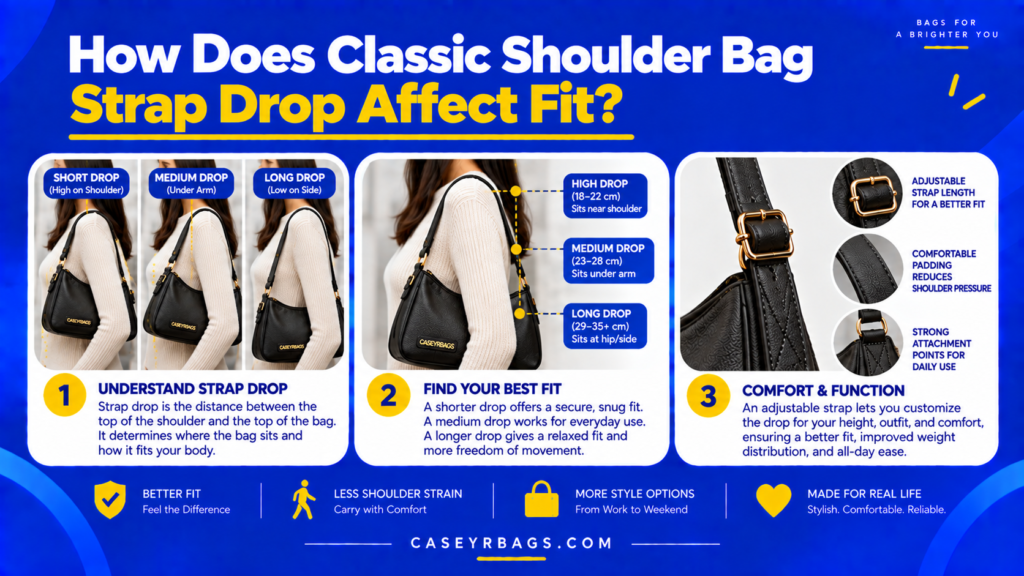
How Does Classic Shoulder Bag Strap Drop Affect Fit? Classic Shoulder Bag strap drop affects fit by determining how much vertical space exists between the top of the bag and the highest point of the strap when carried. That space influences whether the bag clears the shoulder and upper arm, where it rests along the side, and how easily it can be accessed. A shorter drop can keep the bag higher and closer to the underarm, while a longer drop can position it lower and create more clearance. Neither is automatically better because useful fit also depends on bag width, depth, strap anchors, clothing thickness, load, and intended carry position. KEY TAKEAWAY Strap drop is a fit variable, not a universal target. Useful fit comes from the interaction of vertical clearance, bag width and depth, clothing, load behavior, anchor geometry, movement, and access. Classic Shoulder Bag Strap-Drop Signal Key CLEARANCE SIGNALThe shoulder and upper arm enter the strap opening without excessive crowding. POSITION SIGNALThe loaded bag rests at the intended height instead of much higher or lower. MOVEMENT SIGNALSwing and body contact remain manageable during walking and access. GRAY ZONEThe listed drop looks suitable, but width, depth, clothing, or loaded sag changes real fit. What Does Strap Drop Mean for Classic Shoulder Bag Fit? Strap drop describes the vertical distance between the upper part of the bag and the highest point of the strap when positioned for carrying. It represents usable shoulder-clearance space rather than the complete length of the strap material. In a Classic Shoulder Bag, that clearance determines whether the bag can pass over the shoulder and upper arm and where the bag body settles once suspended. A small change in drop can therefore move the bag noticeably higher or lower. Strap drop should not be evaluated alone. Within the broader Shoulder Bag system, bag width, depth, anchor geometry, strap flexibility, clothing, and packed load all affect how the measured drop behaves in actual use. How Is Strap Drop Different From Total Strap Length? Total strap length measures the entire path along the strap material, while strap drop measures the vertical carrying clearance from the bag top to the highest point of the strap. They describe different aspects of the same geometry. Two bags with similar total strap lengths can still create different usable drops because anchor placement, bag-top width, strap curvature, and attachment angle change the suspended shape. Classic Shoulder Bag Strap-Drop Anatomy SVG Classic Shoulder Bag Strap-Drop Anatomy SVG Strap drop links shoulder clearance with the loaded resting height of the bag. Classic Shoulder Bag Strap-Drop Anatomy SVG Strap drop links shoulder clearance with the loaded resting height of the bag. BAG GEOMETRY Shoulder StrapHighest Strap PointStrap AnchorsBag Top FIT GEOMETRY Vertical Strap DropBag WidthBag DepthResting Position Strap drop → shoulder clearance → resting height. Figure 1.0: Strap drop → shoulder clearance → resting height. CASEYRBAGS.COM • Classic Shoulder Bag strap drop Which Parts Determine Usable Strap Drop? Usable drop comes from strap length, anchor location, strap curvature, bag-top width, attachment angle, and adjustment hardware where present. These variables determine the actual opening formed beneath the strap. The measurement therefore works as one geometry system rather than an isolated number. Changes in one part can alter shoulder entry, vertical position, or the arc through which the bag hangs. Why Should Strap Drop Be Evaluated on the Loaded Bag? Loading can change soft bag shape, strap curvature, panel sag, and the final resting height. The same empty bag may settle differently after dense or bulky contents change the suspended geometry. Listed drop and loaded carry position are related but not identical. Real fit should be judged from the bag in the condition in which it will normally be carried. Strap Drop vs Total Strap Length Diagram Strap Drop vs Total Strap Length Diagram Total strap length follows the strap path; strap drop measures vertical carry clearance. Strap Drop vs Total Strap Length Diagram Total strap length follows the strap path; strap drop measures vertical carry clearance. TOTAL STRAP LENGTH Measured along strapFollows full strap pathAffected by curve STRAP DROP Vertical clearanceBag top to strap peakDefines carry opening Strap drop ≠ total strap length. Figure 2.0: Strap drop ≠ total strap length. CASEYRBAGS.COM • Classic Shoulder Bag strap drop How Does Strap Drop Affect Shoulder & Arm Clearance? The open space beneath the strap determines how easily the bag moves onto and off the shoulder and how much room remains for upper-arm movement. What Happens When Strap Drop Provides Limited Clearance? Limited clearance can keep the bag high near the underarm, reduce space around the upper arm, and make placement more difficult over bulky clothing. These effects do not automatically mean poor fit. A short drop can still be functional when the bag is narrow or shallow and the intended carry position is high. The fit becomes poor only when clearance interferes with normal placement, movement, or access. What Happens When Strap Drop Provides Greater Clearance? Greater clearance can make shoulder entry easier, create more underarm space, lower the bag, and allow more repositioning freedom. The bag usually has more room to move around the side. Additional clearance changes both fit and movement potential. More space is useful only while the bag remains at an intentional height with acceptable body contact and access. When Is Additional Clearance No Longer Useful? Extra drop stops helping when it pushes the bag lower than intended, increases movement range excessively, slows access, or reduces useful body contact. At that point the added space creates a new fit trade-off. Useful clearance ends when additional drop stops improving functional fit. Longer drop ≠ automatically better fit. How Does Strap Drop Determine Where the Shoulder Bag Rests? Once the strap is on the shoulder, the vertical drop helps determine whether the bag sits high under the arm, along the side torso, or lower toward the side. How Does a Shorter Drop Affect Resting Height? A shorter drop usually places the bag body higher and