How Does a Shoulder Bag Manage Single-Strap Positioning & Asymmetric Load Control?
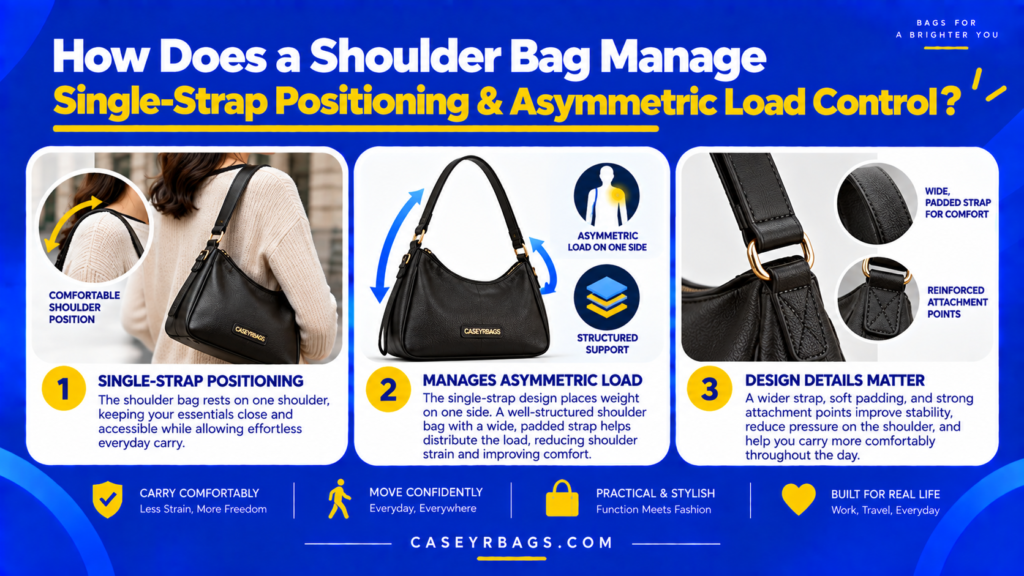
How Does a Shoulder Bag Manage Single-Strap Positioning & Asymmetric Load Control? A Shoulder Bag manages single-strap positioning by suspending the bag from one shoulder-supported strap path while strap length, width, anchor placement, and bag geometry determine where the bag rests and how much it swings, tilts, or rotates during movement. Because the support path is asymmetric, internal load placement and bag structure become especially important. Dense or unevenly positioned contents can increase one-sided pull, while controlled organization and predictable bag positioning can help the load remain stable despite being carried from one strap. KEY TAKEAWAY A Shoulder Bag controls one-sided suspension when strap geometry, anchor geometry, bag position, structure, internal organization, and load center work together. Asymmetric support does not require perfect symmetry; it requires predictable positioning and movement. Shoulder Bag Load-Control Signal Key POSITION SIGNALThe bag remains in a predictable side position without constant correction. LOAD SIGNALDense and loose contents do not create persistent end tilt or outward pull. STRUCTURE SIGNALAnchors, side panels, base, and compartments preserve usable load geometry. GRAY ZONEStrap adjustment improves position but leaves a deeper load or geometry problem unresolved. What Do Single-Strap Positioning & Asymmetric Load Control Mean in a Shoulder Bag? A Shoulder Bag normally uses one primary strap that transfers most of the bag’s suspended load through one shoulder-side support path at a time. Unlike a two-strap backpack system, the bag is not designed around equal left-right suspension. This creates an asymmetric load relationship: the bag hangs to one side of the body and its weight acts through a one-sided strap path. The important question is whether its position, movement, and internal distribution remain predictable. Effective asymmetric load control depends on strap geometry, anchors, bag body, resting position, and contents. Within Everyday Carry, a Shoulder Bag can remain well controlled without becoming symmetrical. Which Features Directly Control Single-Strap Positioning? The strap, strap length, strap width, anchor points, bag body, side panels, base, and internal compartments all influence where the bag hangs and how its load remains organized. Each feature contributes either to suspension geometry, shape control, or content stability. Feature → positioning role → load-control consequence. Strap adjustment sets height, anchors influence orientation, side panels and base preserve structure, and compartments help keep the internal load from migrating while the bag moves. Why Is Shoulder Bag Loading Inherently Asymmetric? A single shoulder-supported path places the suspended bag on one side of the body rather than dividing support across two independent straps. The geometry is one-sided even when the bag itself is centered internally. Single support path → one-sided suspension. Asymmetric support describes the geometry; it does not automatically describe poor control, instability, or unsafe carrying. What Makes an Asymmetric Shoulder Bag Load Controlled? Controlled carry appears when the bag stays in a predictable side position, unwanted tilt remains limited, swing is manageable, contents remain stable, and strap tension does not change erratically during normal movement. Controlled asymmetric carry means predictable positioning and movement, not perfect symmetry or complete absence of motion. The system can move and still remain functionally controlled. Shoulder Bag Single-Strap Load-Path SVG Shoulder Bag Single-Strap Load-Path SVGOne shoulder-supported strap path transfers the packed load through anchors and bag structure. Shoulder Bag Single-Strap Load-Path SVG One shoulder-supported strap path transfers the packed load through anchors and bag structure. LOAD PATHShoulderSingle strapStrap anchorsBag body / base MOVEMENT RESPONSEPacked loadLoad centerTilt / swingRotation Contents → bag body/base → anchors → strap → one-sided support path. Figure 1.0: Contents → bag body/base → anchors → strap → one-sided support path. CASEYRBAGS.COM • Shoulder Bag load control How Does the Single Strap Create the Shoulder Bag Load Path? The suspended load travels from the contents into the bag structure, through the anchors, and then into one strap path, so every stage influences final positioning. How Does Bag Weight Transfer Into the Strap? Contents first load the bag body and base, which transfer force into the anchor zones. The anchors then pass that load into the strap, and the strap carries it along the one-sided shoulder-supported path. Contents → bag body/base → anchor zones → strap → shoulder-supported path. Every structural stage affects control because deformation or imbalance at one stage changes the geometry seen by the next. Why Does Strap Angle Affect Bag Positioning? Anchor location, strap length, and the bag’s resting location combine to create the effective strap angle. That angle influences whether the bag hangs closer to the body, farther outward, higher, or lower on the side. Strap angle should never be judged alone. Anchor geometry and strap length determine it, while the packed load decides how strongly that geometry translates into body contact, tilt, or swing. Why Does One Strap Not Mean One Uncontrolled Suspension Point? Many Shoulder Bags use one continuous strap connected through two separated anchor points. The strap is single, but the bag body can still receive directional control from two attachment zones. One strap can still control the bag through two structural attachment points. Separated anchors can reduce some free pivoting without guaranteeing complete stability. How Does Shoulder Bag Strap Length Control Position? Strap length changes bag height, body contact, movement freedom, and the size of the swing path, so adjustment should refine the intended resting position rather than act as the only stability fix. How Does a Shorter Strap Change Bag Position? A shorter setting usually places the bag higher and closer to the body, reducing some movement range and shortening the potential swing arc. This can improve positional control when the rest of the load system is already compatible. Shorter ≠ automatically better. Excessive shortening can reduce repositioning freedom or force the bag into an awkward geometry without correcting internal imbalance or excessive depth. How Does a Longer Strap Change Bag Behavior? A longer setting lowers the resting position and allows greater movement freedom. The bag may swing through a larger arc and become easier to reposition for access, depending on its size and load. Longer strap → lower position → greater movement
When Does a Crossbody Bag Need Secondary Fastening for Added Access Security?
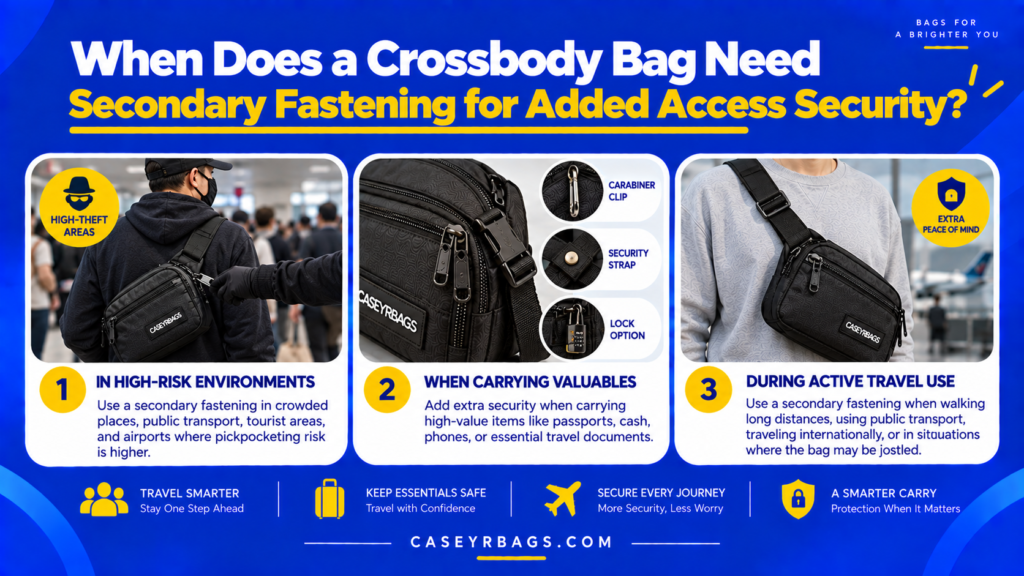
When Does a Crossbody Bag Need Secondary Fastening for Added Access Security? A Crossbody Bag may need secondary fastening when its primary closure alone does not provide enough control over accidental opening, compartment exposure, or movement-related access. A flap, snap, buckle, clip, hook-and-loop tab, or similar retainer can add a second deliberate step before the compartment becomes fully accessible. The extra fastening is most useful when the bag carries important contents, moves frequently, rests in an exposed orientation, or uses a primary closure that can be opened or displaced too easily for the intended context. It becomes less useful when it adds unnecessary friction to high-frequency access without solving a real retention problem. KEY TAKEAWAY Secondary fastening is justified only when it solves a specific access-control weakness left after the primary closure, loading, opening orientation, bag position, and movement have already been evaluated. Added control should outweigh the added retrieval friction. Secondary-Fastening Need Signal Key PRIMARY-CLOSURE SIGNALThe normal closure stays aligned, fully closed, and predictable during real movement. EXPOSURE SIGNALRotation, opening direction, or repeated movement creates a real uncontrolled opening problem. FASTENING SIGNALA second fastener solves one defined retention problem without blocking practical retrieval. GRAY ZONEExtra hardware adds steps but the primary closure had no observable failure to solve. What Does Secondary Fastening Mean in a Crossbody Bag? The primary closure is the main mechanism that closes the compartment, such as a zipper, flap, snap, or draw-style opening. It controls the normal opening path used to enter the bag. A secondary fastening adds another deliberate retention step over, beside, or in addition to that primary closure. Depending on the design, this could be a snap over a zipper, buckle over a flap, retaining clip, hook-and-loop tab, or another secondary mechanism. Its purpose is not simply to make the bag harder to open. Within the broader Crossbody Bag system, secondary fastening should solve a specific problem such as accidental opening, movement-related separation, excessive exposure, or insufficient containment of an important compartment. How Is Secondary Fastening Different From the Primary Closure? The primary closure closes the compartment and defines its normal access path. A secondary fastener sits above or alongside that closure and adds another deliberate release or retention step before the opening can be fully accessed. Primary closure → closes the compartment; secondary fastening → adds another access or retention step. The second layer adds control but should not replace a primary closure that is misaligned, damaged, unsuitable, or left partly open. Which Secondary Fasteners Can Crossbody Bags Use? Common secondary mechanisms include snaps, buckles, clips, hook-and-loop tabs, flap retainers, zipper-pull keepers, and secondary straps or tabs. Each adds a different kind of release step or opening restraint. The fastener should be judged by its purpose rather than ranked universally. A simple snap may suit one access role, while a buckle, clip, or retaining flap may add more deliberate handling for another. Why Does a Second Fastener Not Automatically Improve the Bag? A second fastener can slow retrieval, add hardware, require extra opening steps, increase two-handed operation, or complicate reset after use. Those costs remain even when the fastener is mechanically functional. Secondary fastening should solve a real access-control problem. If the primary closure already keeps the compartment controlled, another layer may create more friction than functional benefit. Primary Closure vs Secondary Fastening SVG Primary Closure vs Secondary Fastening SVG The second layer adds deliberate retention after the primary closure has already been identified. Primary Closure vs Secondary Fastening SVG The second layer adds deliberate retention after the primary closure has already been identified. PRIMARY CLOSURE Main compartmentPrimary zipperNormal opening pathBaseline containment SECONDARY LAYER Retaining flapSnap / clipExtra release stepAdded control Closed → release secondary fastener → operate primary closure → access contents. Figure 1.0: Closed → release secondary fastener → operate primary closure → access contents. CASEYRBAGS.COM • Crossbody secondary fastening When Is the Primary Closure Enough? The primary closure is enough when it remains predictably closed, aligned, and contained through the bag’s normal load, movement, orientation, and access cycle. When Does a Zipper Provide Sufficient Access Control on Its Own? A zipper may be sufficient when it stays fully closed during movement, the opening remains controlled, zipper pulls do not migrate unintentionally, and the compartment is not overfilled. These conditions show that the primary closure is already managing the normal opening path. Stable primary zipper → controlled opening → low secondary-fastening need. This does not imply theft-proofing or complete security; it only means another layer may add little functional access-control value. When Can a Flap, Snap, or Other Primary Closure Be Sufficient? A flap, snap, magnetic closure, or other primary system can be sufficient when it provides appropriate retention, predictable reclosure, suitable access speed, and enough containment for the actual contents and movement pattern. The useful question is whether the closure performs its intended job under real use. If it stays aligned and predictable without uncontrolled exposure, another fastener may be unnecessary. Why Should Unnecessary Secondary Fastening Be Avoided? Redundant fastening can create access friction, add hardware, slow routine use, and make the closing sequence more complicated. High-frequency pockets are especially sensitive to repeated extra release steps. If the primary closure already solves the access-control need, a second layer may add little functional value. More closure layers ≠ better usability. Secondary-Fastening Need Matrix Condition Primary Closure Behavior Secondary Fastening Need Stable closed zipper Remains controlled Low Closure shifts during movement Less predictable Moderate–high Wide exposed opening More contents exposed Higher High-frequency routine pocket Frequent intentional access Keep added fastening minimal Important low-frequency compartment Rarely opened Added layer may provide value Which Conditions Create a Need for Secondary Fastening? A second layer becomes more defensible when a specific opening, exposure, or retention weakness remains after the primary closure and load are functioning as intended. When Does Accidental-Opening Risk Justify Added Fastening? Repeated closure separation, zipper-pull migration, flap lifting, snap release under load, or opening pressure can indicate that the primary system is not staying fully controlled during normal use.
How Does Crossbody Bag Closure Control Access in Travel Settings?
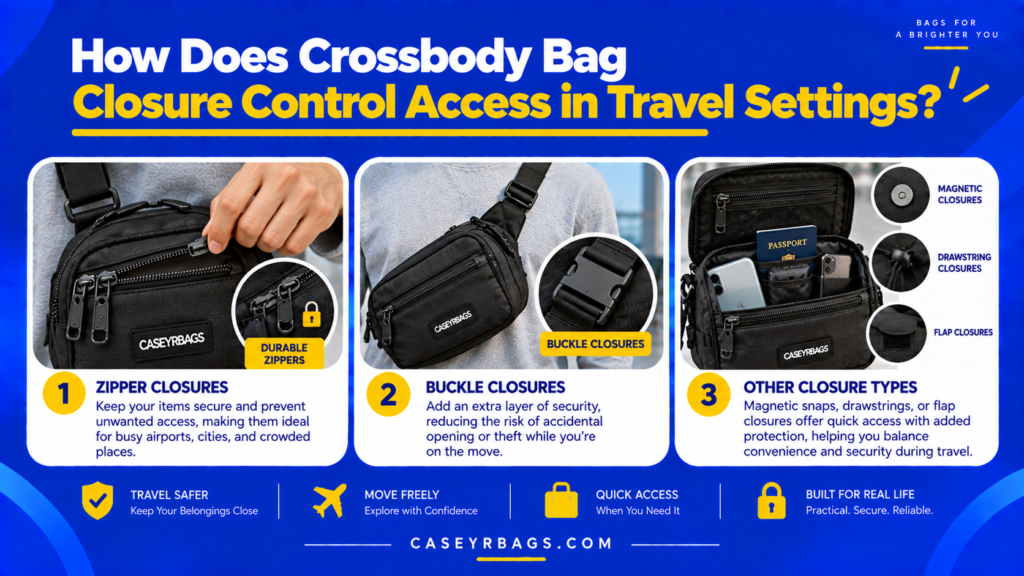
How Does Crossbody Bag Closure Control Access in Travel Settings? A Crossbody Bag closure controls travel access by determining how deliberately the bag must be opened, how much of the compartment becomes exposed, and how quickly the user can retrieve an item. Zippers, flaps, snaps, magnets, and other closure systems create different balances between retention and retrieval speed. Travel use adds repeated movement, seated transitions, short retrieval tasks, and changing access frequency. The most effective closure system keeps important contents contained while allowing necessary items to be reached without fully opening or removing the bag each time. Closure control ≠ theft-proofing, and faster retrieval ≠ better access for every item. KEY TAKEAWAY Travel closure quality comes from matching closure type, opening orientation, pocket hierarchy, carry position, and retrieval frequency. The goal is deliberate access with controlled exposure and quick return to a closed carry state—not maximum closure complexity. Crossbody Travel Closure Signal Key CONTROL SIGNALThe closure opens deliberately and limits unnecessary exposure of unrelated contents. ACCESS SIGNALFrequently used items can be reached without repeated full-compartment opening. RESET SIGNALThe pocket or compartment returns quickly to a predictable closed state after retrieval. GRAY ZONEMore closure layers increase handling without meaningfully improving containment or access control. What Does Closure-Controlled Access Mean in a Crossbody Bag? Closure-controlled access means the user must intentionally operate a zipper, flap, snap, magnet, or similar mechanism before reaching the contents. The closure creates a boundary between carried items and the surrounding travel environment. Different closures create different levels of opening effort and exposure. A full zipper can keep most of the main opening closed until deliberately opened, while a flap or lighter closure may allow faster access but expose the compartment differently. Effective travel access does not require maximum closure complexity. Within the broader Crossbody Bag system, the useful closure matches access frequency and item importance while allowing the bag to return quickly to a controlled closed state. Which Closure Types Most Directly Affect Crossbody Travel Access? Zippers, flaps, snaps, magnetic closures, hook-and-loop systems where relevant, and open secondary pockets all change how much effort is required before contents become reachable. Each creates a different relationship among opening speed, containment, exposure, and reclosure. Closure → opening effort → exposure level → travel consequence. A more complete closure can support stronger containment, while a lighter closure can support faster routine retrieval. The right role depends on the pocket and the frequency of access. How Does a Closure Change the Access Sequence? Every closure adds one or more actions between reaching the bag and retrieving an item. The typical path is reach bag → locate closure → open → retrieve → close → return to carry, with each added step affecting speed and handling. A useful closure keeps those steps predictable. More steps can be appropriate when stronger containment matters, but unnecessary steps can create repeated repositioning or encourage the user to leave a compartment partly open during movement. Why Does Stronger Closure Not Automatically Mean Better Travel Access? Stronger or more layered closures can slow retrieval, require two-handed operation, become awkward while seated, or force more bag repositioning. Those effects can reduce travel usability even when containment is high. Travel closure quality depends on appropriate control, not maximum resistance. The strongest closure is useful only when the access role and contents justify the extra effort without creating avoidable friction. Crossbody Closure & Travel Access Anatomy SVG Crossbody Closure & Travel Access Anatomy SVG Closure type, opening path, pocket role, and body-facing carry work together to control retrieval. Crossbody Closure & Travel Access Anatomy SVG Closure type, opening path, pocket role, and body-facing carry work together to control retrieval. CLOSURE SYSTEM Main zipperFlapQuick-access pocketBody-facing pocket ACCESS SYSTEM Main compartmentStrapBody-facing panelClosure reset Closure → opening path → item access → closure reset. Figure 1.0: Closure → opening path → item access → closure reset. CASEYRBAGS.COM • Crossbody travel access How Do Different Closure Types Change Travel Access? Common Crossbody closures differ mainly in how much of the opening they control, how quickly they can be operated, and how directly they return to a closed state. How Does a Zipper Control the Main Opening? A fully closed zipper contains the opening; partial opening creates a narrower access window; full opening exposes more of the compartment. This lets the user vary how much of the main space becomes reachable at one time. Full zipper → deliberate opening → greater opening control. Partly opened zipper → narrower access window → reduced compartment exposure. That flexibility is useful, but a zipper is not automatically the best closure for every pocket or access frequency. How Does a Flap Change Access Behavior? A flap creates staged access because the covering layer must be moved before a secondary closure or compartment becomes reachable. It can provide opening coverage and visual shielding while adding another action to the retrieval sequence. Lift flap → expose secondary closure or compartment → retrieve. The added step can be useful where coverage matters, but repeated routine access can become slower if the flap must be managed every time. How Do Snaps or Magnetic Closures Change Retrieval Speed? Snaps and magnetic closures can support quick opening and fast reclosure with relatively little manipulation. They can work well for routine-access zones when a lighter level of containment is acceptable. Snap or magnet → fast open/reclose → different retention level from a fully zipped compartment. They should not be labeled universally weak; their suitability depends on the pocket role, contents, alignment, and travel use. Closure Type Matrix Closure Type Access Speed Opening Control Typical Trade-Off Full zipper Moderate High More deliberate opening Flap Moderate Medium–high Additional access step Snap Fast Moderate Partial opening control Magnet Fast Moderate Retention depends on design Open pocket Very fast Low Greater exposure How Does Opening Orientation Affect Travel Access Control? Closure type alone does not determine access control because the direction the opening faces can change containment, exposure, and how much repositioning is needed. How Does an Upward-Facing Opening
Where Should a Crossbody Bag Rest to Maintain Stable Body-Facing Access?
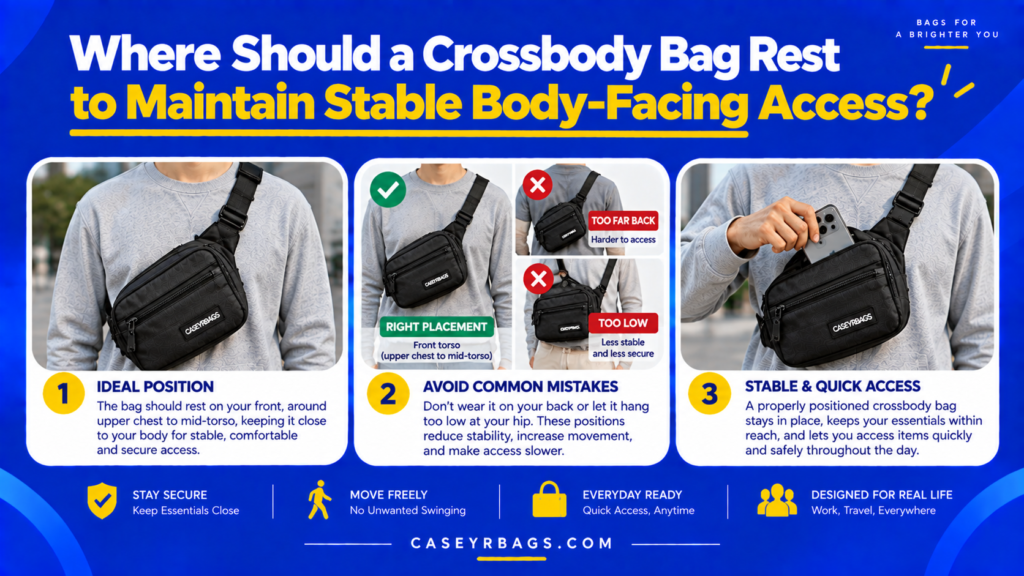
Where Should a Crossbody Bag Rest to Maintain Stable Body-Facing Access? A Crossbody Bag should rest in a position where its main body stays predictably close to the torso or hip without excessive swinging, rotation, or outward pull. For many designs, a front-side or side position can provide a practical balance between stable body contact and easy repositioning for access. The exact position depends on bag size, depth, strap length, anchor geometry, load placement, and opening design. The most functional resting zone is one that remains controlled during movement but can still be rotated or shifted toward the front for deliberate retrieval. No single height or body location is universally ideal. KEY TAKEAWAY The best Crossbody resting position is a functional zone, not one fixed point: it should keep the loaded bag predictably body-facing during movement while allowing a short, controlled transition into access and an equally easy return to normal carry. Crossbody Resting-Position Signal Key CONTACT SIGNALThe body-facing panel stays predictably near the torso or hip without strong outward pull. MOVEMENT SIGNALSwing and rotation remain manageable during normal walking and repositioning. ACCESS SIGNALThe bag can move toward the front, open predictably, and return without full removal. GRAY ZONEOne position feels stable but repeatedly makes access awkward, or access is easy but movement becomes uncontrolled. What Does a Stable Body-Facing Resting Position Mean for a Crossbody Bag? A stable resting position keeps the Crossbody Bag close enough to the body that it does not swing, rotate, or pull outward excessively during normal movement. The bag should remain in a reasonably predictable location instead of requiring repeated manual correction. Body-facing access means the bag can be repositioned toward an accessible zone while the opening and contents remain controlled. Routine retrieval should not require complete detachment or removal where the design is intended for on-body access. The best position balances movement control with access. Within the broader Crossbody Bag system, a position that maximizes stability while making retrieval awkward—or maximizes access while allowing excessive movement—can still be a poor overall fit. Which Factors Determine Where a Crossbody Bag Naturally Rests? Strap length, anchor position, bag width, bag depth, internal load, strap angle, and body contact all influence the resting zone. Each factor changes either where the bag hangs, how closely it follows the body, or how freely it can move during normal activity. Factor → resting position → stability/access consequence. Strap adjustment sets the broad height, anchors influence orientation, geometry changes body contact, and the loaded center determines whether the bag remains predictable or drifts away from its intended zone. What Makes a Resting Position Stable? A stable position keeps the bag in a predictable location with controlled swing, limited rotation, reasonable body contact, and a load that does not repeatedly shift the bag away from its resting zone. Some movement can remain normal. Stable position = predictable movement, not zero movement. The useful test is whether normal walking or minor repositioning creates repeated correction, strong outward pull, or changing orientation that interferes with access. What Makes a Resting Position Accessible? An accessible resting zone allows easy hand reach, manageable rotation toward the front, a visible or predictable opening, and a controlled return after retrieval. The bag does not need to remain in the exact same position for both carrying and opening. Useful access depends on the transition as much as the resting point. The bag should move along a short, understandable path into the access position and then return without strap binding, flipping, or repeated manual correction. Crossbody Resting-Position SVG Crossbody Resting-Position SVG Front, front-side, and side/hip positions create different movement and access paths. Crossbody Resting-Position SVG Front, front-side, and side/hip positions create different movement and access paths. CARRY POSITIONS FrontFront-sideSide / hipBody-facing panel ACCESS TRANSITION Bag centerMain openingAccess directionReturn to carry Carry position → reposition → access → return. Figure 1.0: Carry position → reposition → access → return. CASEYRBAGS.COM • Crossbody resting position How Does Front Carry Affect Crossbody Stability & Access? Front carry reduces the distance between the resting zone and the access zone, which can improve visibility and hand reach while increasing the chance that a larger bag interferes with normal movement. How Does Front Positioning Improve Visual and Hand Access? A front position can place the main opening within direct view and easy hand reach, reducing the amount of rotation needed before retrieval. This can make opening and closing more deliberate when the bag remains controlled against the body. Front position → direct visual and hand access → minimal repositioning. The benefit concerns access management, not theft prevention, and the bag still needs appropriate closure control and stable load placement. When Can Front Carry Interfere With Movement? A wider or deeper bag can occupy more of the front body zone and may interfere during walking, bending, or sitting. The same location that gives direct access can therefore become less convenient when the bag’s physical profile is large. Direct access does not automatically mean best carry stability. Front carry should be judged by whether the bag remains out of the way during normal movement while preserving predictable opening access. When Is Front Carry Most Functionally Useful? Front carry can be useful during short access-heavy periods, with compact bag profiles, or when frequent retrieval makes repeated rotation inefficient. It can also serve as a temporary access position rather than the permanent resting zone. Front carry is one functional option, not the universal answer. If it creates walking interference, poor body contact, or awkward load behavior, a front-side or side position may provide a better carry/access balance. Why Can Front-Side Carry Balance Stability & Access? Front-side carry places the bag partly against the front and side of the torso, often shortening the access path while preserving more freedom for normal movement than full front carry. How Does Front-Side Positioning Maintain Body Contact? A front-side position can spread contact across part of the front and side body zone, helping the bag maintain a predictable plane when its depth, anchors,
How Does Crossbody Bag Strap Anchoring Control Movement?
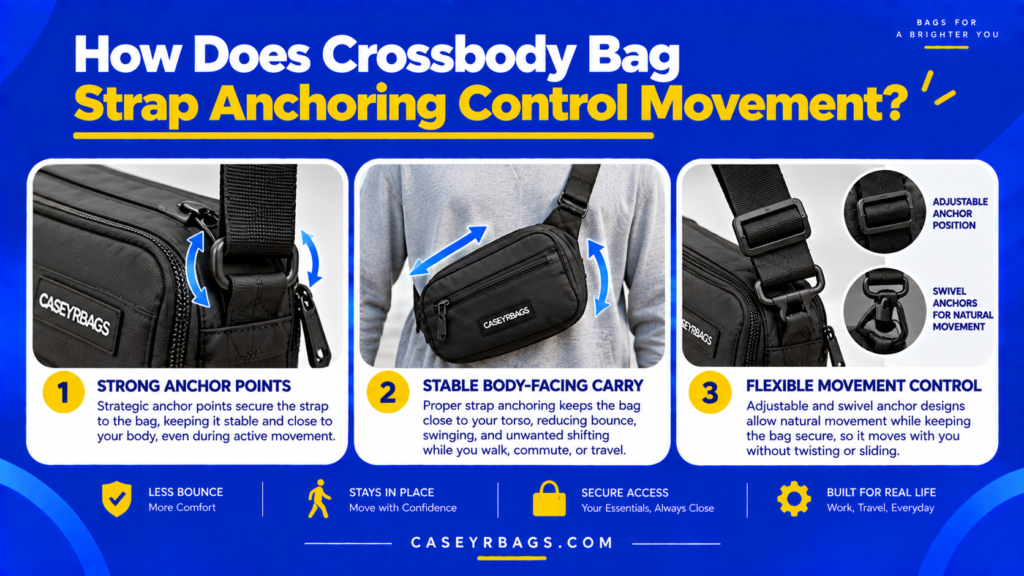
How Does Crossbody Bag Strap Anchoring Control Movement? Crossbody Bag strap anchoring controls movement by defining where the diagonal strap connects to the bag and how strap tension enters the bag body. Anchor spacing, height, attachment position, and hardware geometry influence whether the bag stays relatively flat, tilts, rotates, or swings during normal movement. The anchors work together with strap length, bag dimensions, body contact, and internal load placement. Well-integrated anchor geometry can improve orientation control, but it cannot completely eliminate movement or compensate for a poorly balanced load. Anchor stability ≠ zero movement, and strong attachment ≠ effective anchor geometry. KEY TAKEAWAY Crossbody movement control comes from anchor geometry that transfers diagonal strap tension into a stable bag body while matching strap path and internal load. Spacing, height, hardware articulation, panel support, and load balance must work together. Crossbody Anchor-Control Signal Key GEOMETRY SIGNALAnchor spacing and height create a predictable strap-to-bag force path. STRUCTURE SIGNALSide panels hold anchor position without excessive collapse or twisting. LOAD SIGNALDense and loose contents do not create persistent unequal anchor demand. GRAY ZONEStrong anchors are present, but rotation or tilt persists because geometry or loading remains mismatched. What Does Strap Anchoring Mean for Crossbody Bag Movement? A Crossbody Bag strap usually connects to the bag body at one or more defined attachment points. These anchors determine where strap tension enters the bag and therefore influence the bag’s orientation relative to the torso, side, or hip. When two anchors are separated across the bag body, they can create a broader control relationship than a single concentrated attachment point. The geometry may resist some unwanted rotation because the strap is connected to more than one structural position. Anchor geometry does not work in isolation. Within the broader Crossbody Bag system, strap length, bag depth, internal weight, hardware movement, and body position all change how the same anchor layout behaves during walking or repositioning. Which Parts Make Up a Crossbody Strap-Anchor System? The system includes the strap, left and right anchor points, anchor tabs, rings or clips, reinforcement zones, bag side panels, and strap-adjustment hardware. Each component influences either where tension enters the bag or how much movement occurs between the strap and the body structure. Component → anchor role → movement consequence. Stable attachment tabs hold geometry, rings or clips transmit tension, side panels preserve anchor position, and adjustment hardware changes the effective strap path. No single component determines orientation by itself. How Does Strap Tension Enter the Bag Through the Anchors? Diagonal strap tension reaches the bag through the attachment points and then spreads into the surrounding panels. Movement control begins at that force-transfer zone because the direction of tension influences how the bag body hangs, tilts, or rotates. Diagonal strap tension → anchor points → bag body → bag orientation. If the anchors remain predictably located, the strap path stays more consistent; if the attachment zone deforms, the force direction can change while the user is moving. Why Can the Same Anchor Layout Behave Differently With Different Loads? Item density, left-right imbalance, bag depth, strap length, and body position can all change the demand placed on identical anchors. A centered light load may keep both sides comparatively balanced, while one dense side can pull one anchor more strongly. Anchor geometry creates control potential; the actual load determines how that control behaves. Symmetrical anchors ≠ automatically symmetrical load behavior, so the loaded bag must be observed rather than judging geometry from the empty bag alone. Crossbody Strap-Anchor Geometry SVG Crossbody Strap-Anchor Geometry SVG Diagonal strap tension passes through anchors into the bag body and influences orientation. Crossbody Strap-Anchor Geometry SVG Diagonal strap tension passes through anchors into the bag body and influences orientation. ANCHOR SYSTEM Left anchorRight anchorStrap pathBag centerline LOADED BAG Body-facing panelLoad centerRotation directionOrientation response Strap tension → anchors → bag orientation. Figure 1.0: Strap tension → anchors → bag orientation. CASEYRBAGS.COM • Crossbody strap anchoring How Does Anchor Spacing Affect Crossbody Bag Rotation? Anchor spacing changes how broadly the strap connects across the bag body and therefore how much pivoting or rotational freedom the attachment geometry allows. How Can Wider Anchor Separation Improve Orientation Control? Separated anchors create a broader attachment geometry that can distribute directional control across more of the bag body. Compared with a highly concentrated connection, this may reduce some pivoting by giving the strap system two more distinct control points. Separated anchors → broader attachment geometry → greater orientation-control potential. Wider spacing is not always better because the result still depends on bag width, side-panel support, strap angle, hardware articulation, and the packed load. How Can Narrowly Spaced Anchors Change Movement Behavior? Narrow spacing can make the bag behave more like it is suspended from a concentrated zone, increasing the potential for pivoting around that area. The effect becomes more noticeable when the bag is wide, deep, flexible, or unevenly loaded. Narrow anchor spacing → concentrated support zone → greater pivot potential. The actual result must be judged with bag rigidity, hardware behavior, load position, and strap path rather than spacing alone. Why Is Anchor Spacing Relative to Bag Width More Important Than Spacing Alone? The same physical distance between anchors can create different geometry on a narrow bag and a wide bag. On one body it may span much of the width; on another it may function as a concentrated central attachment zone. Anchor spacing should be evaluated relative to the bag body it controls. Effective spacing depends on the proportion between attachment points and the structure they are expected to stabilize, not on a universal measurement. Anchor Spacing → Rotation Matrix Anchor Pattern Orientation Control Rotation Potential Main Variable Closely spaced More concentrated Potentially higher Bag width Moderately separated Broader control Potentially lower Strap angle Widely separated Broad control path Design-dependent Bag structure Single concentrated point Pivot-focused Greater freedom to rotate Hardware + load How Does Anchor Height Change Strap Angle & Bag Position? Anchor height changes the direction of diagonal strap tension, which can
How Does a Crossbody Bag Maintain Stable Body-Facing Carry & Secure Access?
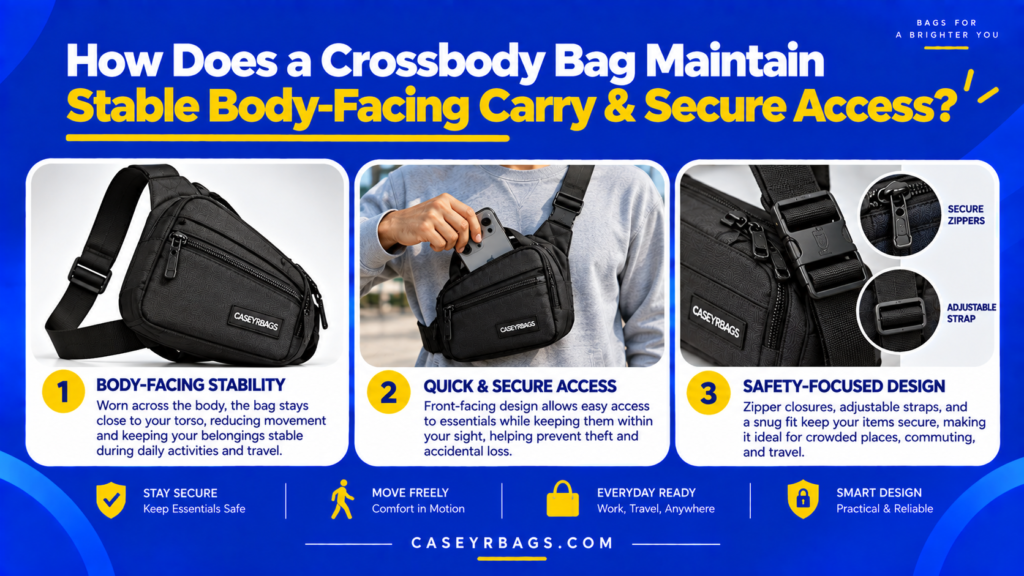
How Does a Crossbody Bag Maintain Stable Body-Facing Carry & Secure Access? A Crossbody Bag maintains body-facing carry through a diagonal strap path that links the bag to the opposite shoulder while strap length, anchor placement, bag depth, and internal load determine how much the bag swings, rotates, tilts, or pulls away from the body during movement. Secure access comes from controlling how the bag opens and which contents become exposed during repositioning or retrieval. Opening orientation, closures, internal pockets, and quick-access zones can keep routine access deliberate while reducing unnecessary exposure. Stable positioning ≠ zero movement, body-facing carry ≠ theft prevention, and closure control ≠ guaranteed security. KEY TAKEAWAY Effective Crossbody carry combines controlled movement with controlled retrieval: strap geometry and load placement keep the bag predictably body-facing, while opening orientation, closures, and pocket zoning keep access deliberate without unnecessary exposure or repeated destabilization. Crossbody Carry & Access Signal Key POSITION SIGNALThe bag stays in a predictable torso, side, or hip zone without repeated correction. LOAD SIGNALDense and loose contents do not create persistent tilt, rotation, or outward pull. ACCESS SIGNALThe opening and pocket layout support routine retrieval without unnecessary exposure. GRAY ZONECarry looks stable until routine access repeatedly forces rotation, removal, or re-adjustment. What Do Stable Body-Facing Carry & Secure Access Mean in a Crossbody Bag? Stable body-facing carry means the Crossbody Bag remains in a reasonably predictable position against the torso, side, or hip instead of repeatedly swinging, rotating, or pulling strongly away from the body during normal movement. Secure access means the user can reach intended contents while the opening, closure, and pocket layout keep other items reasonably contained and avoid unnecessary exposure. It describes retention and access control rather than theft prevention or guaranteed security. The two functions are connected. Within Everyday Carry, a bag that moves excessively is harder to access predictably, while an opening that requires awkward repositioning can destabilize otherwise controlled crossbody carry. Which Features Directly Support Stable Body-Facing Carry? A diagonal shoulder strap, strap adjustment, anchor placement, bag width, bag depth, the body-facing panel, and internal load position all influence where the bag sits and how strongly it moves. Each feature changes the relationship between the bag body, the strap path, and the intended carry zone. Feature → position effect → stability consequence. Strap adjustment sets overall location, anchors influence orientation, bag geometry affects body contact, and internal load placement determines whether the packed bag stays centered or pulls toward one side. Which Features Directly Control Access? Zippers, flaps, snaps or magnetic closures where present, opening orientation, internal pockets, exterior quick-access pockets, and compartment zoning control how contents become reachable. These features determine how much of the bag must open and how much else becomes exposed during retrieval. Access feature → exposure control → retrieval consequence. Faster access can help routine items, while more complete containment can help items that should remain controlled. Neither maximum speed nor maximum closure complexity is automatically superior. Why Must Stability and Access Be Evaluated Together? A stable bag with awkward access can force repeated rotation or removal, while an easy-opening bag that moves excessively can expose contents unpredictably during retrieval. The two systems therefore affect each other during every routine access cycle. Effective Crossbody carry combines controlled position with controlled retrieval. The bag should move enough to support access when needed, then return predictably to its normal body-facing carry zone without repeated correction. Crossbody Carry & Access Anatomy SVG Crossbody Carry & Access Anatomy SVGStable carry and controlled access depend on strap geometry, load position, opening control, and pocket roles. Crossbody Carry & Access Anatomy SVG Stable carry and controlled access depend on strap geometry, load position, opening control, and pocket roles. CARRY MECHANICSShoulder strapStrap anchorBody-facing panelDense-item zoneACCESS MECHANICSMain openingQuick-access pocketMain compartmentClosure controlStrap geometry → bag position • Opening control → secure access. Figure 1.0:Strap geometry → bag position • Opening control → secure access.CASEYRBAGS.COM • Crossbody carry & access How Does Crossbody Strap Geometry Stabilize the Bag? Diagonal strap geometry creates a body-linked carrying system by supporting the bag from the opposite shoulder and limiting some of the free movement associated with single-shoulder carry. How Does Diagonal Carry Differ From Single-Shoulder Carry? A crossbody path runs from one shoulder across the torso to the bag on the opposite side. Within Everyday Carry, that diagonal linkage can provide more positional control than a bag hanging from one shoulder because the strap connects the bag to a broader body position rather than one local suspension point. The advantage remains mechanical rather than medical. Diagonal carry can reduce some movement potential, but final stability still depends on strap length, anchor placement, bag depth, packed shape, and load behavior during movement. How Does Strap Angle Affect Bag Position? The path from the shoulder to the bag defines the direction in which strap tension supports the load. Strap Anchoring and strap length can move the bag toward the front, side, or hip and change how closely the body-facing panel contacts the user. Shoulder point → diagonal strap path → bag location. The useful angle is the one that supports the intended carry zone while preserving controlled movement and workable access rather than forcing one universal position. Why Can a Crossbody Bag Still Swing Despite Diagonal Carry? A long strap setting, deep bag body, dense contents, normal walking movement, or loose internal load can still create swing and rotation. This remains distinct from Sling Bag rotational carry because the diagonal strap reduces some freedom but does not eliminate inertia or load movement. Diagonal carry reduces some movement potential but does not eliminate motion. Stable carry therefore means predictable, manageable movement rather than a bag that never shifts at all. Strap Geometry → Bag Position Map Strap Geometry → Bag Position MapStrap length changes height, body contact, repositioning freedom, and swing potential. Strap Geometry → Bag Position Map Strap length changes height, body contact, repositioning freedom, and swing potential. SHORTER / MODERATEHigher or closer positionLower free-swing potentialMore deliberate repositioningLONGER SETTINGLower