How Does Flap-Over Messenger Bag Closure Control Access?
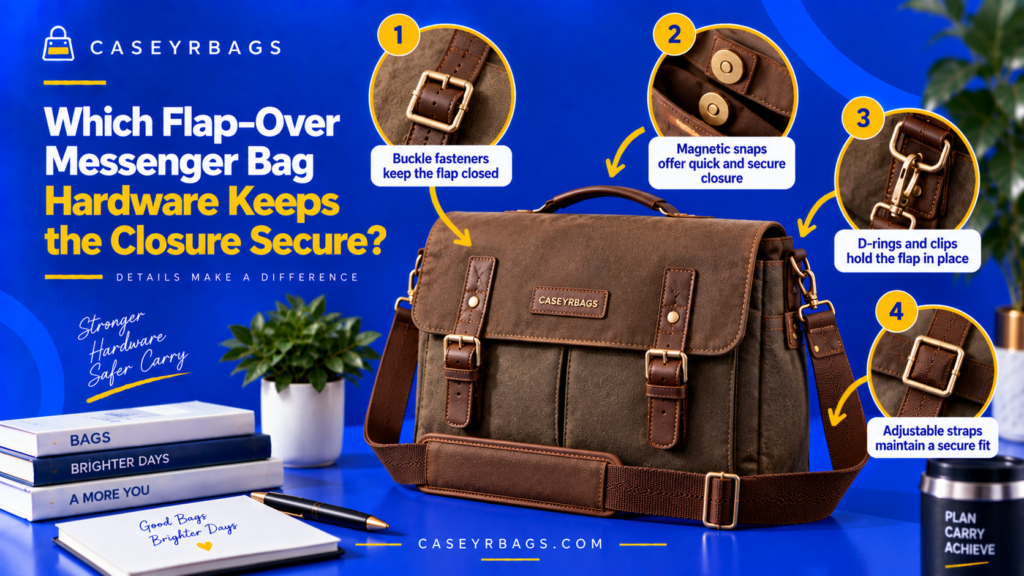
How Does Flap-Over Messenger Bag Closure Control Access? A Flap-Over Messenger Bag controls access by placing a broad flap over the main opening and using one or more fasteners to determine when that opening becomes exposed. The user must release the closure and move the flap before reaching the main compartment, creating a deliberate access sequence rather than an always-open entry path. The effectiveness of that system depends on more than the fastener itself. Flap overlap, fastener placement, flap stiffness, opening width, internal closures, item location, and load all affect how easily the user can release, expose, retrieve, and reclose the bag. KEY TAKEAWAY Flap-controlled access works when coverage, fastener behavior, flap movement, opening geometry, item location, loaded fit, and reclosure create a predictable release → expose → retrieve → reclose sequence without unnecessary friction. Flap-Over Messenger Access Signal Key COVERAGE SIGNALThe flap physically covers the intended opening without implying complete sealing. RELEASE SIGNALFasteners are identifiable, reachable, and proportionate to retrieval frequency. RETRIEVAL SIGNALAfter release, the opening remains visible, reachable, and easy to reclose. BOUNDARY SIGNALClosure retention is not theft-proofing, and flap overlap is not waterproof construction. What Does Closure-Controlled Access Mean in a Flap-Over Messenger Bag? Closure-controlled access means the main compartment is not fully exposed until the user performs a deliberate opening sequence. In a Flap-Over Messenger Bag, that sequence usually begins by releasing a fastener and moving the flap away from the main opening. The flap provides the physical cover, while the fastener determines when that cover can move freely. Opening quality therefore depends on both the retention mechanism and the geometry of the flap and main opening. The useful question is whether release, exposure, retrieval, and reclosure remain predictable and proportionate to the items being accessed. Within the broader Messenger Bag system, flap control supports work-item carry only when the opening itself remains usable. Which Parts Create the Closure-Controlled Access System? The system includes the front flap, flap overlap, primary fastener, fastener attachment, main opening, and any secondary internal closure. Each part affects either exposure, release, or retrieval. Flap coverage establishes the physical barrier, fasteners regulate flap movement, and the main opening determines whether exposure becomes usable access after release. Why Is Flap Coverage Not the Same as Sealing? A closed flap can cover the opening while side gaps, seams, fabric, closure gaps, or the base remain potential exposure paths. Covered opening ≠ sealed opening. Flap coverage should be evaluated as opening control rather than evidence of waterproof construction. Why Is Closure Control Not the Same as Theft Prevention? Fasteners can keep the flap in its intended closed position and require a deliberate release action before the opening is exposed. Closure retention ≠ theft prevention. The system controls normal opening behavior without guaranteeing resistance to unauthorized access. Flap-Over Messenger Access Anatomy SVG Flap-Over Messenger Access Anatomy SVGThe flap, fasteners, opening, pockets, and long strap operate as one access sequence.Flap-Over Messenger Access Anatomy SVGThe flap, fasteners, opening, pockets, and long strap operate as one access sequence.CLOSURE SYSTEMFront FlapFlap OverlapPrimary FastenerFastener AttachmentMain OpeningACCESS SYSTEMInternal ClosureMain ChamberQuick-Access PocketLong StrapReclosureRelease → Lift → Expose → Retrieve → Reclose.Figure 1.0:Release → Lift → Expose → Retrieve → Reclose.CASEYRBAGS.COM • Flap-Over Messenger access How Does Flap Coverage Control Main-Compartment Exposure? Flap overlap determines how much of the main opening is physically covered before release and how far the flap must move before the opening becomes usable. How Does Broader Flap Overlap Reduce Direct Exposure? More overlap covers more of the opening and upper bag face, reducing the amount of the access area directly exposed while the flap remains closed. More overlap → more opening coverage. The effect is physical coverage only and should not be interpreted as complete sealing or waterproofing. How Can Insufficient Flap Overlap Reduce Access Control? Limited overlap can leave edge sections or parts of the opening more visible and less physically covered when the flap is closed. Less coverage changes exposure control but does not by itself prove poor retention. Fastener placement and opening geometry still matter. When Can Too Much Flap Coverage Slow Access? Excess overlap can require greater flap movement, more repositioning, or a larger lift path before the user reaches the main opening. More overlap ↔ more flap movement. Coverage becomes inefficient when the extra movement adds friction without a useful access-control benefit. Flap Coverage → Opening Exposure Map Flap Coverage → Opening Exposure MapOverlap changes how much of the opening is covered and how far the flap must move.Flap Coverage → Opening Exposure MapOverlap changes how much of the opening is covered and how far the flap must move.BROAD / MODERATEBroad OverlapMore Opening CoveredModerate OverlapControlled ExposureLIMITED / EXCESSLimited OverlapMore Edge ExposureExcess OverlapMore Flap MovementCoverage controls exposure; it does not rank security or waterproofing.Figure 2.0:Coverage controls exposure; it does not rank security or waterproofing.CASEYRBAGS.COM • Flap-Over Messenger access How Do Different Fasteners Control Flap Access? Fastener type changes the release action required before the flap can move, but no closure format is universally best for every retrieval pattern. How Do Buckles or Side-Release Clips Control Access? Buckles and clips use a positive mechanical release that must be intentionally disengaged before the flap can move. Positive mechanical release → deliberate opening step. The added step can suit some tasks while becoming unnecessary friction for frequent retrieval. How Do Snaps, Magnets, or Hook-and-Loop Fasteners Change the Sequence? Snaps use localized release points, magnets rely on alignment and separation, and hook-and-loop uses a broader contact release. Each format changes reach, release motion, and closure feel. None should be treated as universally fastest or best. Why Can the Same Fastener Work Differently Across Bags? Placement, fastener size, flap stiffness, load, and opening geometry can make the same closure type easy on one bag and awkward on another. Hardware type alone does not determine access quality. For the dedicated mechanism, see Flap Hardware. Closure Type → Access-Step Matrix Closure Format Typical Release Character Main Access Effect Buckle / clip Deliberate mechanical release More explicit opening step Snap Localized release
How Does Flap-Over Messenger Bag Closure Control Access?
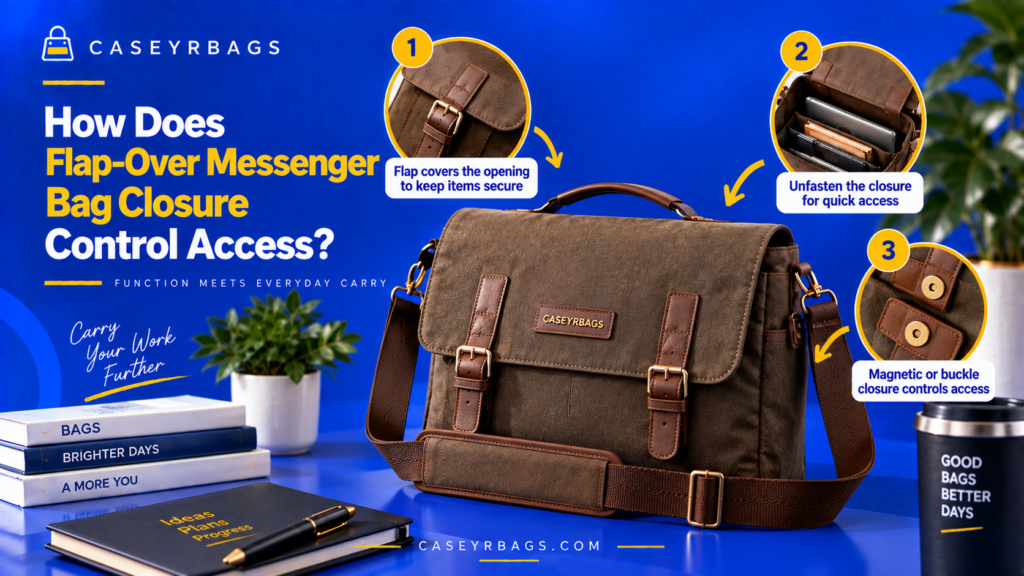
How Does Flap-Over Messenger Bag Closure Control Access? A Flap-Over Messenger Bag controls access by placing a broad flap over the main opening and using one or more fasteners to determine when that opening becomes exposed. The user must release the closure and move the flap before reaching the main compartment, creating a deliberate access sequence rather than an always-open entry path. The effectiveness of that system depends on more than the fastener itself. Flap overlap, fastener placement, flap stiffness, opening width, internal closures, item location, and load all affect how easily the user can release, expose, retrieve, and reclose the bag. KEY TAKEAWAY Flap-controlled access works when coverage, fastener behavior, flap movement, opening geometry, item location, loaded fit, and reclosure create a predictable release → expose → retrieve → reclose sequence without unnecessary friction. Flap-Over Messenger Access Signal Key COVERAGE SIGNALThe flap physically covers the intended opening without implying complete sealing. RELEASE SIGNALFasteners are identifiable, reachable, and proportionate to retrieval frequency. RETRIEVAL SIGNALAfter release, the opening remains visible, reachable, and easy to reclose. BOUNDARY SIGNALClosure retention is not theft-proofing, and flap overlap is not waterproof construction. What Does Closure-Controlled Access Mean in a Flap-Over Messenger Bag? Closure-controlled access means the main compartment is not fully exposed until the user performs a deliberate opening sequence. In a Flap-Over Messenger Bag, that sequence usually begins by releasing a fastener and moving the flap away from the main opening. The flap provides the physical cover, while the fastener determines when that cover can move freely. Opening quality therefore depends on both the retention mechanism and the geometry of the flap and main opening. The useful question is whether release, exposure, retrieval, and reclosure remain predictable and proportionate to the items being accessed. Within the broader Messenger Bag system, flap control supports work-item carry only when the opening itself remains usable. Which Parts Create the Closure-Controlled Access System? The system includes the front flap, flap overlap, primary fastener, fastener attachment, main opening, and any secondary internal closure. Each part affects either exposure, release, or retrieval. Flap coverage establishes the physical barrier, fasteners regulate flap movement, and the main opening determines whether exposure becomes usable access after release. Why Is Flap Coverage Not the Same as Sealing? A closed flap can cover the opening while side gaps, seams, fabric, closure gaps, or the base remain potential exposure paths. Covered opening ≠ sealed opening. Flap coverage should be evaluated as opening control rather than evidence of waterproof construction. Why Is Closure Control Not the Same as Theft Prevention? Fasteners can keep the flap in its intended closed position and require a deliberate release action before the opening is exposed. Closure retention ≠ theft prevention. The system controls normal opening behavior without guaranteeing resistance to unauthorized access. Flap-Over Messenger Access Anatomy SVG Flap-Over Messenger Access Anatomy SVGThe flap, fasteners, opening, pockets, and long strap operate as one access sequence.Flap-Over Messenger Access Anatomy SVGThe flap, fasteners, opening, pockets, and long strap operate as one access sequence.CLOSURE SYSTEMFront FlapFlap OverlapPrimary FastenerFastener AttachmentMain OpeningACCESS SYSTEMInternal ClosureMain ChamberQuick-Access PocketLong StrapReclosureRelease → Lift → Expose → Retrieve → Reclose.Figure 1.0:Release → Lift → Expose → Retrieve → Reclose.CASEYRBAGS.COM • Flap-Over Messenger access How Does Flap Coverage Control Main-Compartment Exposure? Flap overlap determines how much of the main opening is physically covered before release and how far the flap must move before the opening becomes usable. How Does Broader Flap Overlap Reduce Direct Exposure? More overlap covers more of the opening and upper bag face, reducing the amount of the access area directly exposed while the flap remains closed. More overlap → more opening coverage. The effect is physical coverage only and should not be interpreted as complete sealing or waterproofing. How Can Insufficient Flap Overlap Reduce Access Control? Limited overlap can leave edge sections or parts of the opening more visible and less physically covered when the flap is closed. Less coverage changes exposure control but does not by itself prove poor retention. Fastener placement and opening geometry still matter. When Can Too Much Flap Coverage Slow Access? Excess overlap can require greater flap movement, more repositioning, or a larger lift path before the user reaches the main opening. More overlap ↔ more flap movement. Coverage becomes inefficient when the extra movement adds friction without a useful access-control benefit. Flap Coverage → Opening Exposure Map Flap Coverage → Opening Exposure MapOverlap changes how much of the opening is covered and how far the flap must move.Flap Coverage → Opening Exposure MapOverlap changes how much of the opening is covered and how far the flap must move.BROAD / MODERATEBroad OverlapMore Opening CoveredModerate OverlapControlled ExposureLIMITED / EXCESSLimited OverlapMore Edge ExposureExcess OverlapMore Flap MovementCoverage controls exposure; it does not rank security or waterproofing.Figure 2.0:Coverage controls exposure; it does not rank security or waterproofing.CASEYRBAGS.COM • Flap-Over Messenger access How Do Different Fasteners Control Flap Access? Fastener type changes the release action required before the flap can move, but no closure format is universally best for every retrieval pattern. How Do Buckles or Side-Release Clips Control Access? Buckles and clips use a positive mechanical release that must be intentionally disengaged before the flap can move. Positive mechanical release → deliberate opening step. The added step can suit some tasks while becoming unnecessary friction for frequent retrieval. How Do Snaps, Magnets, or Hook-and-Loop Fasteners Change the Sequence? Snaps use localized release points, magnets rely on alignment and separation, and hook-and-loop uses a broader contact release. Each format changes reach, release motion, and closure feel. None should be treated as universally fastest or best. Why Can the Same Fastener Work Differently Across Bags? Placement, fastener size, flap stiffness, load, and opening geometry can make the same closure type easy on one bag and awkward on another. Hardware type alone does not determine access quality. For the dedicated mechanism, see Flap Hardware. Closure Type → Access-Step Matrix Closure Format Typical Release Character Main Access Effect Buckle / clip Deliberate mechanical release More explicit opening step Snap Localized release
How Does a Messenger Bag Support Flap-Controlled Access & Work-Item Carry?
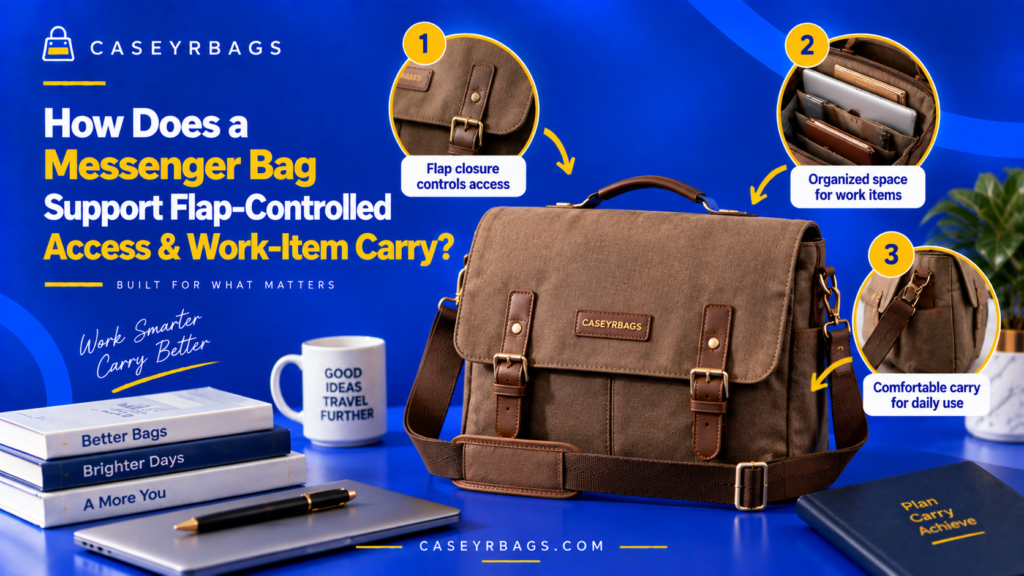
How Does a Messenger Bag Support Flap-Controlled Access & Work-Item Carry? A Messenger Bag supports flap-controlled access by placing a broad front flap over the main opening, often combined with buckles, snaps, hook-and-loop, magnets, zippers, or other retention systems. This creates a deliberate access layer while allowing the bag to maintain a relatively broad opening for retrieving work-related contents. Its work-item carry function comes from a generally rectangular body, flat storage zones, internal dividers, accessory pockets, and a shoulder- or crossbody-oriented strap. These features help separate documents, notebooks, compatible electronics, and smaller accessories while keeping the bag accessible during transport. KEY TAKEAWAY Messenger Bag identity is strongest when a broad flap controls the main opening while rectangular work-item geometry, purposeful internal zoning, and a long side-carry strap keep contents accessible, separated, and predictably positioned. Messenger Bag Work-Carry Signal Key ACCESS SIGNALThe front flap covers and exposes the main opening through a repeatable retrieval sequence. WORK-ZONE SIGNALFlat items, compatible electronics, and small accessories occupy purposeful storage roles. CARRY SIGNALThe long strap and separated anchors keep the loaded rectangular body reasonably oriented. BOUNDARY SIGNALFlap coverage is not waterproofing, closure control is not theft-proofing, and device capacity is not verified protection. What Defines a Messenger Bag Through Flap-Controlled Access & Work-Item Carry? A Messenger Bag typically uses a broad flap that folds over the upper or front portion of the main compartment. This creates a recognizable access architecture in which the opening is covered and exposed by moving the flap rather than relying only on an uncovered top opening. The body is commonly wider than it is deep and often uses a rectangular or near-rectangular profile. This geometry supports flat or moderately thick work items such as documents, notebooks, folders, and appropriately sized electronics. A long shoulder- or crossbody-oriented strap then supports side carry and allows repositioning for access. Within Everyday Carry, Messenger Bag identity comes from the combined flap + work-item body + long-strap carry system rather than one visible feature alone. Which Features Create the Strongest Messenger Bag Identity? A broad front flap, controlled main opening, rectangular work-item body, flat storage zones, internal organization, and a long shoulder- or crossbody-oriented strap create the strongest Messenger Bag signal. Feature → functional role → Messenger Bag identity. Flap control manages exposure, the body supports work-item geometry, and the strap creates the side-carry path. Which Features Are Secondary Rather Than Defining? Decorative buckles, logos, color, exterior styling, grab handles, and detachable accessories can alter appearance or convenience without defining the category by themselves. Secondary details matter only when they change the dominant access, work-storage, or carry architecture. Visual resemblance alone is a weak taxonomic signal. Why Must Flap, Body, and Carry Geometry Be Evaluated Together? A long strap can appear on many Shoulder Bags and Crossbody Bags, while a front flap can appear on satchels and other formats. Neither feature independently establishes Messenger identity. Long strap alone ≠ Messenger Bag and front flap alone ≠ Messenger Bag. Identity is strongest when flap-controlled access, flat-item storage, and side-carry geometry operate together. Messenger Bag Structural Anatomy SVG Messenger Bag Structural Anatomy SVGThe front flap, work-item body, internal zones, and long strap operate as one Messenger Bag system.Messenger Bag Structural Anatomy SVGThe front flap, work-item body, internal zones, and long strap operate as one Messenger Bag system.ACCESS & BODYFront FlapFlap EdgeMain OpeningPrimary ClosureRectangular BodyWORK & CARRYDocument ZoneDevice SleeveAccessory PocketLong StrapStrap AnchorsFlap control + work organization + side carry = Messenger structure.Figure 1.0:Flap control + work organization + side carry = Messenger structure.CASEYRBAGS.COM • Messenger Bag work carry How Does the Front Flap Control Messenger Bag Access? The front flap acts as the first structural layer between the user and the main chamber, controlling when the opening is covered and when it becomes visible and reachable. How Does the Flap Cover the Main Opening? With the flap lowered, the upper or front opening is physically covered; lifting the flap exposes the access path to the main chamber. Flap closed → opening covered; flap lifted → main access exposed. This creates a deliberate first access step without sealing the bag. How Does Flap Size Affect Compartment Exposure? Broader coverage can overlap more of the opening and upper bag face, while shorter or narrower flaps may leave more side or edge area exposed. More coverage changes opening exposure, not guaranteed security or waterproofing. Coverage should be judged as a physical access layer. Why Is Flap Coverage Different From Complete Sealing? Flap sides, seams, closure gaps, fabric, and lower edges can remain potential exposure paths even when the main opening is covered. Covered opening ≠ sealed opening. For the subtype-specific retrieval mechanism, see Flap-Over Access. Flap → Access-Control Sequence Flap → Access-Control SequenceThe flap creates a repeatable cover, release, retrieval, and reclosure sequence.Flap → Access-Control SequenceThe flap creates a repeatable cover, release, retrieval, and reclosure sequence.CLOSED STATEFlap ClosedOpening CoveredRelease ClosureLift FlapACCESS STATEOpening ExposedRetrieve Work ItemLower FlapRe-secure ClosureFlap closed → release → lift → retrieve → reclose.Figure 2.0:Flap closed → release → lift → retrieve → reclose.CASEYRBAGS.COM • Messenger Bag work carry How Do Flap Closures Change Access Control? Closure systems add different release steps to the flap, so the useful design depends on retrieval frequency and the amount of deliberate retention the task needs. How Do Buckles or Clips Affect Access? Buckles or clips usually require an intentional mechanical release before the flap can be lifted, creating a clear retention step. Deliberate release → added opening step → controlled access. The extra step can be useful or unnecessarily slow depending on retrieval frequency. How Do Snaps, Magnets, or Hook-and-Loop Closures Affect Access? Snaps create localized release points, magnets provide quick alignment and release, and hook-and-loop uses a broader contact area. Each mechanism changes the release feel and sequence rather than establishing a universal best closure. Work-item frequency should guide the fit. When Does Closure Complexity Slow Work-Item Retrieval? Multiple redundant fasteners, difficult one-handed release, or frequent items behind several layers can make routine retrieval unnecessarily slow. More closure steps ≠
When Does a Handbag-Style Bag Shift From Hand Carry to Elbow Carry?
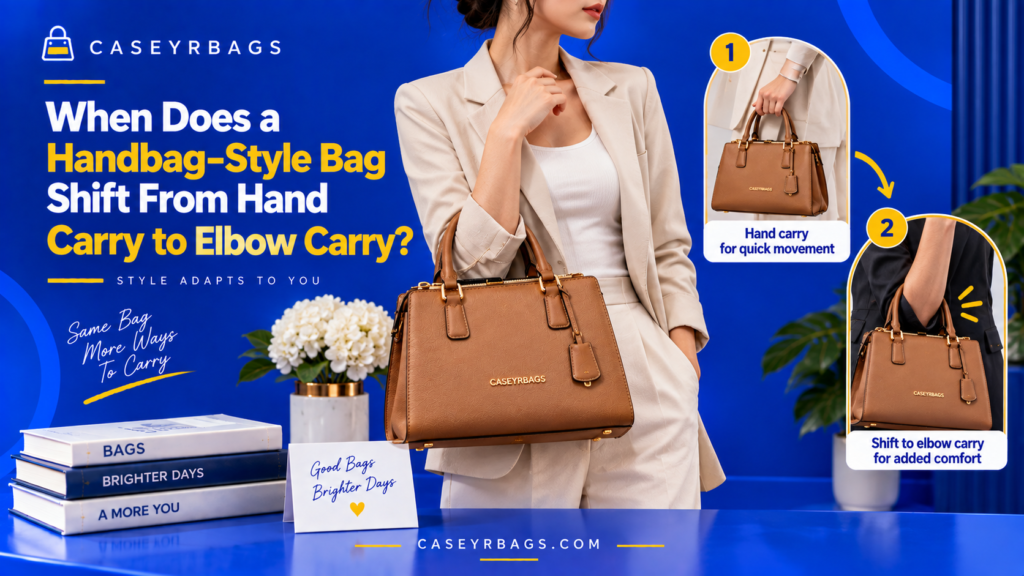
When Does a Handbag-Style Bag Shift From Hand Carry to Elbow Carry? A Handbag-Style Bag shifts from hand carry to elbow or forearm-crook carry when its short handles provide enough usable opening for the forearm to pass through and the bag to rest higher along the arm without distorting the handles or bag body. This depends on handle drop, handle spacing, bag width, handle flexibility, and load. The transition does not require the bag to become shoulder-oriented. Hand carry can remain the primary mode while elbow carry provides a secondary way to free the hand briefly or reposition the bag, provided the handles and load remain controlled. KEY TAKEAWAY Elbow carry works only when the complete short-handle aperture provides natural forearm entry and the normally loaded bag remains controlled in the higher support position. Handle drop alone cannot prove the transition. Hand-to-Elbow Carry Signal Key CLEARANCE SIGNALThe forearm passes through the usable handle opening without forced stretching or distortion. LOAD SIGNALThe loaded bag keeps its orientation instead of slipping, twisting, or rotating excessively. TRANSITION SIGNALThe bag can move from hand to elbow and back to hand carry without unnecessary correction. GRAY ZONEMore handle drop can increase clearance while also pushing the design toward hybrid or shoulder-oriented carry. What Does the Shift From Hand Carry to Elbow Carry Mean? Hand carry suspends the Handbag directly below the hand, with the handles held primarily by the fingers or palm. This creates the shortest and most direct relationship between the hand and the bag. Elbow or forearm-crook carry moves the same handles farther up the arm so they rest around the forearm or inner-elbow region rather than remaining in the hand. The exact resting point varies with handle opening, bag geometry, and the individual carrier. This transition does not necessarily alter the bag’s structural identity. Within the broader Handbag-Style Bag system, elbow carry remains an alternate short-handle position when structured access and direct short-handle carry still dominate. What Changes Mechanically Between Hand and Elbow Carry? In hand carry, the handles remain concentrated at the hand and the bag hangs from a lower, direct support point. Moving the same handles farther up the forearm raises the support point and changes the bag’s position relative to the side. Support point changes → bag height and angle change → hand availability changes. The bag can sit higher while the carrying hand becomes available for a short task. Which Features Determine Whether the Shift Is Possible? Handle drop, usable handle opening, handle spacing, bag width, handle flexibility, and normal load all determine whether the forearm can enter naturally and whether the bag remains controlled afterward. The shift depends on complete geometry rather than one dimension. Hand clearance ≠ forearm clearance, and empty fit ≠ loaded fit. Why Does Elbow Carry Not Turn the Bag Into a Shoulder Bag? Elbow or forearm-crook carry still supports the short handles lower along the arm, while shoulder carry requires enough clearance for the handle or strap to move onto the shoulder. Short-handle forearm/elbow support remains different from long shoulder suspension. Carry-position variation does not automatically change bag type. Hand-to-Elbow Carry Transition SVG Hand-to-Elbow Carry Transition SVG The same short-handle system moves from direct hand support to forearm entry and a higher elbow-crook position. Hand-to-Elbow Carry Transition SVG The same short-handle system moves from direct hand support to forearm entry and a higher elbow-crook position. HAND CARRY Hand Holds HandlesShort SuspensionLower Direct PositionPrimary Mode ELBOW TRANSITION Forearm Enters OpeningHandles Move Up ArmHigher Support PointSecondary Mode Hand carry → forearm entry → elbow-crook carry. Figure 1.0: Hand carry → forearm entry → elbow-crook carry. CASEYRBAGS.COM • Hand-to-elbow carry How Does Handle Drop Determine the Carry Transition? Vertical handle drop is one of the main variables controlling whether the hand and forearm can move through the opening, but it never works independently from width, spacing, and handle shape. What Does a Very Short Handle Drop Favor? A very short drop usually favors direct hand carry, compact suspension, and limited forearm clearance because the opening beneath the handles remains relatively small. This geometry can strongly support primary hand carry while providing little or no useful elbow-carry transition. Limited clearance is not automatically a design flaw when elbow carry is not intended. When Does Additional Drop Begin to Support Elbow Carry? More usable vertical clearance increases the possibility that the hand and forearm can pass through the handle opening naturally without forcing the handles or bag body. More usable vertical clearance → greater forearm-entry potential. No universal numeric drop threshold applies because the complete aperture still depends on other geometry. Why Can Too Much Handle Drop Begin to Change the Bag’s Carry Identity? Greater clearance can progressively support deeper forearm positioning and, in some designs, enough room for shoulder compatibility. The relevant question is whether the handle remains short-handle oriented after clearance increases. More drop ≠ automatically better elbow carry. Handle Drop → Carry Transition Matrix Handle-Drop Character Hand Carry Forearm/Elbow Carry Shoulder Carry Potential Very short Strong Limited Very low Short Strong Possible Low Short–moderate Strong Stronger Design-dependent Long Possible Strong Greater potential Why Does Usable Handle Opening Matter More Than Drop Alone? The forearm must pass through a two-dimensional opening shaped by drop, spacing, curve, stiffness, and bag-top width rather than one vertical number. What Creates the Usable Handle Opening? Vertical drop, horizontal handle spacing, handle curve, handle stiffness, and bag-top width combine to define the actual space available for hand or forearm entry. Drop + spacing + curve + bag-top width → functional clearance. The same nominal drop can create very different openings on different bags. Why Can Two Bags With the Same Handle Drop Fit Differently? Two bags can share the same listed drop while differing in width, anchor spacing, handle curvature, or stiffness, which changes the usable opening area. Same drop + different width/spacing/curve → different usable opening. Handle drop ≠ complete usable handle opening. What Indicates That the Opening Is Too Small for Elbow Carry? The opening is too
Why Does a Handbag-Style Bag Use Short Handles?

Why Does a Handbag-Style Bag Use Short Handles? A Handbag-Style Bag uses short handles because they create a direct hand or forearm carry path that keeps the bag close to the point of support. This suits a compact structured bag whose body, opening, and contents are intended to remain predictably oriented during everyday handling. Short handles also reinforce the bag’s structural identity by limiting long suspension, supporting controlled lifting, and making it easier to stabilize the bag while opening or retrieving personal items. Their usefulness still depends on handle drop, bag width, anchors, load, and the intended carry mode. KEY TAKEAWAY Short handles matter because limited drop creates a compact, directly controlled carry path. Their strongest Handbag-Style role appears when handle geometry, bag structure, anchor placement, load, and structured access work together as one primary carry system. Handbag Short-Handle Carry Signal Key CARRY SIGNALLimited handle drop keeps the primary support path close to the hand or forearm. CONTROL SIGNALDirect support helps lifting, repositioning, orientation, and access control. FIT SIGNALUsable clearance depends on handle drop, bag width, anchor spacing, and intended carry mode. GRAY ZONEShort handles strengthen identity, but they do not alone define the Handbag-Style category. What Functional Role Do Short Handles Serve on a Handbag-Style Bag? Short handles connect the bag directly to the carrying hand or forearm rather than creating a long suspension path from the shoulder. This keeps the bag close to the point where it is being controlled. Because the bag remains near the hand, short handles can support deliberate lifting, repositioning, setting down, and opening. This complements the structured access pattern common to Handbag-Style Bags. Their role is therefore both carry-related and structural. Within the broader Handbag-Style Bag system, short handles help define how the bag moves while reinforcing the compact body-access-carry relationship of the form. Which Functions Do Short Handles Perform? Short handles support hand carry, forearm carry where the opening permits it, lifting, repositioning, stabilization, and access control. Each function keeps the primary point of control close to the bag body. Handle function → bag-control effect → Handbag-Style consequence. Their value comes from the direct support relationship rather than from appearance alone. Why Are Short Handles More Than a Decorative Feature? Handle geometry determines where the bag is supported and therefore influences the primary carry mode, suspension distance, bag position, and how quickly the bag can be stabilized. Handle geometry → primary carry mode. Decorative treatment can change appearance, but the carry path is what makes short handles structurally important. Why Do Short Handles Work Especially Well With Structured Bag Bodies? Direct support works predictably when the bag body retains enough shape that lifting does not cause uncontrolled collapse or shifting orientation. Direct support + stable body → predictable bag orientation. Short handles reinforce structure when the bag body retains a controlled shape. Handbag Short-Handle Carry Anatomy SVG Handbag Short-Handle Carry Anatomy SVG Short handles connect direct support with structured bag control. Handbag Short-Handle Carry Anatomy SVG Short handles connect direct support with structured bag control. HANDLE SYSTEM Short HandlesHandle DropHandle AnchorsMain Opening STRUCTURED BODY Structured BodyBaseMain CompartmentDirect Support Hand → short handle → structured bag. Figure 1.0: Hand → short handle → structured bag. CASEYRBAGS.COM • Handbag short-handle carry How Do Short Handles Create Direct Hand Carry? The mechanical advantage of short handles is the compact suspension path they create between the hand and the bag body. How Does Limited Handle Drop Keep the Bag Near the Hand? Limited handle drop creates a short suspension distance, so the bag hangs directly below the carrying hand instead of farther down a long strap. Short suspension distance → bag remains directly below carrying hand → stronger direct-control relationship. The bag stays close to the point from which it is lifted and repositioned. How Does Direct Hand Carry Improve Bag Control? Direct hand support makes lifting, repositioning, orientation correction, and immediate stabilization easier because the support point is close to the bag. The short carry path reduces the amount of free suspension between hand and body. That makes the bag easier to deliberately place without claiming zero movement. Why Does Direct Control Not Mean Reduced Bag Weight? A shorter suspension path changes how the bag is controlled, but it does not reduce the actual mass of the contents or remove load from the carrying hand. Shorter suspension changes control geometry; it does not reduce the load itself. Direct carry control ≠ weight reduction. How Does Handle Drop Determine Handbag Carry Mode? Handle drop controls the available clearance beneath the handles and therefore influences whether the bag is primarily carried by hand, forearm, or a more shoulder-oriented path. What Does a Short Handle Drop Support? A short drop typically supports hand carry, close lifting, and compact bag positioning by keeping the handles near the upper bag structure. This geometry strongly reinforces short-handle identity when the body and access system support the same compact carry role. When Can a Slightly Larger Drop Support Forearm Carry? A somewhat larger opening beneath the handles may allow the hand to pass through so the handles can rest lower on the forearm, depending on bag width and handle geometry. Forearm compatibility is functional rather than numeric. When this transition matters, Elbow Carry is the closest supporting question; no universal handle-drop measurement guarantees the same fit across different bags or users. When Does a Longer Drop Begin to Shift the Carry Identity? As clearance increases, forearm use becomes easier and possible shoulder compatibility can appear, making the carry architecture more hybrid. Increasing clearance → forearm / possible shoulder compatibility. At some point long suspension becomes more dominant and the short-handle identity weakens. Handle Drop → Carry Mode Matrix Handle Drop Character Primary Carry Behavior Identity Signal Very short Hand carry Strong short-handle identity Short Hand / possible forearm Strong Moderate Forearm / hybrid Mixed Long shoulder clearance Shoulder-oriented Weaker short-handle identity How Do Short Handles Affect Handbag Position? Limited suspension keeps the Handbag-Style Bag in a compact carry zone whose position
When Does a Structured Handbag-Style Bag Slow Access?

When Does a Structured Handbag-Style Bag Slow Access? A structured Handbag-Style Bag slows access when its shape-retaining body, opening geometry, closure system, or internal divisions create extra steps between locating an item and reaching it. This can happen when the opening is narrow, the body is highly rigid, or frequently used items sit behind several fixed barriers. Structure itself is not the problem. A well-structured bag can make item locations more predictable, but access becomes slower when structural control exceeds what the retrieval task requires or when packed contents block the intended opening path. The key question is whether organization benefits still justify the added retrieval friction. KEY TAKEAWAY Structured access becomes inefficient when body rigidity, opening geometry, closure layers, compartment barriers, handle placement, or packed volume add more retrieval friction than the structural control they provide. Structured Handbag Access-Friction Signal Key CONTROL SIGNALStructure keeps the opening, pockets, and compartments predictably positioned. FRICTION SIGNALRigid edges, layered closures, or barriers add unnecessary retrieval steps or obstruction. FREQUENCY SIGNALSmall delays become more important when the same item is retrieved repeatedly. GRAY ZONESlower access can still be reasonable when the structural control serves the intended use. When Does Handbag Structure Shift From Helpful to Slow? A structured Handbag-Style Bag can improve access by keeping its main opening, compartments, and pockets in predictable positions. The user does not need to reshape the bag every time it is opened. The same structure can become restrictive when rigid edges, narrow opening geometry, fixed internal barriers, or layered closures reduce the amount of usable access space. The bag remains organized but begins demanding more manipulation to reach contents. The key distinction is therefore between structure that guides retrieval and structure that obstructs retrieval. Within the broader Handbag-Style Bag system, access slows when structural control adds more steps or obstruction than the retrieval task reasonably needs. Which Structural Features Can Slow Access? Rigid upper edges, narrow main openings, stiff closure paths, fixed dividers, deep chambers, short-handle interference, and rigid pocket openings can all reduce usable access space or add manipulation. Feature → access restriction → retrieval consequence. The same feature may still be useful when its organizational benefit is greater than the friction it introduces. Which Structural Features Usually Help Access? A stable opening, predictable pocket location, controlled compartment shape, and stable base can reduce searching by keeping access geometry and item zones consistent. Structure helps when it reduces searching without increasing unnecessary opening steps. Predictability is valuable only while the physical access path remains usable. How Can the Same Feature Help One User but Slow Another? Item size, access frequency, packed load, hand path, and preferred organization can change whether the same divider, closure, or opening feels useful or restrictive. The relevant comparison is task-specific. A structural feature can support occasional deliberate access yet become inefficient for repeated quick retrieval. Structured Handbag Access-Friction Anatomy SVG Structured Handbag Access-Friction Anatomy SVG Useful structure organizes the access path; excessive structure can become a barrier. Structured Handbag Access-Friction Anatomy SVG Useful structure organizes the access path; excessive structure can become a barrier. STRUCTURE → CONTROL Rigid Upper EdgeMain OpeningQuick-Access PocketMain Compartment STRUCTURE → BARRIER Closure LayersFixed DividerDeep ZoneShort Handles Useful structure guides retrieval; excessive structure adds friction. Figure 1.0: Useful structure guides retrieval; excessive structure adds friction. CASEYRBAGS.COM • Structured Handbag access How Does Excessive Body Rigidity Slow Access? Body rigidity becomes a retrieval problem when fixed walls and edges prevent the bag from flexing enough around the hand or intended contents. How Can Rigid Side Panels Restrict Hand Movement? Fixed wall geometry reduces the bag’s ability to flex around the hand, which can create awkward reach angles, difficult corner access, or less room to maneuver an item during removal. Rigid body wall → less flex around hand → reduced reach adaptability. The problem appears when the fixed geometry becomes more restrictive than the contents require. How Can a Rigid Upper Edge Reduce Usable Opening Width? The measured width of the bag can be greater than the opening space actually available to the hand when the upper edge does not spread, fold back, or deform. Rigid upper edge → limited opening spread → smaller usable entry. Interior capacity therefore does not guarantee equivalent access capacity. When Is Rigidity Still Useful Despite Slower Access? Rigidity can still justify some access cost when it preserves shape, keeps compartments predictable, and separates contents in a way that reduces searching. The relevant question is whether the structural benefit justifies the access cost. Slightly slower access can remain functional when the organization gain is meaningful. Structure Benefit vs Access Cost Matrix Structure Level Main Benefit Possible Access Cost Soft-structured Flexible reach Less predictable shape Semi-structured Shape + adaptability Moderate restriction Highly structured Strong shape retention Less flexible hand path Over-rigid for contents Limited added benefit High retrieval friction When Does Opening Geometry Become the Main Access Bottleneck? Opening geometry becomes the main bottleneck when the actual entry width or corner shape limits visibility and reach more than the interior volume itself. How Can a Narrow Opening Hide Usable Interior Space? A bag can have substantial internal volume while the entry remains too narrow to expose or reach that space efficiently. Large interior + narrow entry → available volume that is harder to reach. Interior capacity ≠ access opening capacity. How Do Rigid Corners Affect Opening Width? Fixed corners can prevent the opening from spreading, folding back, or exposing deep areas, leaving more of the interior outside the direct hand path. Rigid corners reduce the usable opening even when the top edge looks wide from the outside. Effective width is the space the hand and intended contents can actually use. When Does a Structured Opening Remain Efficient? A structured opening remains efficient when it provides enough width, good visibility, a predictable closure path, and direct reach to the intended storage zones. Controlled opening ≠ restricted opening. Structure helps when the boundary stays predictable without unnecessarily narrowing entry. Opening Geometry → Access-Speed Map Opening Geometry →