When Does a Rolling Duffel Bag Outperform a Rolling Suitcase Bag?
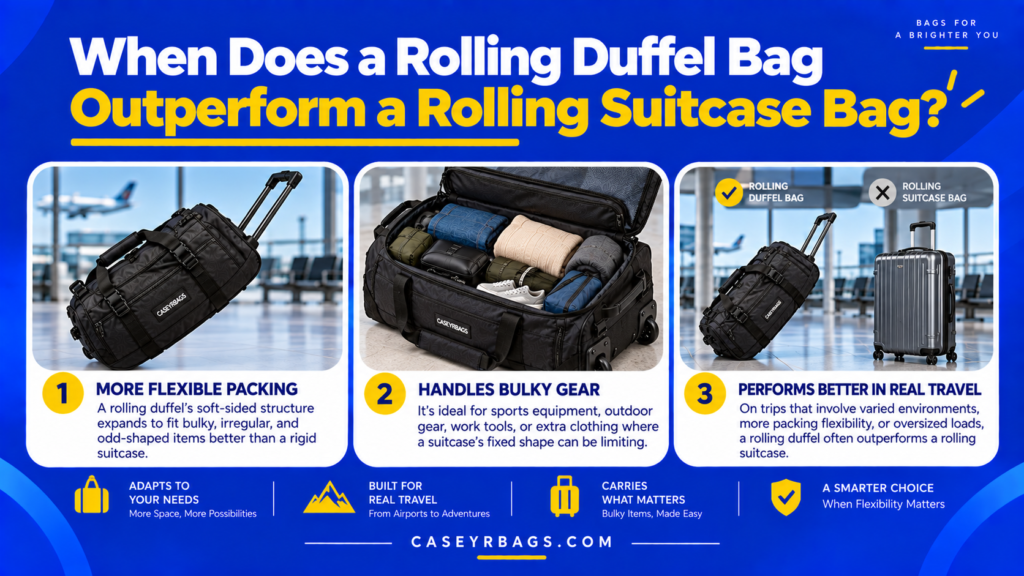
When Does a Rolling Duffel Bag Outperform a Rolling Suitcase Bag? A Rolling Duffel Bag can outperform a Rolling Suitcase Bag when flexible packing, adaptable cavity shape, and a softer upper structure solve the intended load and storage demands better than a more fixed wheeled shell. This advantage is strongest with bulky, soft, irregular, or changing contents that benefit from a less rigid packing boundary. The advantage is conditional rather than universal. A Rolling Suitcase may be the stronger fit when shape retention, fixed organization, or persistent exterior geometry matters more, while travel surfaces, lifting transitions, and storage constraints can change the result for either format. Outperform ≠ universally superior, flexible structure ≠ unlimited packing, and rigid shell ≠ unlimited protection. KEY TAKEAWAY A Rolling Duffel outperforms a Rolling Suitcase only when its flexible rolling structure solves the actual packing, transition, and storage demands with fewer important trade-offs than the Suitcase’s more fixed shell geometry. Rolling Duffel vs Rolling Suitcase Fit Key DUFFEL SIGNALIrregular or soft contents benefit from adaptable cavity shape and partial collapsibility. SUITCASE SIGNALShape-sensitive contents benefit from more persistent exterior geometry and structured packing boundaries. TRIP SIGNALRolling surfaces, lifting frequency, and storage constraints determine which structure fits the trip. GRAY ZONEBoth formats solve some needs well, and no clear winner appears across the full trip. What Does “Outperform” Mean When Comparing a Rolling Duffel & Rolling Suitcase? A Rolling Duffel outperforms a Rolling Suitcase only when its structural characteristics better solve the specific packing, movement, and storage demands of the trip. The comparison should therefore begin with the intended contents and travel conditions rather than with a general winner. The central structural difference is flexibility. A Rolling Duffel typically combines a more flexible upper packing body with a reinforced rolling base, while a Rolling Suitcase generally retains more fixed exterior geometry across a larger portion of the bag. Neither structural approach is automatically superior. Within the broader Duffel Bag system, flexible geometry supports adaptability around contents, while more rigid geometry supports shape retention and a more predictable packing boundary. Which Variables Should Determine the Comparison? The comparison should examine contents, structural flexibility, shape-retention needs, packing organization, travel surfaces, lifting frequency, and storage constraints. These variables reveal whether the Rolling Duffel’s adaptability solves a real trip problem or whether the Suitcase’s fixed geometry provides more useful control. Feature → mechanism → consequence → best-fit condition. No single variable should determine the result because a format can perform strongly in one dimension and create a meaningful trade-off in another. The stronger fit is the one that solves more important needs with fewer costly mismatches. Why Is Wheel Presence Alone a Weak Comparison? Both formats may use wheels, but the body structure surrounding those wheels remains different. A Rolling Duffel combines rolling hardware with a more flexible packing body, while a Rolling Suitcase usually combines wheels with more persistent external geometry and structured interior boundaries. Same mobility feature ≠ same luggage format. Wheels solve only the surface-supported movement task; they do not erase differences in cavity conformity, storage footprint, lifting behavior, packed-shape control, or organization. Why Should the Comparison Remain Context-Dependent? One format may solve flexible packing, partial collapse, or direct repositioning better, while the other may solve fixed geometry, shape retention, or structured organization better. The advantage changes when the contents or trip pattern changes. Context determines value because the same structural feature can be helpful in one scenario and restrictive in another. Outperform should therefore mean better functional fit for the actual trip, not a universal quality ranking. Rolling Duffel vs Rolling Suitcase Anatomy SVG Rolling Duffel vs Rolling Suitcase Anatomy SVG Flexible rolling structure and more fixed wheeled structure solve different packing and travel tasks. Rolling Duffel vs Rolling Suitcase Anatomy SVG Flexible rolling structure and more fixed wheeled structure solve different packing and travel tasks. ROLLING DUFFEL Flexible upper bodyMain cavityReinforced rolling baseGrab + pull handles ROLLING SUITCASE More fixed shellStructured interiorWheel basePersistent geometry Flexible rolling structure versus more fixed wheeled structure. Figure 1.0: Flexible rolling structure versus more fixed wheeled structure. CASEYRBAGS.COM • Rolling Duffel vs Rolling Suitcase How Does Structural Flexibility Differ Between the Two Formats? Structural flexibility changes how each format responds to irregular contents, external pressure, packed shape, and storage space. How Does a Rolling Duffel Retain Flexible Packing Behavior? A Rolling Duffel typically retains flexible sidewalls, a softer upper structure, a conformable main cavity, and a packed profile that changes more strongly with the contents. Its rolling hardware introduces fixed zones without eliminating upper-body adaptability. Rolling hardware reduces some Duffel flexibility without eliminating it. The bag can therefore combine a structured lower mobility base with a more content-responsive upper packing area, creating a hybrid between soft-sided packing and wheeled movement. How Does a Rolling Suitcase Retain More Fixed Geometry? A Rolling Suitcase generally uses more persistent shell boundaries, defined corners, and exterior surfaces that retain their shape regardless of how lightly the interior is packed. Not every suitcase is fully rigid, but the overall geometry is usually less content-responsive than a Duffel. Fixed exterior boundaries create a more predictable profile and can support consistent internal organization. The trade-off is lower cavity conformity when an irregular item does not align naturally with the shell geometry. When Does Flexible Structure Become the Stronger Advantage? Flexible structure becomes stronger when the load includes changing item mixes, bulky soft contents, irregular shapes, or contents that do not need fixed shell geometry. The cavity can adapt around the load rather than forcing the load to match one persistent outline. That advantage remains conditional on control. If flexibility produces excessive bulging, weak shape retention, or unstable packing, the structural benefit decreases and the Suitcase’s more fixed geometry may become the stronger fit. Structural Flexibility Comparison Matrix Structural Trait Rolling Duffel Rolling Suitcase Upper body More flexible More fixed Rolling base Structured Structured Exterior geometry Content-responsive More shape-retaining Collapsibility Potentially greater Usually lower Irregular-item conformity Usually greater More constrained When Does Rolling Duffel Packing Flexibility Become More
How Does Rolling Duffel Bag Mobility Alter Travel Use?
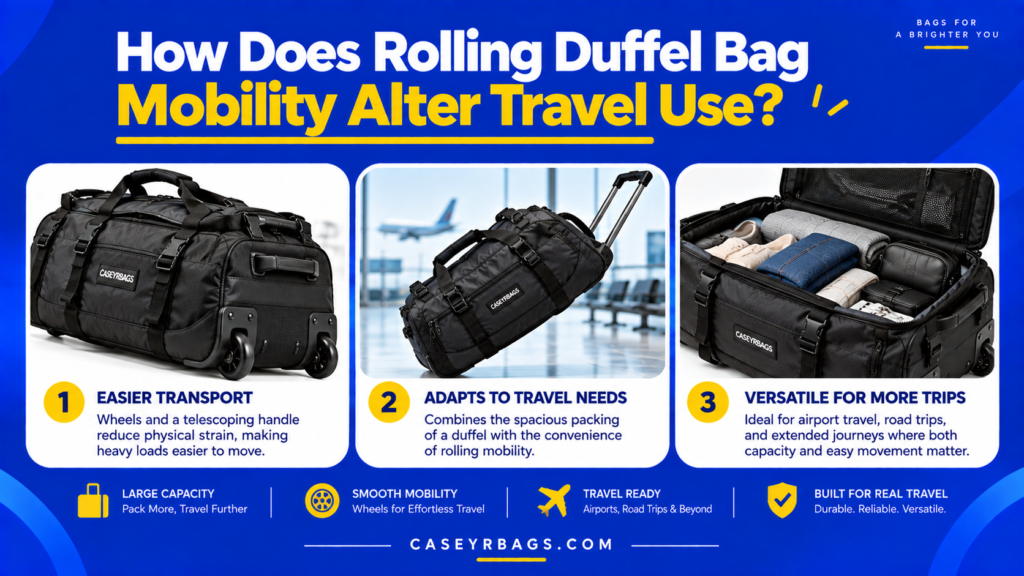
How Does Rolling Duffel Bag Mobility Alter Travel Use? Rolling Duffel Bag mobility changes travel use by adding a wheel-supported base and pull system that can move part of the trip from continuous hand or shoulder carrying to surface-supported rolling. On suitable floors, the packed Duffel can travel between points with less need for continuous lifting while still retaining direct carry options for transitions. The benefit remains dependent on surface type, packed-load control, wheel structure, storage conditions, and how often the bag must still be lifted. Stairs, rough ground, tight storage, unstable packing, and frequent transfer points can reduce the practical advantage of rolling. Rolling ≠ no lifting, wheels ≠ useful on every surface, and added hardware ≠ automatic travel advantage. KEY TAKEAWAY A Rolling Duffel provides useful mobility when wheel-supported movement replaces meaningful amounts of continuous carrying on suitable surfaces without creating bigger problems during lifting, stairs, storage, or packed-load transitions. Rolling Duffel Mobility Signal Key ROLLING SIGNALSmooth or firm surfaces let the wheel-supported base replace repeated carrying. PACKING SIGNALThe load stays controlled when the Duffel tilts into rolling orientation. TRANSITION SIGNALPull and grab handles support rolling, lifting, stairs, vehicle transfers, and storage. GRAY ZONEWheels are present, but rough surfaces or frequent lifts leave little real benefit. What Does Rolling Mobility Change in a Duffel Bag? A Rolling Duffel Bag adds a wheel-supported base and pulling system to a flexible or semi-structured Duffel body. This allows part of the travel task to shift from carrying the packed bag entirely by handles or straps to moving it across suitable surfaces. The change is functional rather than absolute. Rolling can reduce continuous carrying on smooth travel surfaces, but the bag still requires direct handling during stairs, vehicle transfers, storage placement, rough ground, and other transitions where wheels provide little help. Rolling mobility should therefore be judged by how often it replaces carrying during the intended trip. The broader Duffel Bag relationship places rolling within flexible packing, carry options, packed-shape control, and adaptable travel mobility. Which Components Create Rolling Duffel Mobility? Wheels, wheel housings, a reinforced lower area, pull handle, grab handles, and the rolling base work together to create Rolling Duffel mobility. Wheels support ground travel, the reinforced base stabilizes the rolling interface, and handles control pulling or lifting transitions. Component → mobility role → travel consequence. The system is useful only when these parts work with the packed bag rather than in isolation. Strong wheel hardware does not automatically produce good mobility if the load is unstable, the surface is unsuitable, or lifting remains frequent. How Does a Rolling Duffel Differ From a Classic Carry Duffel? A classic carry Duffel moves mainly through hand handles or shoulder carry, while a Rolling Duffel adds surface-supported movement. That extra method can replace continuous carrying across suitable travel segments. Rolling hardware also adds structure, fixed geometry, and physical components that a simple carry Duffel may not need. More ground mobility is gained, but lower-body flexibility and storage compressibility can decrease. Why Does Rolling Not Replace Every Other Carry Method? Rolling cannot replace stairs, vehicle loading, rough ground, curbs, thresholds, storage placement, or lifting onto surfaces. These transitions still require direct handling even when wheels perform well between them. Rolling supplements direct carry; it does not remove it. A useful Rolling Duffel therefore needs both effective ground mobility and accessible grab points for the portions of a trip where wheels cannot solve the movement task. Rolling Duffel Mobility Anatomy SVG Rolling Duffel Mobility Anatomy SVGWheel-supported base → surface-supported movement.Rolling Duffel Mobility Anatomy SVGROLLING HARDWAREWheels + housingReinforced baseTRAVEL CONTROLPull + grab handlesFlexible upper bodyWheel-supported base → surface-supported movement.Figure 1.0:Wheel-supported base → surface-supported movement.CASEYRBAGS.COM • Rolling Duffel mobility How Do Wheels Change Duffel Bag Ground Mobility? Wheels transfer part of the movement task to surface contact, reducing continuous carrying during suitable travel segments. How Does Rolling Reduce Continuous Carrying Demand? A wheel-supported base lets the ground support much of the bag’s load while the user directs movement through the pull system. On suitable surfaces, this can replace repeated hand or shoulder carrying during longer travel segments. Wheel-supported base → part of load supported through ground contact → reduced continuous carrying during suitable segments. The benefit ends whenever the route requires lifting, climbing, or surfaces that interrupt wheel travel. How Does Wheel Placement Affect Bag Tracking? Wheel placement, lower-body structure, bag orientation, and load alignment influence tracking. A wheel system positioned consistently relative to the reinforced base can help the Duffel follow a predictable line when packed geometry is balanced. Wheel placement ≠ packed-load balance. Even well-positioned wheels can track poorly if the contents create strong left-right asymmetry or if dense mass sits away from the intended rolling centerline. Why Can the Packed Load Still Affect Rolling Behavior? Rolling behavior comes from the interaction between wheel hardware and packed geometry. One-sided bulging, a top-heavy load, or internal movement can alter the bag’s tilt and change how the rolling base meets the surface. Wheel hardware + packed geometry → actual rolling behavior. Stable wheels cannot fully compensate for an unstable packed load, so load control must be established before wheel performance can be judged meaningfully. Wheel-Supported Movement Matrix Travel Condition Wheel Role Mobility Effect Smooth level surface Continuous rolling Strongest rolling benefit Short threshold Interrupted rolling Direct control may increase Stairs Little/no rolling value Lift required Rough ground Reduced wheel efficiency Carrying may become practical Tight turn Directional control Packed geometry matters How Does the Rolling Base Change Duffel Structure? Wheel housing and base reinforcement create a more stable lower structure for rolling while reducing local softness. Why Does a Rolling Duffel Need a Stronger Lower Structure? Wheel-supported use normally requires lower-body support for wheel attachment, base stability, tilted orientation, and repeated ground interaction. A simple soft base would provide less predictable support for those functions. Rolling support requires more fixed structure than a simple soft base. The lower area becomes more defined while the upper Duffel can remain comparatively flexible for packing and shape adaptation. How
How Does Soft-Sided Duffel Bag Flexibility Improve Overhead-Bin Packing?
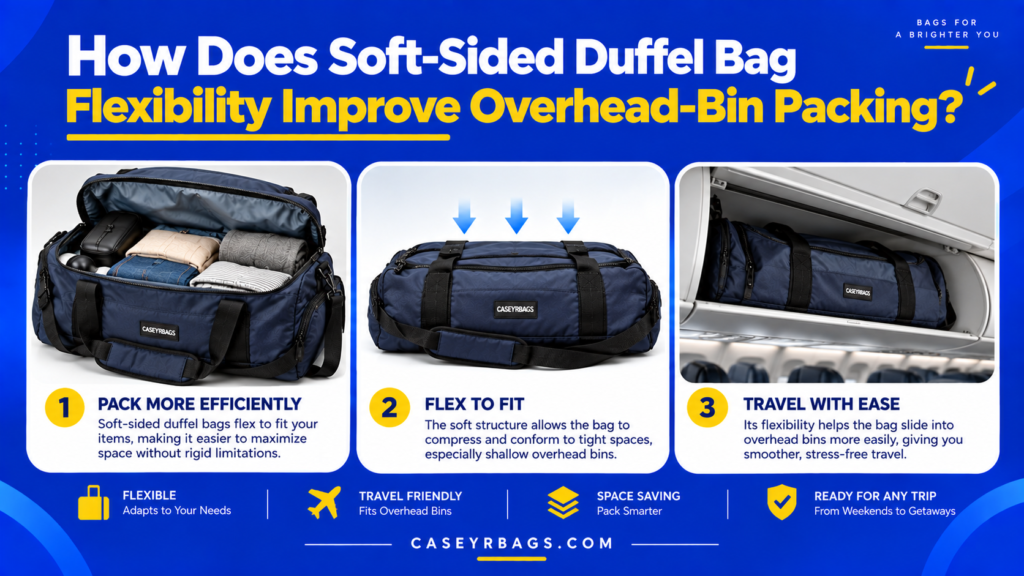
How Does Soft-Sided Duffel Bag Flexibility Improve Overhead-Bin Packing? Soft-Sided Duffel Bag flexibility can improve overhead-bin packing because flexible body panels can conform around compressible contents and adapt the final packed profile more readily than a fully rigid shell. When the load leaves usable empty space, local side or top areas can collapse inward instead of preserving the full empty-bag shape. This advantage depends on the packed system rather than softness alone. Rigid objects, maximum fill, closure strain, fixed structural zones, or dimensions beyond applicable baggage limits can remove much of the useful adaptability. Flexible exterior ≠ guaranteed overhead-bin fit, compressible bag ≠ compressible contents, and physical fit ≠ airline-compliance guarantee. KEY TAKEAWAY Soft-sided flexibility helps overhead-bin packing only where the finished load preserves real shape adaptability. Compressible contents, controlled bulging, usable panel movement, secure exterior straps, and acceptable final packed dimensions matter more than how soft the empty Duffel feels. Soft Duffel Overhead-Bin Fit Key FLEXIBILITY SIGNALUnused or compressible volume allows controlled panel movement. RIGIDITY SIGNALHard contents create local dimensions the fabric cannot reduce. PROFILE SIGNALFinal packed shape remains predictable with limited bulging. GRAY ZONEThe bag is soft, but taut panels leave little usable compression. What Does Soft-Sided Flexibility Mean for Overhead-Bin Packing? A Soft-Sided Duffel relies on flexible fabric panels rather than a completely rigid shell to define its exterior geometry. When the load leaves unused space, those panels can collapse inward or conform around the contents instead of maintaining the full empty-bag profile. That adaptability can help during overhead-bin placement because small differences in height, width, or side profile may be absorbed through controlled panel movement. The benefit depends on whether the packed contents themselves can compress or reposition slightly without losing load control. Flexibility therefore creates shape tolerance, not limitless fit. Within the broader Duffel Bag relationship, overhead-bin adaptability is one part of the larger connection between flexible packing, controlled shape, access, and travel mobility. Which Structural Features Create Soft-Sided Duffel Flexibility? Fabric side panels, a flexible top panel, soft end panels, limited internal framing, a flexible base where applicable, compression features, and pliable compartment walls all contribute to shape adaptability. Each feature determines how much of the packed exterior can respond to unused or compressible internal volume. Structural feature → shape adaptability → overhead-bin consequence. Flexible panels can reduce a local profile, while reinforced zones preserve more fixed shape. Compression can refine unused volume, but it cannot shrink rigid contents or remove dimensions created by a tightly packed load. How Does Soft-Sided Structure Differ From Rigid-Shell Geometry? A soft-sided Duffel has final dimensions partly influenced by the contents, while a rigid shell keeps its exterior geometry comparatively fixed regardless of how lightly it is packed. The soft format therefore offers more local shape tolerance where the load still permits movement. Neither format is universally better. Soft construction favors conformity but provides less fixed geometry, while rigid structure offers predictable shape with little local compression. Overhead-bin usefulness depends on the real packed profile rather than the material category alone. Why Does Flexibility Not Guarantee Overhead-Bin Fit? Flexibility cannot override packed dimensions, rigid contents, full volume, closure tension, structural base zones, bin geometry, or applicable baggage requirements. A flexible panel helps only where the load behind it retains enough freedom to change shape. Flexible construction increases adaptability; it does not remove dimensional limits. A soft Duffel that is overfilled or built around hard contents can behave much more like a fixed-volume object than its empty appearance suggests. Soft Duffel → Overhead-Bin Fit SVG Soft Duffel → Overhead-Bin Fit SVG Flexible panels help only when the packed load preserves usable shape adjustment. Soft Duffel → Overhead-Bin Fit SVG Flexible panels help only when the packed load preserves usable shape adjustment. CONTROLLED FLEXIBLE LOAD Flexible panelsCompressible contentsShape adjustment OVERFILLED / RIGID LOAD Taut panelsFixed contentsMinimal adjustment Packed-load flexibility determines practical fit adaptability. Figure 1.0: Packed-load flexibility determines practical fit adaptability. CASEYRBAGS.COM • Soft Duffel overhead-bin packing How Do Flexible Panels Adapt to Overhead-Bin Space? Flexible exterior panels can change local shape when genuine unused or compressible internal volume remains available. How Can Side Panels Compress During Bin Placement? Side panels can move inward where the chamber contains unused space or compressible material behind that area. This can reduce a local side profile and create a small amount of placement tolerance around compartment contours or neighboring soft luggage. Unused internal space → side-panel compression → smaller local profile. The movement should come from available flexibility rather than force. Controlled conformity ≠ forced compression, and a taut panel should not be treated as meaningfully compressible simply because its material remains soft. How Can Top-Panel Flexibility Reduce Excess Height? Where the upper chamber is not completely filled, a flexible top can settle around the packed load and reduce unnecessary exterior height. The benefit is strongest when soft or compressible contents leave vertical room that the panel can occupy. Unfilled upper volume → controlled top collapse → reduced packed profile. Rigid objects near the top can establish a minimum height the fabric cannot meaningfully reduce, even when the surrounding top panel remains flexible. When Do Flexible Panels Stop Providing Useful Dimensional Adjustment? Useful adjustment decreases when the Duffel is tightly packed, hard objects define local dimensions, reinforced panels resist movement, a rigid base fixes geometry, closures are stretched, or expansion sections are fully occupied. Panel flexibility exists only where the packed load allows movement. Once the contents make the exterior taut, extra pressure produces distortion or concentrated force rather than useful dimensional reduction. Panel Flexibility Matrix Panel Condition Packed Behavior Overhead-Bin Effect Flexible + underfilled Can collapse inward Greater shape adaptability Flexible + fully packed Limited compression Less dimensional flexibility Flexible + rigid contents Exterior follows hard contents Low local compression Reinforced panel Retains more shape More predictable but less conformable How Do Compressible & Rigid Contents Change Duffel Flexibility? The contents determine how much of the Duffel’s theoretical flexibility remains after packing because the fabric can move only where the load
How Does Classic Soft-Sided Duffel Bag Structure Affect Packing?
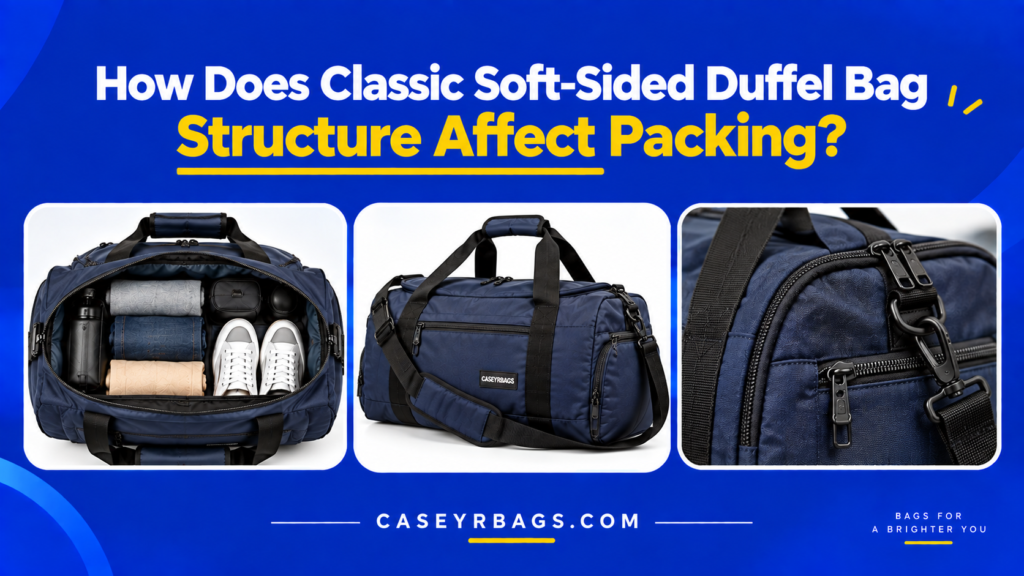
How Does Classic Soft-Sided Duffel Bag Structure Affect Packing? A Classic Soft-Sided Duffel Bag uses flexible body panels and a relatively open main chamber that can conform around changing item shapes. This lets bulky, soft, or irregular contents use available space without being constrained by a fully rigid shell, while the final bag shape is influenced by what is packed inside. That flexibility also increases the importance of item density, placement, base support, opening geometry, and internal movement. Flexible volume ≠ unlimited volume, easy loading ≠ stable packing, and soft structure ≠ absence of structural limits. The goal is controlled adaptability: contents should fit efficiently while the packed Duffel remains accessible, reasonably stable, and predictable in shape. KEY TAKEAWAY Classic Soft-Sided Duffel packing works best when flexible panels adapt around the contents without allowing dense items, empty gaps, or poor placement to create uncontrolled sag, bulging, internal movement, or closure strain. Soft-Sided Duffel Packing Signal Key FLEXIBILITY SIGNALBody panels conform around contents without losing useful overall shape. SUPPORT SIGNALBase, end panels, seams, and internal organization keep the load sufficiently controlled. MOVEMENT SIGNALDense and loose items remain predictably positioned after the Duffel is packed. GRAY ZONEThe bag closes, but uneven bulging, sag, movement, or blocked access shows weak packing control. What Does Soft-Sided Structure Mean for Classic Duffel Bag Packing? A Classic Soft-Sided Duffel Bag relies primarily on flexible body panels rather than a rigid outer shell to define its packed shape. As items are added, those panels can expand, compress, and conform around the load, which changes how much of the chamber becomes practically usable. This gives the main chamber more freedom to accommodate different item shapes, but it also means the load contributes significantly to the bag’s structure. Poorly positioned dense items or large unsupported gaps can make the Duffel sag, twist, bulge, or collapse unevenly. Soft-sided packing therefore requires a balance between adaptability and control. The wider Duffel Bag relationship connects this flexible packing behavior with access, packed-shape control, and travel mobility, while this page focuses narrowly on the structural packing mechanism. Which Structural Features Most Directly Affect Packing? Flexible body panels, the main chamber, top opening, base panel, end panels, seams, internal pockets or dividers, and compression features where present all influence how the Duffel accepts and controls contents. Each feature changes either the available geometry, the support around the load, or the amount of movement possible after packing. Structural feature → packing behavior → practical consequence. Flexible walls increase conformity, the base influences lower-shape support, end panels help define length, the opening determines practical access, and limited internal organization can reduce movement. No single component determines packing quality because the finished load depends on how these features work together. How Does a Soft Body Differ From Rigid Packing Structure? A soft-sided body responds strongly to the contents, while rigid structure constrains the contents more strongly within a predetermined geometry. Soft construction can accept irregular shapes more easily, but it also provides less inherent shape retention when the load is poorly positioned or only partially fills the chamber. Neither format is universally superior. Flexible structure favors conformity and changing item geometry, while rigid structure favors shape retention and more fixed boundaries. The relevant question is whether the Duffel’s normal contents benefit from flexibility without causing excessive sag, movement, or distortion. Why Does the Packed Load Become Part of the Duffel’s Structure? In a soft-sided Duffel, the contents help determine the final external geometry because the panels do not fully dictate the shape on their own. Dense, bulky, soft, and irregular items each push, support, or deform the bag differently, so item placement becomes part of the structural behavior. Flexible shell + contents → final packed shape. The softer the structure, the more item placement influences bag geometry. This makes packing control important even when the same Duffel volume is used, because two loads with similar volume can produce very different balance, sag, and access behavior. Classic Soft-Sided Duffel Packing Anatomy SVG Classic soft-sided Duffel packing anatomy Diagram showing flexible side panel, main chamber, top opening, end panel, base panel, dense item zone, bulky item zone, internal pocket, and the relationship between contents, body shape, and item fit. Classic Soft-Sided Duffel Packing Anatomy Contents → Body Shape • Body Flexibility → Item Fit TOP OPENING DENSE ITEMZONE BULKY ITEMZONE INTERNAL POCKET MAIN CHAMBER FLEXIBLE SIDE PANEL END PANEL BASE PANEL Figure 1.0: The packed load and flexible structure work together to create the final Duffel geometry. CASEYRBAGS.COM • Classic soft-sided Duffel packing anatomy How Do Flexible Body Panels Affect Packing Space? Flexible panels increase shape adaptability by allowing the chamber to conform around irregular or bulky contents, but that same freedom creates limits when the packed load no longer holds a predictable form. How Do Soft Panels Conform Around Bulky or Irregular Items? Soft panels can expand around irregular profiles, accommodate compressible contents, reduce rigid geometric constraints, and collapse inward around smaller loads. This gives the chamber more ability to adapt its usable shape to the actual contents instead of forcing every item into a fixed shell geometry. Irregular contents → panel conformity → adaptable usable volume. The benefit remains limited by the seams, closure path, panel dimensions, base, end structure, and intended Duffel volume. Flexibility changes how space is used; it does not create unlimited additional capacity. Why Does Flexible Space Not Equal Unlimited Capacity? Flexible space remains constrained by seam length, zipper or closure geometry, panel dimensions, handle anchors, base construction, and the overall design volume. Panels can bulge or conform, but excessive outward expansion increases closure tension and can distort the relationship between the body, base, and end panels. Body expansion ≠ additional unlimited capacity. A Duffel that still closes can nevertheless be poorly packed if the closure is under excessive strain, the panels are strongly distorted, or dense items create concentrated pressure that the flexible structure cannot control predictably. When Does Panel Flexibility Begin to Reduce Packing Control? Panel flexibility starts reducing control
How Does a Duffel Bag Combine Flexible Packing & Adaptable Travel Mobility?
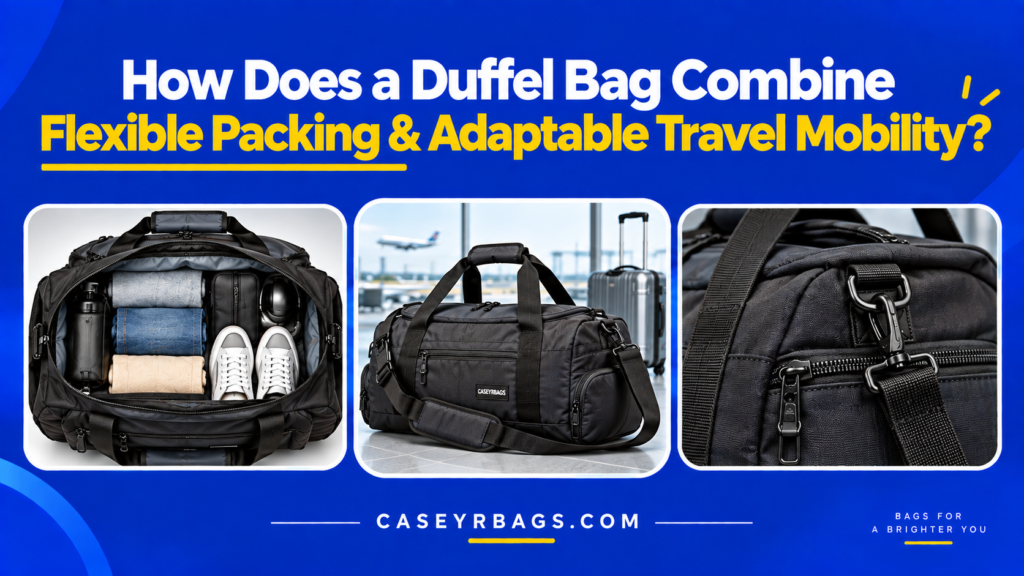
How Does a Duffel Bag Combine Flexible Packing & Adaptable Travel Mobility? A Duffel Bag combines flexible packing and adaptable travel mobility through a soft or semi-structured main cavity that can conform around different contents while carry handles, a shoulder strap, or an optional rolling system provide more than one way to move the packed load. Its structure adapts both to what is packed and to how the bag travels. That adaptability depends on control rather than softness alone. The opening must remain usable, the packed shape must stay manageable, and the carry system must match the travel stage. Flexible structure ≠ unlimited capacity, packing adaptability ≠ guaranteed organization, and multiple carry options ≠ equal usefulness in every travel context. KEY TAKEAWAY A Duffel works best when flexible cavity shape, practical opening access, controlled packed geometry, and the available carry system stay compatible. Softness creates adaptability, but the load still needs enough shape control for predictable lifting, carrying, storing, or rolling. Duffel Packing & Mobility Signal Key PACKING SIGNALThe cavity adapts around contents without uncontrolled bulging, closure strain, or unstable load shift. ACCESS SIGNALThe main opening remains usable after packing instead of being blocked by the load. MOBILITY SIGNALHandles, shoulder carry, or rolling support match the travel stage and the packed shape. GRAY ZONEMore capacity or more carry options are present, but the packed load becomes difficult to control. What Do Flexible Packing & Adaptable Mobility Mean in a Duffel Bag? Flexible packing describes the Duffel Bag’s ability to let its main cavity conform around different item shapes instead of forcing every load into a fixed shell geometry. The degree of conformity depends on panel structure, base stiffness, fill level, and the shape and density of the contents. Adaptable travel mobility describes the Duffel’s ability to move through different travel stages using handles, shoulder carry, or secondary systems such as wheels where present. These methods do not behave identically, but they can let the same bag transition between lifting, carrying, storing, and rolling. The defining relationship is therefore not softness or mobility hardware alone. Within Everyday Carry, a useful Duffel must keep flexible packing and travel movement connected so the load remains accessible, sufficiently stable, and practical to move after the external bag shape changes around the contents. What Makes Duffel Packing Structurally Flexible? Soft or semi-structured panels, adaptable sidewalls, a large main cavity, and limited fixed internal geometry allow a Duffel to change shape around the packed contents. Instead of forcing irregular items into a rigid shell, the body can conform within the limits of the panel, base, seams, and closure system. Flexible body → adaptable cavity shape. This flexibility is useful only while the packed load remains controllable. The sidewalls can conform, but they should not be treated as unlimited expansion because excessive fill can distort the opening, change balance, or place unnecessary strain on the closure and carry system. What Makes Duffel Travel Mobility Adaptable? Duffel travel mobility becomes adaptable when the bag can be lifted by paired handles, carried by a shoulder strap where present, or moved through a secondary system such as wheels on suitable surfaces. Each method solves a different movement task and changes how the packed load is positioned or controlled. Multiple mobility methods ≠ identical travel performance. Handles provide direct lifting control, shoulder carry can free the hands, and wheels can reduce continuous lifting on smooth surfaces. The useful method depends on packed shape, travel distance, stairs, storage transitions, and the travel surface. Why Must Packing Flexibility and Mobility Be Evaluated Together? Packing changes the Duffel’s external geometry, load center, balance, handle demand, strap behavior, and rolling stability. A bag that looks manageable when empty can move differently after dense items create one-sided bulging or the cavity is filled enough to change the base and sidewall shape. Packed shape influences how the Duffel moves. Within Everyday Carry, flexible packing is valuable only when the final load can still be lifted, carried, stored, or rolled predictably. Packing and mobility therefore need to be judged as one system rather than as independent features. Duffel Packing & Mobility Anatomy SVG Duffel packing and mobility anatomyDuffel showing main cavity, flexible sidewalls, base, main opening, carry handles, handle anchors, shoulder strap, optional wheel zone and packed load center. Duffel Packing & Mobility AnatomyFlexible Packing ↔ Adaptable Travel Mobility MAIN OPENING MAIN CAVITY PACKED LOAD CENTER FLEXIBLE SIDEWALL FLEXIBLE SIDEWALL BASE CARRY HANDLES + HANDLE ANCHORS SHOULDER STRAP OPTIONAL WHEEL ZONE Figure 1.0:Duffel adaptability comes from the relationship between cavity flexibility, load control, and carry systems.CASEYRBAGS.COM • Duffel packing and mobility anatomy How Does Soft-Sided Construction Support Flexible Duffel Packing? Soft-Sided Duffel construction changes packing by letting the cavity respond to irregular item geometry while reducing the fixed shape control that a rigid shell provides. How Do Flexible Panels Conform Around Irregular Contents? Flexible panels can bend and shift around irregular contents instead of forcing every object to match a predetermined internal wall. As a bulky or uneven item presses against the sidewall, the bag can change its external shape and use available cavity space more adaptively. Irregular item shape → sidewall conformity → adapted external bag shape. The benefit is not unlimited expansion. Panel movement remains constrained by seams, base geometry, zipper path, and surrounding contents, so overfilling can turn useful conformity into uncontrolled bulging. How Does a Soft Main Cavity Use Available Packing Space? A soft main cavity uses available space through fewer rigid internal boundaries and a fill pattern that can change with the item mix. Contents can occupy slightly different positions as the sidewalls and top structure conform around the load instead of preserving one fixed internal box. Usable packing flexibility depends on the actual load shape. Softness can help with mixed or irregular contents, but it does not organize the cavity by itself. Dense items, loose objects, and fill level still determine whether the final shape remains controlled and accessible. When Does Soft-Sided Flexibility Reduce Packing Control? Soft-Sided Duffel flexibility reduces control
How Does Tactical Backpack Bag MOLLE Webbing Organize Equipment?
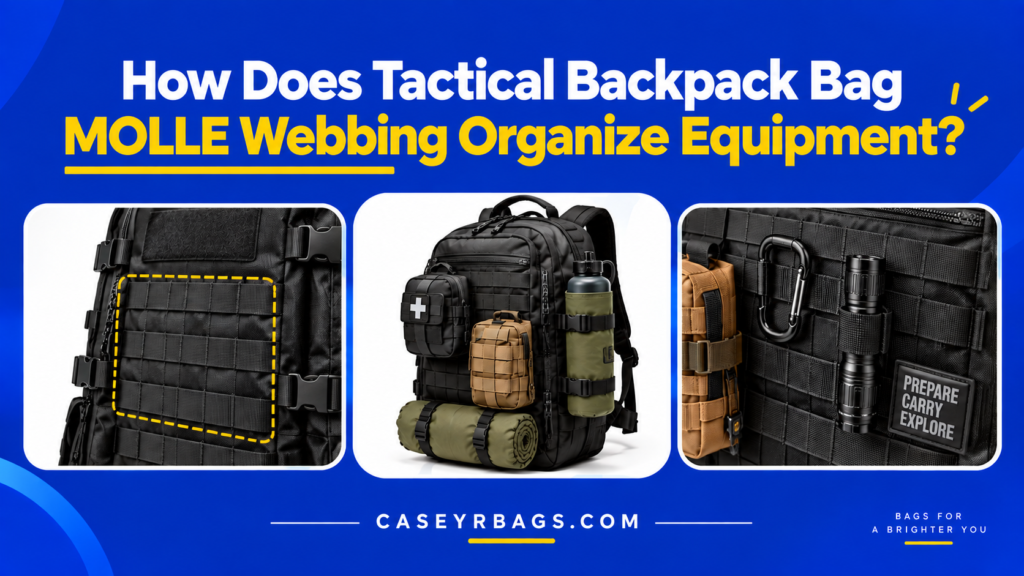
How Does Tactical Backpack Bag MOLLE Webbing Organize Equipment? Tactical Backpack Bag MOLLE webbing organizes equipment by providing a structured external attachment grid where compatible pouches, holders, and removable modules can be positioned according to function and access priority. The webbing does not organize equipment by itself; it creates repeatable mounting positions that allow the external storage layout to be configured. This system can separate equipment into dedicated external zones, make selected items easier to identify, and allow modules to be removed or repositioned as the carried set changes. Effective MOLLE organization still depends on secure attachment, sensible module placement, opening clearance, internal storage roles, and reasonable load balance. More attachment space or more pouches does not automatically create a better organization system. KEY TAKEAWAY MOLLE webbing is attachment architecture, not storage by itself. Organization comes from choosing compatible modules with clear roles, placing them where access and balance remain sensible, securing them against unnecessary movement, and removing modules that add bulk without solving a repeated need. MOLLE Organization Signal Key ATTACHMENT SIGNALWebbing provides repeatable mounting positions; attached modules create actual storage spaces. ACCESS SIGNALModule position reflects retrieval priority without blocking openings or fixed pockets. BALANCE SIGNALExternal modules remain secure and do not create unnecessary imbalance or depth. GRAY ZONEAttachment space is filled, but roles duplicate or expansion adds bulk without value. What Does MOLLE Webbing Do on a Tactical Backpack Bag? MOLLE-style organization begins with horizontal attachment rows arranged across selected areas of the Backpack. These rows create repeatable positions where compatible pouches, holders, or removable modules can connect, rather than functioning as storage compartments themselves. The organizational value comes from configuration. Instead of relying only on permanent pockets, external modules can be assigned to different zones and changed when the carried equipment changes. The broader Backpack Bag page places this external modular organization within balanced loading, load stability, compartment structure, and modular organization. The system works best when every attached module has one clear role. Filling unused webbing without a functional reason adds bulk and search complexity without necessarily improving organization. Available mounting space is optional architecture rather than storage that must always be occupied. What Is the Difference Between MOLLE Webbing and the Attached Pouch? MOLLE webbing provides attachment architecture, while the pouch, holder, or removable module provides the actual storage component. The webbing defines where compatible equipment can connect to the Backpack surface, but it does not hold contents directly in the way a pocket or compartment does. Attachment system + compatible storage module = configurable organization. This distinction prevents the grid itself from being mistaken for storage capacity. Organization begins only when a module with a clear role is attached in a position that supports access, retention, opening clearance, and the complete load layout. How Does the Webbing Grid Create Attachment Positions? The webbing grid creates attachment positions through horizontal rows with repeated intervals that allow compatible attachment interfaces to connect across a defined Backpack surface. The repeated structure gives modules more than one possible position instead of fixing every external storage role permanently. Grid → repeatable attachment position → compatible module. The concept is functional rather than instructional. The grid creates connection opportunities; module size, role, attachment security, and available surface determine which positions are actually useful for the intended organization. Why Does Webbing Coverage Not Equal Organization Quality? Webbing coverage does not equal organization quality because organization still depends on module choice, placement, retention, access priority, load balance, and actual use. A Backpack can have a large attachment field while using it poorly through duplicated pouches, blocked openings, or random storage roles. Available mounting space ≠ useful organization. More rows increase configuration options, but they also increase the number of possible poor placements. The practical measure is whether selected modules create clearer equipment zones and easier retrieval without adding unnecessary depth, imbalance, or search friction. MOLLE Webbing Organization Anatomy MOLLE Webbing Organization AnatomyThe webbing grid creates mounting architecture; attached modules create functional storage zones. MOLLE Webbing Organization Anatomy Attachment Grid → Compatible Module → Functional Equipment Zone ATTACHMENTGRIDCOMPATIBLEMODULEEQUIPMENTZONEPREDICTABLELOCATIONSELECTIVE CONFIGURATION CREATES ORGANIZATIONRole • access • retention • balance • reconfiguration value Figure 1.0:The webbing grid creates mounting architecture; attached modules create functional storage zones.CASEYRBAGS.COM • MOLLE organization system How Does MOLLE Webbing Create Equipment Zones? Attachment areas can divide external storage into purposeful front, side, or upper zones when each module has a distinct role and does not interfere with the rest of the Backpack. How Can Front, Side & Upper Attachment Zones Serve Different Roles? A front zone can support expandable external organization, side zones can support narrower accessory modules, and an upper area can support smaller accessible modules where the Backpack design permits. These positions are organizational zones rather than mandatory locations for specific equipment. Different surfaces change access, depth, balance, and opening clearance. A front module may increase total Backpack depth, while a side module can affect left-right balance. Zone choice should therefore follow the module’s role and load effect rather than filling whatever attachment area is available. Why Should Each Module Have One Clear Organizational Role? Each module should have one primary role because purposeful zoning reduces duplicated storage, random placement, unnecessary pouch opening, and repeated searching. When a pouch has a stable function, its contents become easier to identify and the external layout becomes more predictable. Module role → predictable location → faster identification. A module can hold several small items, but its organizational purpose should remain clear enough that the user knows why the pouch is attached and when it should be accessed. Ambiguous modules create extra search locations. When Does Adding More Zones Create Unnecessary Complexity? Adding more zones becomes excessive when roles overlap, too many small pouches divide similar contents, the same category appears in multiple places, or retrieval requires deciding among several nearly identical modules. Extra zones can increase visual clutter and organizational friction even when attachment space remains available. More zones ≠ clearer organization. Expansion is useful only when each new zone reduces