What Distinguishes Tactical Backpack Bag Organization?
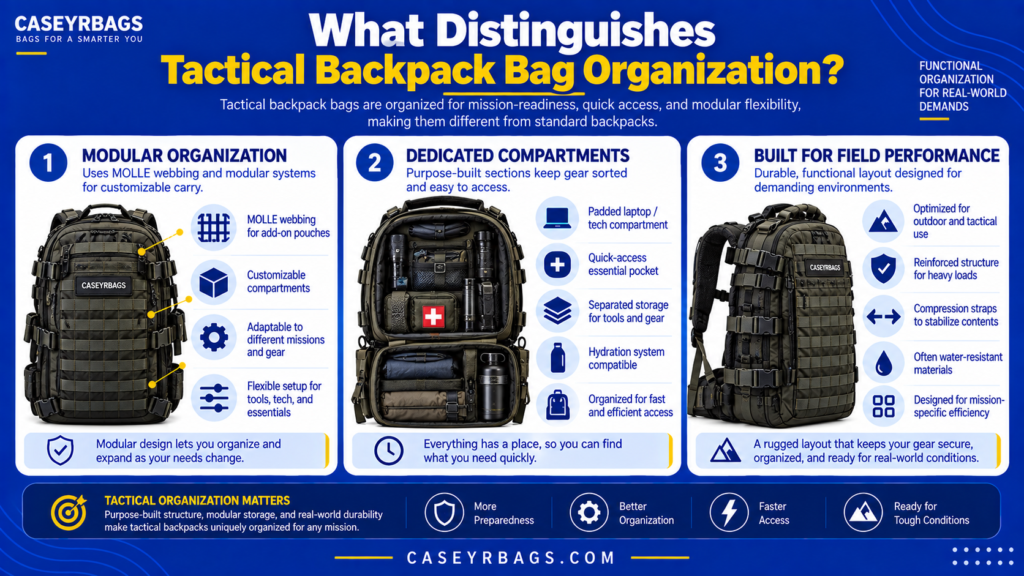
What Distinguishes Tactical Backpack Bag Organization? Tactical Backpack Bag organization is distinguished by purposeful storage zones, internal retention, and configurable attachment areas that allow the layout to adapt to changing item sets. Instead of relying on pocket quantity alone, the organization system combines main storage, admin-style separation, quick-access areas, sleeves, retention features, and modular zones with clearly different roles. Pocket count ≠ tactical organization, external attachment ≠ complete modular system, and modularity ≠ automatic access efficiency. Effective tactical-style organization depends on the relationship between zoning, retention, access priority, internal-versus-external storage, and load control. Added complexity is useful only when it solves a repeated storage or retrieval problem without creating unnecessary bulk, search friction, or left-right imbalance. KEY TAKEAWAY What distinguishes tactical-style organization is not maximum pocket count or rugged appearance. It is a coordinated architecture of functional storage zones, item retention, configurable attachment, access hierarchy, and load-aware placement that can adapt without sacrificing retrieval clarity or stability. Tactical Organization Architecture Key ZONING SIGNALMain, admin, quick-access, sleeve, and modular zones have distinct functional roles. RETENTION SIGNALStraps, sleeves, loops, or organizers control movement instead of merely separating items. MODULARITY SIGNALRemovable or repositionable storage solves actual changes in item sets or access needs. GRAY ZONEMore pockets or modules are present, but roles overlap, access slows, or external loading becomes unbalanced. What Defines Tactical Backpack Bag Organization? Tactical Backpack organization usually divides storage into functional zones rather than treating the interior as one undifferentiated space. Main compartments, admin-style organizer panels, internal sleeves, retention points, quick-access areas, and external attachment fields can each serve a different relationship between item size, access frequency, and load control. A distinguishing feature is configurability. Some storage remains fixed, while other zones may support removable organizers, compatible pouches, attachment fields, or repositionable components that can change when the item set changes. The broader Backpack Bag page places tactical organization within balanced loading, load stability, compartment structure, and modular organization. The system is therefore best understood as organization architecture rather than pocket count. Its effectiveness depends on whether fixed and modular features create predictable item positions, useful access priority, and stable load behavior without adding unnecessary duplication, bulk, or search decisions. Which Features Most Strongly Distinguish Tactical-Style Organization? Compartment zoning, admin-style organizer panels, internal retention straps, modular attachment fields, removable organizers, quick-access zones, and external expansion points are the strongest distinguishing features. Each feature should perform a clear storage function rather than exist only as a visual cue or extra pocket. Feature → organization function → practical distinction. A sleeve creates a defined position, a retention strap restricts movement, a quick-access zone reduces retrieval steps, and a modular field allows compatible storage to be repositioned or removed. Tactical-style organization emerges from how these functions connect, not from maximum feature count. How Is Organization Architecture Different From Having Many Pockets? Many pockets describe the quantity of storage spaces, while organization architecture describes the relationship between zones, access priority, retention, and adaptability. Ten pockets with unclear roles can create more search decisions than a smaller number of zones designed around specific storage functions. More pockets ≠ more organized system. Useful architecture tells the user where broad categories of items belong, how securely they should remain positioned, and how quickly they should be retrievable. Pocket count becomes meaningful only when those storage spaces support the overall layout rather than fragment it unnecessarily. Why Is Configurability a Defining Tactical Characteristic? Configurability matters because changing item sets may require different modules, different pocket assignments, added or removed external storage, or reconfigured internal zones. A tactical-style system can adjust those relationships without requiring the entire Backpack layout to remain permanently fixed. Adaptable storage becomes meaningful when the carried load changes repeatedly. If the same everyday items remain consistent, fixed organization may be simpler and faster. Configurability is therefore a functional advantage only when changing storage roles or module positions solves a repeated organization need. Tactical Backpack Organization Anatomy SVG Tactical Backpack organization anatomy Diagram showing fixed organization and configurable organization including main compartment, admin zone, internal sleeve, retention strap, quick-access pocket, modular attachment field, side attachment zone, and removable organizer. Tactical Backpack Organization Anatomy Fixed Organization + Configurable Organization → Predictable Storage Architecture FIXED ORGANIZATION MAIN COMPARTMENT ADMIN ZONE INTERNAL SLEEVE QUICK-ACCESSPOCKET RETENTION STRAP • Predictable Item Position CONFIGURABLE ORGANIZATION MODULARATTACHMENT FIELD REMOVABLEORGANIZER SIDE ATTACHMENTZONE REPOSITIONABLESTORAGE Figure 1.0: Tactical organization combines fixed storage roles with configurable storage where adaptation is useful. CASEYRBAGS.COM • Tactical organization anatomy How Does Compartment Zoning Distinguish Tactical Backpack Organization? Compartment zoning distinguishes tactical-style organization by dividing storage according to item role, access frequency, and load behavior rather than by pocket quantity alone. How Do Primary and Secondary Storage Zones Differ? A primary zone usually handles larger or central storage, while secondary zones handle smaller organized items that benefit from separation. A quick-access zone serves a different function again by prioritizing easier retrieval over deep storage or maximum capacity. Primary zone → larger or central storage; secondary zone → smaller organized items; quick-access zone → frequently retrieved items. These categories are functional rather than prescriptive. The important distinction is that each zone has a clear role that reduces search effort and supports predictable item placement. What Role Does an Admin-Style Organizer Panel Serve? An admin-style organizer panel separates small accessories, electronics, writing tools, cables, documents, and other general-purpose items that would otherwise collect in one pocket or move freely through a larger compartment. The panel creates multiple defined positions within one broader access zone. The defining value is predictable small-item placement. The organizer should reduce retrieval friction and prevent loose-item movement without creating so many subdivisions that the user has to search multiple nearly identical pockets. Its usefulness depends on role clarity, not visual complexity. Why Should Compartment Count Remain Proportional to the Actual Load? Too many compartments can waste volume, slow retrieval, force items into rigid positions, create forgotten storage zones, and reduce flexibility for bulky contents. Subdivision is useful only when the normal item set actually benefits from separate storage
How Does Backpack Bag Structure Change With Heavier Loads?
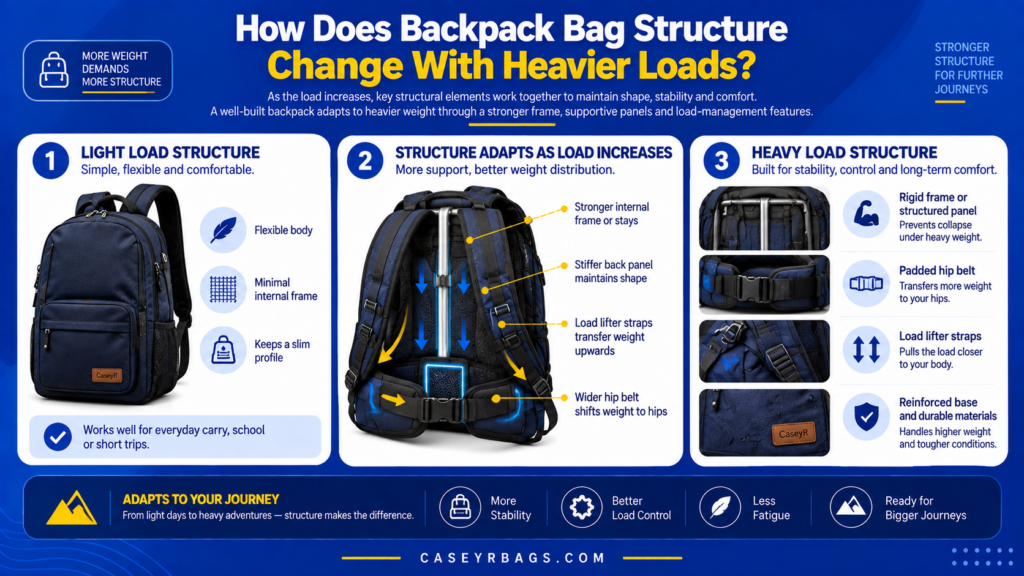
How Does Backpack Bag Structure Change With Heavier Loads? As a Backpack Bag carries a heavier load, its body panels, seams, strap anchors, base, compartments, and any framing system experience greater structural demand. The bag may sag more, stretch at attachment points, change shape, or rely more heavily on reinforcement and frame structure to keep the load controlled. Some of those changes can remain controlled, while others become progressive warning signs. Heavier load ≠ automatic overload, structural deformation ≠ structural failure, and load response ≠ verified safe load capacity. The important question is whether the whole Backpack continues to manage the added demand without worsening distortion, concentrated stress, loss of compartment shape, unstable movement, or damage at structural connections. KEY TAKEAWAY A heavier load increases demand across the complete Backpack structure. Controlled sag, tension, or shape change can occur without failure, but progressive deformation, seam opening, anchor distortion, frame displacement, or loss of load control should trigger reassessment or load reduction. Heavy-Load Structural Response Key CONTROLLED RESPONSEShape change remains limited, repeatable, and stable under the intended heavier load. CONNECTION SIGNALSeams and strap anchors stay intact without progressive pulling, separation, or distortion. LOAD-CONTROL SIGNALThe base, framing, compartments, and bag position remain functionally controlled. REASSESSMENT SIGNALDistortion, sag, tilt, or stress becomes progressively worse as load demand rises. What Changes in a Backpack Bag as the Load Becomes Heavier? A heavier Backpack Bag places greater tension and pressure on the structural path connecting the contents, base, body panels, seams, strap anchors, and shoulder straps. The structure must resist this demand while maintaining a usable bag shape and keeping the load sufficiently controlled during normal movement. Some structural change can be normal. Flexible fabrics may stretch slightly, soft bases may sag, and compartments may become more defined around the contents without indicating failure. The broader Backpack Bag page places this heavier-load response within balanced loading, load stability, compartment structure, and modular organization. The key issue is whether those changes remain controlled and stable or become progressively excessive. Repeated distortion, seam opening, anchor pulling, uncontrolled base sagging, frame displacement, or loss of bag shape can indicate that the load and construction are no longer working together predictably. Which Backpack Components Respond First to Increasing Load? The first structural responses usually appear in the zones that directly receive or transfer load: the base panel, shoulder-strap anchors, lower anchors, load-bearing seams, body panels, back panel, frame structure, and compartment walls. As load increases, each zone experiences more pressure, tension, bending, or shape demand according to its role. Higher load → greater structural demand → visible or functional response. The base may sag more, panels may tighten or bulge, seams may carry greater tension, anchors may pull harder against surrounding material, and compartments may become more compressed. No single component proves whole-bag capacity because the entire structural path must continue functioning together. Which Structural Changes Can Occur Without Immediate Failure? Modest fabric tension, controlled base sag, predictable bag expansion, compartment shaping, and increased strap tension can occur as load rises without proving immediate structural failure. Flexible Backpack bodies are expected to respond to pressure, and some visible shape change may simply reflect the material and construction adapting to the contents. Structural change does not automatically mean structural failure. The more useful distinction is whether the response remains limited, stable, and repeatable. A soft base that sags slightly but stays controlled is different from sag that grows progressively, shifts the load, pulls seams apart, or changes the bag’s ability to remain structurally stable. When Does Deformation Become a Warning Sign? Deformation becomes more concerning when it grows progressively or changes the Backpack’s function. Increasing left-right asymmetry, permanent panel distortion, seam separation, elongated stitch holes, anchor lifting, severe base sag, frame bending, or repeated one-sided collapse indicate that structural demand is no longer producing a simple controlled response. Progressive deformation → reassess load and construction fit. One isolated cosmetic change is less meaningful than a worsening pattern that appears again under repeated loading. The goal is not to predict an exact failure point but to recognize when the Backpack’s structure is losing shape control, connection integrity, or load stability. Backpack Load → Structural Response SVG Backpack load to structural response Increasing load creates base pressure, panel tension, seam stress, anchor tension and frame demand, producing controlled or excessive structural response. Backpack Load → Structural Response Increasing Load → Structural Demand → Controlled or Excessive Response INCREASING LOADGreater structural demand STRUCTURAL DEMANDBase PressurePanel TensionSeam / Anchor Stress STRUCTURAL RESPONSEFrame DemandShape RetentionDeformation CONTROLLED DEFORMATIONStable / predictable EXCESSIVE DEFORMATIONProgressive / unstable WHOLE-BAG STRUCTURAL FITPanels + seams + anchors + base + frame + compartments Figure 1.0: A heavier load increases demand across the complete Backpack structure, not one component alone. CASEYRBAGS.COM • Heavy-load structural response How Does the Backpack Body Change Under Heavier Loads? Body panels and overall bag geometry respond to increased internal pressure through stretching, bulging, sagging, side expansion, or changes in bag depth. How Does Heavier Loading Change Bag-Body Shape? Heavier loading can increase panel tension, outward bulging, vertical sagging, sidewall expansion, and overall bag depth. Flexible materials often conform more closely around dense contents, while structured panels resist that shape change more strongly until the surrounding construction reaches greater demand. Load pressure → panel deformation → changed bag geometry. The response becomes more important when it moves the load center, changes the bag centerline, collapses nearby compartments, or increases tension at seams and anchors. Shape change should therefore be judged by its effect on structural control rather than appearance alone. Why Do Flexible and Structured Backpacks Respond Differently? A flexible body conforms more around the contents, while a structured body resists shape change more strongly. Flexible construction may show visible bulging or sag earlier, whereas stiffer panels can retain geometry longer but still transfer structural demand into seams, anchors, frames, and other connections. Neither response is universally superior. A flexible Backpack can remain functionally controlled even with visible deformation, and a rigid-looking Backpack can still experience significant hidden
When Does Backpack Bag Framing Improve Load Control?
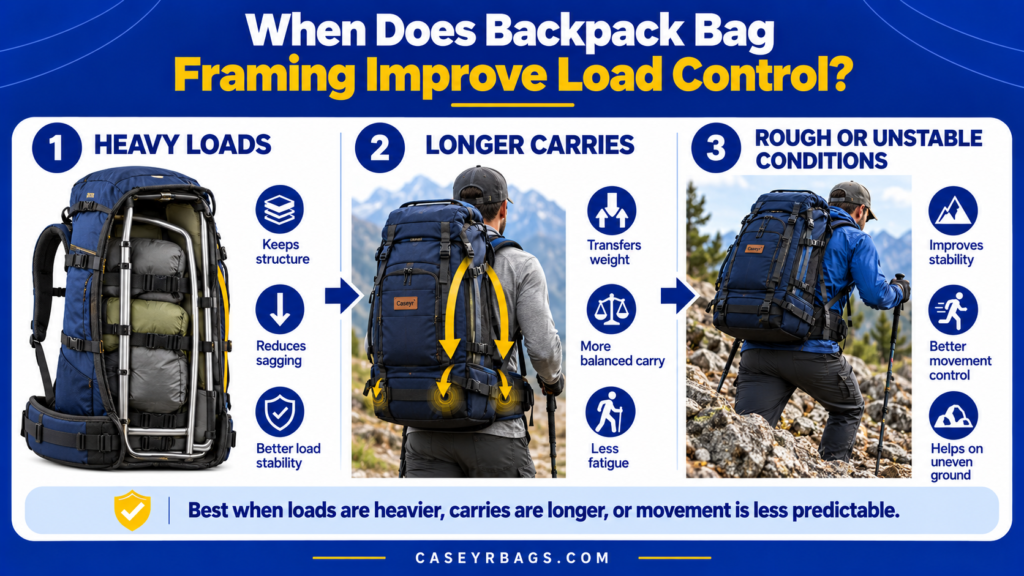
When Does Backpack Bag Framing Improve Load Control? Backpack Bag framing improves load control when added structural support helps the bag maintain a more stable form, resist unwanted deformation, and keep the relationship between the Backpack body and its normal load more predictable during movement. Framing becomes relevant when soft structure repeatedly collapses, folds, shifts, or changes shape enough to disturb load position or rear-panel stability. Framing ≠ higher safe load capacity, structural stability ≠ weight reduction, and framing ≠ automatic load balance. Its value still depends on internal load position, stable contents, Backpack design, back-panel structure, strap support, and normal carrying conditions. Framing should solve a real structural-control problem rather than compensate for strongly off-center contents, loose items, poor adjustment, or an unusual maximum load that does not represent everyday use. KEY TAKEAWAY Backpack framing is useful when it provides observable structural control under the normal load—helping the bag resist repeated deformation, retain a stable rear structure, and keep load position more predictable. More rigidity is not automatically better, and framing cannot replace stable internal loading. Backpack Framing Control Signal Key STRUCTURE SIGNALThe loaded bag retains a controlled form instead of repeatedly collapsing or folding. LOAD SIGNALDense contents remain controlled enough for structural support to work predictably. MOVEMENT SIGNALThe bag position remains more stable during normal walking and directional changes. GRAY ZONEExtra rigidity is present, but poor item placement or adjustment remains the real source of instability. What Does Framing Do in a Backpack Bag? Backpack framing adds structural support to the bag body so the Backpack can resist unwanted deformation and retain a more predictable form under its normal load. The support may stabilize the rear structure, main load zone, side shape, or other structural areas that would otherwise fold, collapse, or change position as pressure increases. Structure affects the relationship between the contents and the bag body. When the bag retains useful shape, load position can remain more consistent, internal pressure is distributed through a more stable structure, and movement becomes easier to interpret. The broader Backpack Bag page places framing within balanced loading, load stability, compartment structure, and modular organization. Framing supports the bag structure; it does not automatically balance the contents. An off-center dense item, overloaded side storage, shifting contents, or poor strap adjustment can still create asymmetry even when the Backpack remains rigid. Useful framing therefore works with controlled loading and normal adjustment rather than replacing them. How Does Framing Support Backpack Structure? Framing supports Backpack structure by resisting excessive folding, collapse, or shape change when the normal load places pressure on the bag body. The frame or structural support helps the Backpack maintain a more defined relationship between the rear structure, main load zone, sides, and base instead of allowing those areas to deform freely. Backpack load → structural demand → framing support → controlled bag form. The purpose is structural control, not unlimited strength. A framed Backpack can still deform under unsuitable loading, and framing does not establish a universal safe capacity. Its value is whether the structure remains more predictable under the load the bag normally carries. How Does Framing Help Maintain Bag Shape? Framing helps maintain bag shape by supporting shape retention around the rear panel, main load zone, and structural sides. When these areas keep a more consistent form, dense items are less likely to force the bag into repeated folds or bulges that move the effective load position during normal carrying. More stable bag form → more predictable load relationship. Shape retention does not mean the bag must remain perfectly rigid or unchanged. Controlled flexibility can still be functional. The important question is whether the normal load causes enough deformation to make bag position, internal support, or movement noticeably less predictable. Why Does Framing Not Automatically Balance the Load? Framing does not automatically balance the load because stable structure and balanced contents are different conditions. Off-center dense items, overloaded side storage, uneven compartment loading, or shifting contents can create asymmetric pressure inside a Backpack even when the frame prevents the bag body from collapsing. Stable structure ≠ balanced contents. Framing can make the bag body resist deformation while the internal load remains strongly offset. That means one side can still experience more structural demand, the bag can still tilt, and the strap system can still receive uneven load behavior. Internal balance must therefore be checked separately. Backpack Framing Load-Control SVG Backpack framing load-control sequence Internal load transfers structural demand into the Backpack body, where framing support helps shape control and load-position stability. Backpack Framing Load Control Internal Load → Backpack Structure → Framing Support → Shape Control → Load-Position Stability INTERNAL LOADMain Load Zone BAG BODYLeft / Right Sides FRAMINGSUPPORTStructural Support SHAPE CONTROLBack Panel LOAD-POSITIONSTABILITY LOAD DIRECTION + STRUCTURAL RESPONSEControl depends on both stable contents and appropriate structure Figure 1.0: Framing helps control the structural relationship between the Backpack body and its normal load. CASEYRBAGS.COM • Backpack framing load control When Does Backpack Structure Need More Load Control? Additional structural control becomes useful when the Backpack’s normal load repeatedly changes the bag’s form or position enough to reduce predictable load stability. When Does Bag-Body Deformation Become Relevant? Bag-body deformation becomes relevant when the normal load repeatedly causes the Backpack to collapse, fold around dense contents, sag strongly, lose useful rear-panel shape, or change position during movement. The key signal is not minor flexibility but repeated structural change that makes the load relationship less predictable. No universal deformation threshold is needed. The practical question is whether the shape change interferes with stable load position, bag centerline, or movement control during ordinary use. A flexible bag can remain functional when its normal load stays controlled, while a visibly rigid bag can still perform poorly if the contents are unstable. How Can Load Movement Expose Structural Weakness? Load movement can expose structural weakness because shifting contents repeatedly change where pressure is applied to the bag body. A loose dense item may push against different panels as the Backpack moves, causing
Why Does a Backpack Bag Use Two Shoulder Straps?
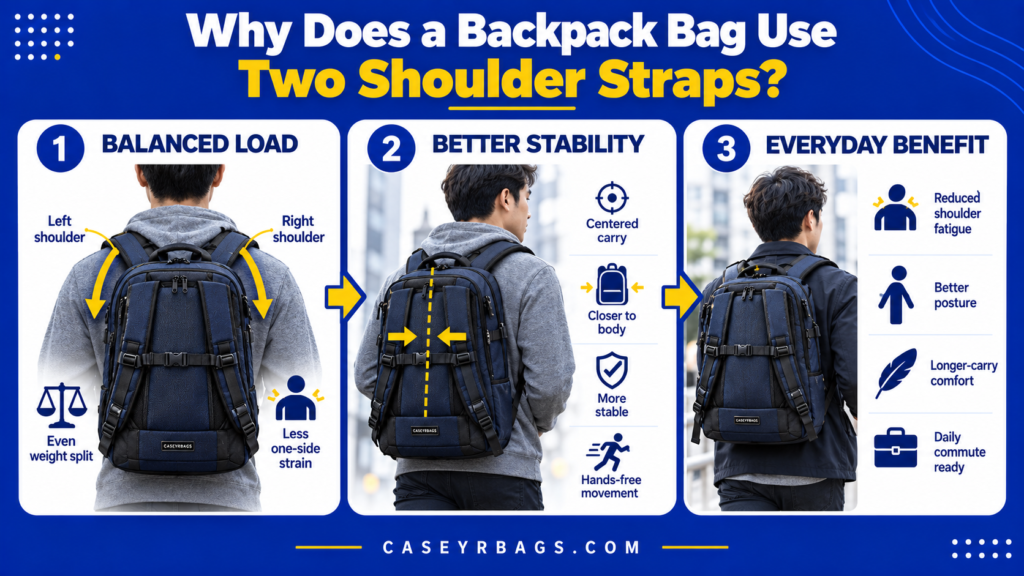
Why Does a Backpack Bag Use Two Shoulder Straps? A Backpack Bag uses two shoulder straps to create two primary support paths between the loaded bag and the carrying surface. The left and right straps connect through upper and lower anchors, helping the Backpack remain more centrally positioned while both sides participate in supporting and controlling the normal load during walking, commuting, and other routine movement. Two support paths ≠ guaranteed equal loading, weight distribution ≠ weight reduction, and two straps ≠ unlimited load capacity. Actual left-right support still depends on strap adjustment, anchor geometry, bag position, side-pocket loading, internal load placement, and whether contents remain stable. The two straps work as one connected carrying system, not as two independent full-load systems, and their effectiveness depends on the loaded Backpack behaving predictably as a whole. KEY TAKEAWAY Two shoulder straps give a Backpack two connected support paths, improving its potential for centered load control, stability, and hands-free carry. They do not guarantee equal loading, reduce total weight, or correct a strongly unbalanced internal load automatically. Backpack Two-Strap Carry Signal Key TWO-PATH SIGNALLeft and right straps are both active parts of one support system. POSITION SIGNALThe bag remains reasonably centered without persistent one-sided pull. LOAD SIGNALInternal contents remain controlled so strap demand stays predictable. GRAY ZONEBoth straps are used, but bag tilt, loose contents, or unequal adjustment still create asymmetry. What Do Two Shoulder Straps Do in a Backpack Bag? Two shoulder straps create a left support path and a right support path from the Backpack. Each path begins at an upper anchor, continues through a shoulder strap, and returns through a lower anchor, while the bag body links both sides into one connected structure. Shared support depends on more than having two visible straps. Internal load position, strap adjustment, anchor position, bag tilt, and external pocket loading can change how much demand reaches each side. The broader Backpack Bag page places this paired strap system within balanced loading, load stability, compartment structure, and modular organization. The two-strap system also helps control bag position and side-to-side movement. When both straps are active and the internal load remains stable, the Backpack has greater potential to stay near its intended centerline during normal movement. That stability improves carrying predictability without implying perfectly equal forces, lighter total weight, or unlimited load capacity. How Do Two Shoulder Straps Create Two Load Paths? Two shoulder straps create separate left and right routes through which the loaded Backpack can transfer carrying demand. Each route combines an upper anchor, shoulder strap, adjustment hardware, lower anchor, and the bag body that connects the two sides. The paths operate simultaneously when both straps are used as intended. Loaded Backpack → Left Strap Path + Right Strap Path → Shared Support. The two straps form connected support paths within one Backpack system; they are not two independent systems each carrying the entire load. Actual demand still depends on internal load position, bag movement, and adjustment, so two paths create balanced potential rather than guaranteed equality. Why Does a Backpack Benefit From Left-Right Support? A Backpack benefits from left-right support because two active paths can restrain the bag from both sides instead of letting the normal load depend mainly on one shoulder. This two-sided relationship helps control lateral movement, bag tilt, shifting position, and repeated rotation during routine carrying. Left-right support is mechanical rather than medical. It improves the Backpack’s potential to remain centered when the contents and adjustment are also reasonably balanced. If one side pocket becomes heavy or a dense item shifts laterally, the bag can still pull off-center despite both straps being active, so two-sided support works best when the load itself remains controlled. Why Do Two Straps Not Automatically Divide Weight Equally? Two straps do not automatically divide weight equally because each support path responds to the actual loaded bag. Off-center contents, uneven strap adjustment, side-pocket loading, bag-body asymmetry, shifting objects, or changing bag angle can alter the demand reaching the left and right sides even when the straps look symmetrical. Two straps create two support paths, not guaranteed 50/50 loading. Symmetrical-looking straps do not guarantee symmetrical forces. A more level bag position can improve the opportunity for comparable demand, but actual sharing remains dependent on internal load position and movement, so equal strap count should never be treated as proof that the load is already balanced. Two-Strap Backpack Load-Path SVG Two-Strap Backpack Load PathBackpack Load → Left Support Path + Right Support Path → Shared SupportBACKPACK LOADINTERNAL LOADBAG CENTERLINELEFT UPPER ANCHORRIGHT UPPER ANCHORLEFT SHOULDER STRAPRIGHT SHOULDER STRAPLOWER ANCHORLOWER ANCHORLOAD DIRECTIONFigure 1.0:Two shoulder straps form connected left and right support paths within one Backpack system.CASEYRBAGS.COM • Two-strap Backpack load path How Do Two Shoulder Straps Share Backpack Load? Two shoulder straps can share Backpack carrying demand across left and right support paths, but the actual share depends on the loaded bag rather than strap count alone. What Determines How Much Load Each Strap Supports? The amount of demand reaching each strap depends on internal load position, strap adjustment, anchor symmetry, bag tilt, external pocket loading, and the geometry formed by the bag body and both support paths. These factors determine how the loaded Backpack presents force to the left and right sides. Load position + strap geometry → left/right strap demand. Neither strap should be described as independently carrying the entire Backpack load because both paths remain connected through the same bag body. A strongly offset internal load can increase demand on one side even when the anchor layout and strap lengths appear symmetrical. How Does Centered Loading Support More Even Strap Demand? Centered stable contents help keep the Backpack’s load center closer to the bag centerline, creating a greater opportunity for the left and right strap paths to experience comparable demand. This does not require perfect numerical symmetry, but it does require avoiding strong lateral concentration of dense items. Centered stable contents → more symmetrical bag position → greater opportunity for comparable strap loading. The two
How Does Backpack Bag Strap Geometry Distribute Weight?
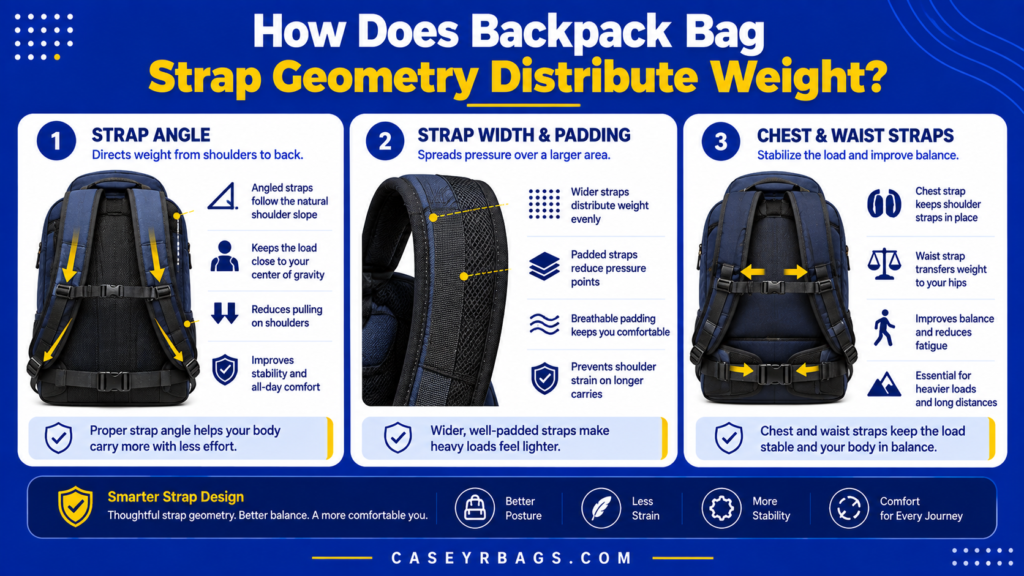
How Does Backpack Bag Strap Geometry Distribute Weight? Backpack Bag strap geometry distributes weight by transferring load from the bag body through upper and lower anchors into two shoulder-strap paths whose spacing, angle, width, adjustment, and position influence how the load is supported. The strap system works together with the back panel, bag position, contact area, and internal load placement rather than functioning as an isolated pair of straps. Symmetrical straps ≠ automatically symmetrical loading, strap geometry ≠ total load capacity, and load distribution ≠ load reduction. Geometry changes how force moves through the system, while an off-center dense item, unequal adjustment, bag tilt, side-pocket loading, or moving contents can still change left-right strap demand. The complete Backpack system must therefore be evaluated through its anchors, strap path, adjustment, bag position, and internal load relationship. KEY TAKEAWAY Backpack strap geometry controls how load is transferred, not how much total load exists. Upper and lower anchors, spacing, angle, width, adjustment, bag position, and internal load placement must work together for stable left-right support. Backpack Strap-Geometry Signal Key ANCHOR SIGNALUpper and lower anchors create coherent left-right strap paths. GEOMETRY SIGNALSpacing and angle support predictable force direction without relying on one universal ideal. ADJUSTMENT SIGNALBoth sides refine bag position without compensating for major internal imbalance. GRAY ZONEVisual symmetry exists, but bag tilt, content offset, or movement still changes strap demand. What Does Strap Geometry Mean for Backpack Bag Weight Distribution? Backpack strap geometry describes the connected arrangement of upper anchors, lower anchors, shoulder straps, spacing, angle, width, and adjustment that creates the load-transfer paths between the bag body and the carrying surface. The loaded bag first transfers force into attachment points before that force continues through the straps. The left and right strap paths provide two support routes, but they may not carry identical demand. Internal load placement, bag tilt, side-pocket loading, unequal adjustment, and moving contents can make one side work harder. The Backpack Bag explains how this strap system fits within balanced loading and modular organization. Straps can support and stabilize the load, but they cannot make an internally unbalanced load disappear. Geometry determines force direction and contact; it does not reduce total Backpack weight. Reliable evaluation therefore combines anchor placement, strap path, bag position, adjustment, and internal load instead of treating visible symmetry as a complete explanation. Which Strap Components Directly Control the Backpack Load Path? Upper anchors, lower anchors, the shoulder straps, adjustment hardware, attachment width, and the back-panel connection directly shape the Backpack load path. Upper anchors determine where load enters the strap system near the bag body, while lower anchors help define the return path and the angle through which the straps control the lower part of the bag. Component → force-transfer role → distribution consequence. Adjustment hardware changes effective strap length, attachment width affects how force enters the panel, and the back-panel connection influences the position from which the bag is supported. No component should be judged alone because each one changes the geometry available to the next part of the path. How Does Backpack Weight Move Through the Strap System? Backpack weight moves from the loaded bag body into the strap anchors, through strap tension, across the contact area, and into the supported carrying system. The bag body, straps, and back contact therefore act as one mechanical relationship rather than as separate parts with independent load behavior. Loaded bag body → strap anchors → strap tension → contact area → supported load. A change in one part can alter the rest of the path: shifting contents can change bag balance, bag balance can change strap tension, and strap tension can change contact distribution. This sequence describes load transfer, not load reduction, because the total Backpack load still remains within the system. Why Do Two Straps Not Automatically Carry Equal Weight? Two straps do not automatically carry equal weight because the left and right support paths respond to the actual bag position and internal load, not merely to visual symmetry. Uneven contents, unequal adjustment, bag tilt, asymmetric anchor placement, one-sided external pockets, or changing load movement can make one strap experience more demand than the other. Two straps create two support paths, not guaranteed 50/50 loading. A symmetrical strap pair can still receive asymmetric force when the bag itself is unbalanced. For the related question of why a Backpack uses a paired support system in the first place, see Shoulder Straps. Backpack Strap Load-Path SVG Backpack strap load pathRear-facing Backpack showing bag load, left and right upper anchors, left and right straps, lower anchors, back panel, and load direction.Backpack Strap Load PathBag Load → Anchors → Straps → Supported LoadBAG LOADLEFT UPPER ANCHORRIGHT UPPER ANCHORLEFT STRAPRIGHT STRAPLOWER ANCHORSLOWER ANCHORSBACK PANELLOAD DIRECTIONFigure 1.0:The Backpack load transfers through anchors into two strap paths and contact areas.CASEYRBAGS.COM • Backpack strap load path How Does Strap Anchor Placement Affect Weight Distribution? Upper and lower strap anchors define the endpoints of the Backpack strap path, so their placement influences strap direction, bag position, and how load transfers into the two shoulder straps. How Do Upper Strap Anchors Influence the Load Path? Upper strap anchors influence the load path through their spacing, height, integration with the bag body, and left-right symmetry. Their position determines where tension leaves the upper Backpack structure and begins traveling through each shoulder strap, so even small design differences can alter strap direction before the load reaches the contact region. Upper anchor position → strap direction → upper load transfer. The useful question is not whether anchors are simply wide or narrow but whether both sides form coherent paths with the bag body and lower anchors. A strong-looking anchor does not by itself prove balanced loading when the internal load or opposite strap path remains asymmetric. How Do Lower Anchors Affect Bag Position & Stability? Lower anchors affect bag position because they define the lower endpoint from which each strap returns to the Backpack body. Their position influences strap angle, lower-bag control, adjustment range, and how closely
How Does a Backpack Bag Support Balanced Loading & Modular Organization?
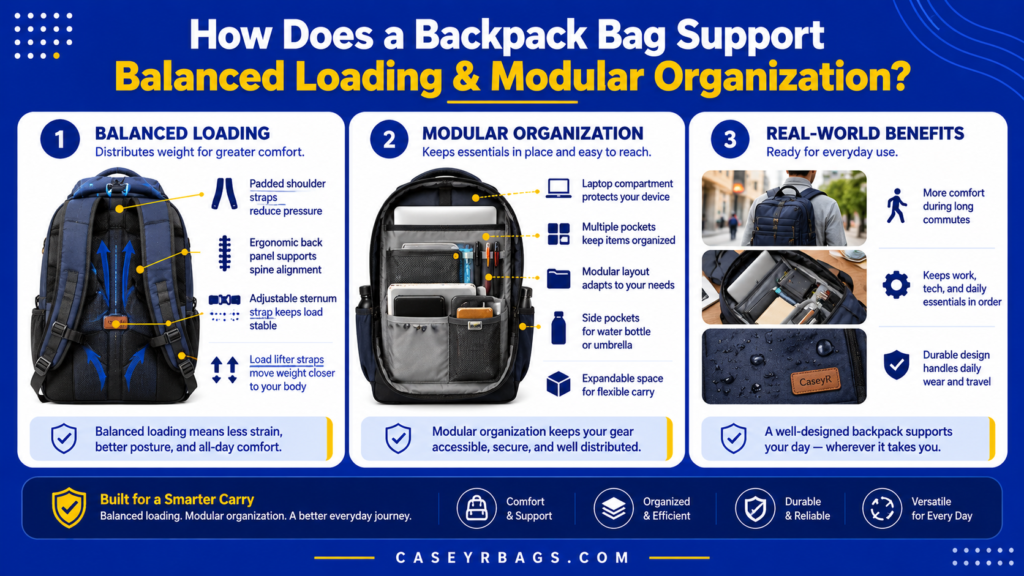
How Does a Backpack Bag Support Balanced Loading & Modular Organization? A Backpack Bag supports balanced loading by combining two-strap carry with stable item placement, while modular organization allows storage zones to adapt when the carried item set changes without unnecessarily destabilizing the load. Shoulder straps, back-panel position, compartment layout, internal dividers, dense-item placement, side storage, adaptable organizers, and access zones all influence whether daily contents remain reasonably controlled during normal use. Two-strap carry ≠ automatically balanced loading, and more compartments ≠ modular organization. Balanced loading depends on carry structure plus content placement, while useful modular organization depends on adaptable storage plus controlled item position. The strongest layout keeps dense items stable, limits one-sided loading, controls loose contents, preserves frequent access, and changes storage boundaries only when the actual item set changes often enough to justify that added flexibility. KEY TAKEAWAY A Backpack Bag balances everyday loads best when two-strap support, controlled back-panel position, dense-item placement, and compartment layout work together. Modular organization adds value only when adaptable storage changes without allowing organizers, pockets, or dense contents to destabilize the load. Backpack Layout-Fit Signal Key LOAD-BALANCE SIGNALDense items remain controlled and left-right loading stays reasonably even. STRUCTURAL SIGNALStraps, back panel, and structure keep the bag from moving unpredictably. MODULARITY SIGNALStorage adapts to changing item groups without creating uncontrolled movement. GRAY ZONEThe layout looks organized, but pocket loading or organizer movement still creates instability. What Do Balanced Loading & Modular Organization Mean in a Backpack Bag? Balanced loading means keeping a Backpack’s contents reasonably stable and free from strong one-sided pull while both shoulder straps support the bag. Two straps can share carrying force, but internal balance still depends on dense-item position, content movement, and whether one side pocket or compartment becomes disproportionately loaded. Modular organization means the storage layout can adapt when item combinations change. Adjustable dividers, removable organizers, flexible main compartments, dedicated sleeves, and attachment zones can change storage boundaries without requiring one permanently fixed arrangement. The broader Everyday context places this Backpack deep dive within carry. Organization should help control the load rather than create new imbalance. A useful layout keeps dense items stable, separates frequent-access items, limits uncontrolled movement, and adds modularity only where changing contents justify it. A highly divided interior can still be a weak fit when storage zones force weight to one side or complicate retrieval. Which Backpack Features Directly Affect Balanced Loading? Balanced loading is influenced by two shoulder straps, strap anchor positions, the back panel, main-compartment depth, base shape, dividers, side pockets, and retention or compression features where present. These parts determine how the bag sits, how contents are contained, and whether dense items remain close to the main support zone during ordinary movement. Structural feature → load behavior → balance consequence. A centered main compartment can support predictable placement, while a heavily loaded side pocket can create lateral offset. Straps can share carrying force, but internal position and movement still determine whether the load behaves symmetrically. No single structural feature guarantees balance by itself, so the loaded bag should be evaluated as one connected support system. Which Features Create Modular Organization? Modular organization can come from removable dividers, adjustable compartments, organizer panels, attachment loops, modular pouches, flexible main storage, and dedicated sleeves that can be reassigned as contents change. The defining feature is not the number of pockets but whether storage boundaries or item groups can change meaningfully while the items remain controlled. Organization feature → storage adaptability → practical consequence. A removable divider can reshape one compartment, an organizer can move a group of accessories together, and an attachment zone can add a dedicated module when required. Modularity remains useful only when the changed layout stays secure, preserves access, and does not introduce uncontrolled shifting or one-sided loading. Why Does One Backpack Layout Not Work for Every Load? One Backpack layout does not work for every load because item size, density, access frequency, electronics, documents, personal items, and daily changes create different spatial relationships. A layout that works well for flat work items may be inefficient for irregular accessories, denser equipment, or a mixed load that changes between different parts of the day. Different load patterns → different organization needs. The strongest layout matches actual contents rather than forcing every item into the same fixed positions. When contents remain predictable, fixed storage can be efficient; when item groups change frequently, adaptable zones can provide greater value if they remain stable and do not reduce the useful load-control function of the interior. Backpack Balanced Loading & Organization SVG Backpack balanced loading and modular organization Diagram labeling left strap, right strap, main load zone, dense item zone, modular organizer, quick-access zone, side storage and back panel, with arrows for load placement to balance and organization layout to load control. Backpack Balanced Loading & Organization Load placement and organization should reinforce the same stable layout LEFT STRAP RIGHT STRAP BACK PANEL MAIN LOAD ZONE DENSE ITEM ZONE MODULAR ORGANIZER QUICK-ACCESS ZONE SIDE STORAGE SIDE STORAGE LOAD PLACEMENT → BALANCE ORGANIZATION LAYOUT → LOAD CONTROL Figure 1.0: Carry structure and internal organization must support the same stable load. CASEYRBAGS.COM • Backpack balanced loading & modular organization How Does Backpack Structure Support Balanced Loading? Backpack structure supports balanced loading by combining two shoulder straps, controlled bag positioning, and internal structure that keeps the load from moving unpredictably during normal use. How Do Two Shoulder Straps Support Load Distribution? Two shoulder straps create the potential for shared support because the Backpack load can be carried through both the left and right strap paths instead of relying on one side. That support works best when both straps are used, adjustment is reasonably even, and the contents are not strongly offset to one side. Backpack load → left strap + right strap → shared support. Two straps provide symmetrical support potential, not automatic load balance. Internal contents, side-pocket loading, strap adjustment, and bag deformation still influence actual behavior. For the narrower carry-system mechanism, see Shoulder Straps. How