When Does a Utility Tote Bag Need Reinforced Seams or a Water-Resistant Base?
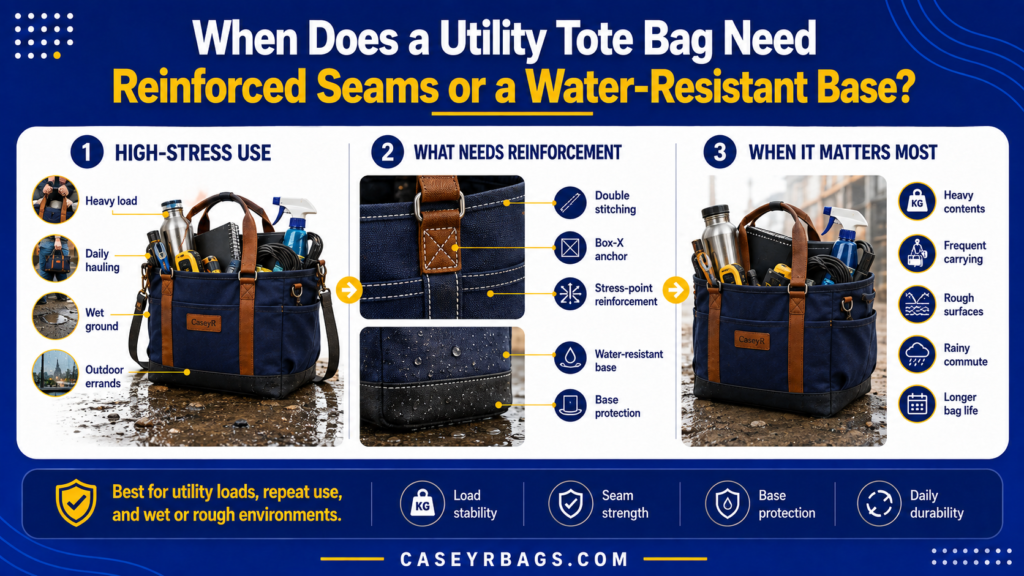
When Does a Utility Tote Bag Need Reinforced Seams or a Water-Resistant Base? A Utility Tote Bag needs reinforced seams when repeated carrying creates meaningful structural stress along load-bearing connections, while a water-resistant base becomes more useful when repeated floor contact exposes the lower bag to moisture or similar environmental wear. Seam stress usually develops around handle anchors, side seams, gussets, and base seams, whereas base-protection demand comes from damp floors, wet ground, spills, rough surfaces, and repeated set-down contact. Structural reinforcement ≠ moisture protection, and a water-resistant base ≠ a waterproof bag. Some Utility Totes need reinforced seams only, some need localized base protection only, some need both, and lower-demand routines may need neither. The correct decision depends on the actual failure mechanism: recurring load tension should lead to structural reinforcement decisions, while repeated moisture or abrasion exposure should lead to lower-bag protection decisions. KEY TAKEAWAY Reinforced seams answer structural load demand; a water-resistant base answers localized lower-bag moisture exposure. A Utility Tote needs both only when repeated use creates both meaningful seam stress and meaningful environmental base exposure. Utility Tote Protection-Need Signal Key STANDARD CONSTRUCTION FITStructural demand and lower-bag environmental exposure remain low. SEAM-REINFORCEMENT FITRepeated load stress raises the value of targeted structural reinforcement. BASE-PROTECTION FITRepeated moisture or floor-contact exposure justifies localized lower-bag protection. COMBINED PROTECTION FITStructural and environmental demands occur together often enough to justify both features. What Determines Whether a Utility Tote Needs Reinforced Seams or Base Protection? A Utility Tote needs reinforced seams, base protection, or both according to whether normal use creates structural load stress, repeated lower-bag environmental exposure, or both conditions together. Handle anchors, side seams, gussets, and base seams receive recurring tension when dense contents, repeated lifting, or shifting loads create sustained structural demand. Base protection solves a different problem. Damp floors, wet ground, spills, rough surfaces, repeated set-down cycles, and bottom-corner contact expose the lower Tote to moisture, abrasion, or both. The broader Tote Bag structure provides the parent context for this narrower reinforcement and base-protection question. Different failure mechanisms require different protection features. Reinforced seams improve structural connection and load transfer, while a water-resistant base reduces localized lower-bag moisture exposure. Neither feature should be added simply because it looks durable; the useful choice follows actual recurring stress, exposure, and wear in the Tote’s intended utility environment. Which Use Conditions Create a Need for Reinforced Seams? Reinforced seams become more relevant when repeated moderate-to-heavy loads, dense contents, frequent lifting, shifting loads, concentrated handle-anchor stress, loaded gussets, or repeated carrying cycles create recurring structural demand. These conditions repeatedly pull on the same load-bearing connections rather than producing only an isolated short-term event. Use condition → seam stress → reinforcement need. Warning signals include seam distortion, local stretching, repeated anchor pull, progressive opening at panel joins, or visible concentration of force around a narrow connection. Reinforcement should answer those actual load paths and does not establish a universal safe load rating or guarantee that every connected zone can tolerate the same demand. Which Conditions Create a Need for a Water-Resistant Base? A water-resistant base becomes more useful when the Tote is repeatedly set on damp floors, wet ground, spill-prone surfaces, outdoor areas, cleaning environments, dirty floors, or other locations where the lower panel contacts moisture. Repeated contact matters more than a single incidental exposure because it creates a recurring lower-bag protection need. Base exposure → moisture risk → protection need. The purpose is localized protection at the bottom panel and nearby corners, not whole-bag waterproofing. A water-resistant base may add little value in a consistently dry, controlled environment, while frequent damp or spill-prone contact can make lower-bag moisture resistance a meaningful durability feature. Why Does One Protection Feature Not Solve Both Problems? One protection feature does not solve both problems because reinforced seams and water-resistant base materials address different failure mechanisms. Reinforced seams improve structural connection where load transfer creates repeated tension, while a water-resistant base reduces localized moisture transfer through the lower panel during contact with damp or wet surfaces. Different failure mechanism → different protection feature. Structural reinforcement does not make the base moisture-resistant, and a coated or water-resistant base does not strengthen weak handle anchors or load-bearing seams. A Utility Tote should therefore receive the feature that matches the observed structural or environmental demand rather than using one visible durability feature as a substitute for another. Seam Reinforcement vs Base Protection SVG Utility Tote seam reinforcement versus base protectionDiagram separating structural stress zones from environmental exposure zones while showing both as Utility Tote durability needs. Seam Reinforcement vs Base ProtectionDifferent failure mechanisms require different construction responses STRUCTURAL STRESSHandle AnchorTop / Side SeamGusset SeamBase Seam→ Reinforcement need ENVIRONMENTAL EXPOSUREBottom PanelBottom CornersFloor Contact Zone→ Base-protection need UTILITY TOTE DURABILITY NEEDS Figure 1.0:Seam reinforcement answers load stress; base protection answers lower-bag exposure.CASEYRBAGS.COM • Utility Tote protection mechanisms When Do Utility Tote Seams Need Reinforcement? Utility Tote seams need added reinforcement when repeated load transfer creates enough recurring tension, distortion, or anchor demand that ordinary panel connections become a meaningful durability concern. How Does Repeated Loading Increase Seam Demand? Repeated loading increases seam demand because each lifting cycle transfers tension through handle anchors, top-edge connections, side seams, gussets, and base seams. Even when one load event does not cause visible damage, recurring tension can gradually change stitch holes, seam alignment, surrounding material, or the way force moves through the connection. Repeated lift → tension cycle → seam demand. Watch for stitch fatigue, material distortion, progressive seam opening, repeated anchor pull, and changes that appear only after many carrying cycles. No universal cycle-count threshold applies because construction, material, load distribution, and carrying frequency vary from Tote to Tote. Which Seams Usually Face the Greatest Structural Demand? The seams with the greatest structural demand are usually those nearest the load path: handle-anchor seams, top-edge seams near the handles, side-panel seams, gusset seams, and base seams. Their relative importance depends on how the Tote body transfers force from the active handles into the lower and side
Which Construction Features Make a Utility Tote Bag Durable?
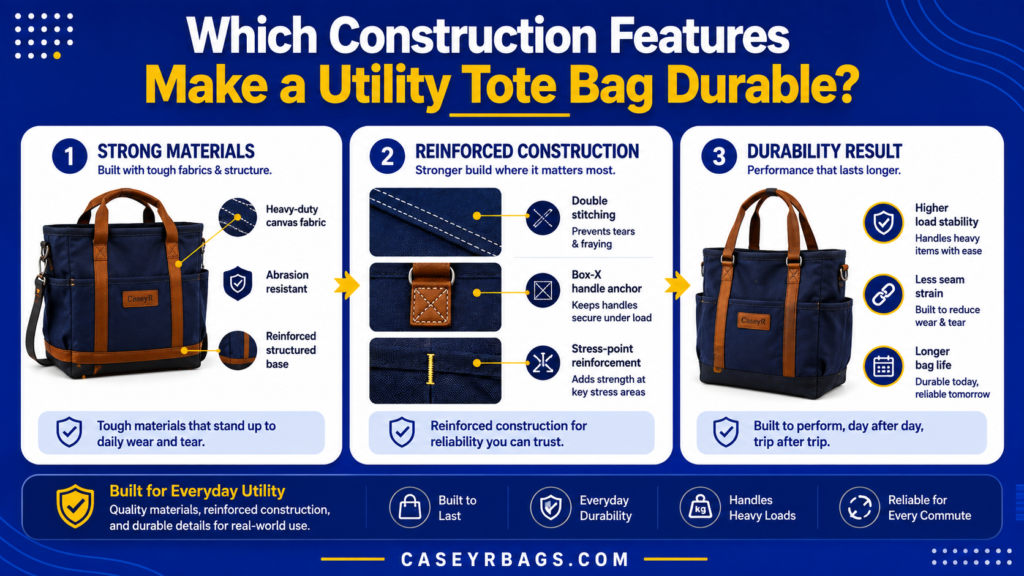
Which Construction Features Make a Utility Tote Bag Durable? A durable Utility Tote Bag depends on a connected construction system in which body material, load-bearing seams, handle anchors, base structure, gussets, edge finishing, and closures work together to resist repeated loading and structural wear. Durability is not created by one rugged-looking feature; it develops from how well all major load and wear zones remain integrated through repeated carrying, movement, flexing, abrasion, and set-down cycles. Material strength ≠ whole-bag durability, and visible reinforcement ≠ verified durability. Strong fabric can still be limited by weak seams, a reinforced handle can still depend on fragile surrounding material, and a rigid-looking base may still wear at corners or junctions. The correct evaluation follows the entire construction path and asks whether structural and high-contact zones remain suitable for repeated utility use. KEY TAKEAWAY Utility Tote durability comes from connected construction: wear-resistant body material, intact seams, integrated handle anchors, supported base and gusset zones, protected edges, secure closures, and reinforcement placed where repeated use actually creates stress. Utility Tote Durability Signal Key STRUCTURAL SIGNALSeams, anchors, panels, and base zones remain connected under repeated load transfer. WEAR-RESISTANCE SIGNALEdges, corners, surfaces, and closures resist progressive abrasion, fraying, and repeated contact. WARNING SIGNALSeparation, tearing, anchor distortion, base sagging, or progressive wear appears in meaningful zones. GRAY ZONEConstruction looks rugged, but whole-bag durability under repeated real use remains uncertain. What Construction Features Directly Determine Utility Tote Bag Durability? Utility Tote durability depends on how effectively its load-bearing and wear-resistant construction zones work together during repeated carrying, loading, movement, and set-down use. The body contains the load, structural seams join the panels, handle anchors transfer carrying force, and the base supports contents while the bag is lifted, moved, and placed on surfaces. Connected weaknesses matter because one strong feature cannot compensate for a weak neighboring zone. Strong material + weak seam → weak durability system, while strong anchor + weak surrounding panel → the same result. The broader Tote Bag structure provides the parent context for this narrower Utility Tote durability question. Durability also depends on wear zones outside the main load path. Bottom corners, opening edges, closure attachments, and contact surfaces experience repeated rubbing, folding, impact, and handling. A durable construction system therefore combines structural integrity with wear resistance instead of treating load-bearing strength and surface durability as the same property. Which Parts of a Utility Tote Receive the Most Structural Stress? The highest structural stress zones usually include handle anchors, top-edge seams, side seams, gusset seams, base seams, bottom corners, opening edges, and closure attachment zones. These areas repeatedly receive tension, panel movement, load transfer, contact, or flexing as the Tote is lifted, filled, carried, set down, and reopened. Stress zone → repeated demand → durability consequence. Handle anchors receive concentrated carrying force, seams maintain panel continuity, the base and corners support contents and contact surfaces, and closure attachments experience repeated opening force. The exact limiting zone varies by construction, so durability should be assessed across all connected high-demand areas rather than from one reinforced location. How Do Load-Bearing & Wear-Resistant Features Differ? Load-bearing construction resists the tension and structural demand created by carried contents, while wear-resistant construction resists abrasion, rubbing, flexing, fraying, and surface deterioration during repeated contact. A seam or handle anchor can remain structurally strong while an exposed edge gradually abrades, and a wear-resistant panel can still depend on a weak joining seam. Durability requires both structural integrity and wear resistance. Load strength does not automatically predict long-term wear behavior, and abrasion resistance does not establish load capacity. The two systems overlap at corners, seams, and attachment zones, but they should still be evaluated as distinct durability functions within the same Utility Tote. Why Can One Strong Feature Not Make the Entire Utility Tote Durable? One strong feature cannot make the entire Utility Tote durable because repeated use transfers demand through connected materials, seams, anchors, base zones, edges, and closures. A strong body panel can still be limited by weak stitching, a strong seam can still connect to a weak anchor, and a reinforced anchor can still depend on fragile surrounding material. Strong material + weak seam = weak system; strong seam + weak anchor = weak system; strong anchor + weak panel = weak system. Whole-bag durability depends on connected construction, not isolated strength. The practical question is whether each major structural and wear zone supports the next part of the system without becoming the obvious weak point. Utility Tote Durability Anatomy SVG Utility Tote durability anatomyDiagram highlighting body panel, handle anchor, top edge, side seam, gusset, base seam, bottom corner and closure zone as durability areas. Utility Tote Durability AnatomyDurability depends on connected structural and high-wear zones LOAD STRESS WEAR STRESS BODY PANEL SIDE SEAM HANDLE ANCHOR TOP EDGE GUSSET BASE SEAM BOTTOM CORNER CLOSURE ZONE Figure 1.0:Structural and wear zones must remain connected for stronger repeated-use durability.CASEYRBAGS.COM • Utility Tote durability anatomy How Does Body Material Affect Utility Tote Durability? Body material affects Utility Tote durability through resistance to tearing, abrasion, repeated flexing, deformation, fraying, and its ability to support structural seams and reinforcement. Which Material Properties Matter Most for Utility Tote Durability? The material properties that matter most are tear resistance, abrasion resistance, dimensional stability, flexibility, resistance to repeated folding, stitch-holding ability, and fray resistance. These properties influence whether the body can contain irregular loads, support seams and anchors, and resist repeated contact at surfaces and edges. Tear resistance supports local rupture resistance, abrasion resistance helps high-contact areas survive rubbing, and dimensional stability limits progressive distortion. Flexibility can accommodate irregular contents but also creates more fold cycles. No single material property determines durability, so the body should be evaluated by how its combined behavior matches the expected utility environment. Why Does Thicker Material Not Automatically Mean Better Durability? Thicker material does not automatically mean better durability because material structure, weave or construction, fiber behavior, seam interaction, repeated flexing, abrasion exposure, and workmanship all influence real performance. A thick panel can still
Which Tote Pack Bag Strap Arrangement Supports Office Commuting?
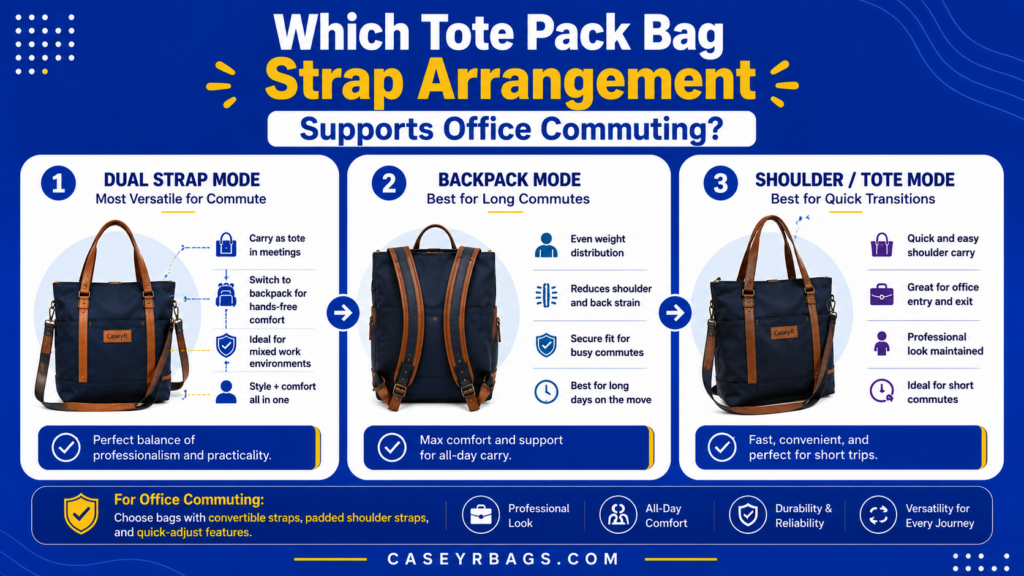
Which Tote Pack Bag Strap Arrangement Supports Office Commuting? A Tote Pack Bag supports office commuting best when its Backpack straps provide stable sustained carry while its Tote handles remain easy to use for short transitions, lifting, office entry, and workplace handling. Strap adjustment, upper and lower anchors, handle position, stowage, and conversion hardware determine whether each carry mode works cleanly during walking, transit, and indoor movement. More strap options ≠ better commuting arrangement, and convertible carry ≠ efficient carry transition. The strongest setup depends on the actual commute, normal office load, movement duration, transition frequency, and access needs. Backpack straps may dominate longer movement, while Tote handles can become more useful at building entrances, security desks, elevators, desks, and other short handling phases where quick repositioning matters more than sustained back carry. KEY TAKEAWAY The strongest office-commute Tote Pack strap arrangement divides carry roles clearly: Backpack straps handle sustained movement, Tote handles support quick workplace transitions, and inactive components stay controlled without blocking access or adding unnecessary conversion friction. Office Commute Strap-Fit Key BACKPACK-DOMINANT FITSustained movement makes the two-strap Backpack system the primary commute mode. MIXED-MODE FITBackpack and Tote carry both occur repeatedly across transit and workplace transitions. TOTE-DOMINANT FITShort movement and frequent handling make quick Tote access more important. CONDITIONAL FITThe arrangement works, but one meaningful adjustment, storage, access, or transition compromise remains. What Strap Arrangement Does a Tote Pack Bag Need for Office Commuting? An office-commute Tote Pack needs a strap arrangement that supports sustained movement through Backpack carry while preserving quick Tote handling for office entry, lifting, desk use, and short indoor transitions. Walking and transit place greater value on stable two-strap carry, while workplace movement often requires faster repositioning. Backpack straps and Tote handles therefore perform different commute roles. Upper and lower Backpack anchors create the active two-strap path for longer movement, while accessible Tote handles support short lifts, set-downs, and rapid changes in carry position. The broader Tote Bag structure provides the parent context for this office-commute strap question. The strongest arrangement supports repeated transitions without unnecessary adjustment, dangling hardware, or blocked access. Fixed, stowable, partly detachable, and removable systems can all work when inactive components remain controlled and the main opening stays usable. The correct arrangement matches the actual commute rather than simply providing more strap options. Which Strap Components Directly Affect Office-Commute Performance? The components that most directly affect office-commute performance are the Backpack shoulder straps, Tote handles, upper anchors, lower anchors, strap adjusters, clips or buckles, storage sleeves, and any padding integrated into the active strap system. Each part influences whether the bag can move cleanly between sustained walking and short workplace handling. Strap component → carry effect → commuting consequence. Adjusters change bag position, anchors define the Backpack load path, storage zones control inactive webbing, and Tote handles determine how quickly the bag can be lifted or repositioned indoors. No single component proves commuter fit unless the complete arrangement works together through the actual commute sequence. How Should Tote & Backpack Carry Divide Their Commuting Roles? Backpack carry usually has the clearest role during longer movement because two active shoulder straps can keep the Tote Pack closer to the back and reduce some free swing during walking or transit. Tote carry becomes useful for short transitions, quick lifting, elevators, security desks, desk placement, and movement between nearby indoor locations. This is a functional pattern, not a universal rule. A short commute may rely mostly on Tote handles, while a walking-heavy route may use Backpack mode for nearly the entire journey. The best division depends on duration, load, access frequency, and how often the user changes mode rather than on assuming one carry system is always superior. Why Does One Strap Arrangement Not Fit Every Office Commute? One strap arrangement does not fit every office commute because walking distance, transit use, office load, indoor movement, access frequency, and carry-mode transition frequency vary from one routine to another. A commuter who walks for a long period may value rapid Backpack activation and stable adjustment more than someone whose movement is mainly between a car, elevator, and desk. Different commute patterns → different strap priorities. A mixed transit routine may benefit from quick Tote/Backpack switching, while a Tote-dominant routine may care more about easy handles and controlled inactive straps. Fit should therefore be judged from the real commute pattern rather than from generic versatility claims. Office Commute Strap Arrangement SVG Office commute Tote Pack strap arrangementCommute flow from home and walking through transit, office entry, and desk handling, showing when Backpack straps or Tote handles are active. Office Commute Strap ArrangementCarry roles change as the commute moves from sustained travel to workplace handling HOME / WALKBackpack Straps ActiveSustained movement TRANSITStable Back CarryControlled position OFFICE ENTRYCarry TransitionQuick reposition DESK / SHORT MOVETote Handles ActiveWorkplace handling Figure 1.0:Office commuting often shifts from Backpack-dominant movement to quick Tote handling near the workplace.CASEYRBAGS.COM • Tote Pack office-commute carry roles How Should Backpack Straps Be Arranged for Office Commuting? Backpack straps should support stable repeated commuting through usable adjustment, reliable attachment, and controlled inactive positioning without adding unnecessary conversion complexity. How Does Strap Adjustment Affect Commuting Fit? Strap adjustment affects commuting fit by changing the Tote Pack’s position relative to the back and controlling how evenly the left and right strap paths support the bag. Adjustment range matters because clothing layers, load volume, and carrying position can change across the day, making one fixed setting less practical for repeated use. Adjustment → bag position → carry stability. The system should allow both straps to reach a consistent working position without requiring repeated major rethreading or creating large loose sections. A wider adjustment range can improve adaptability, but it does not make every load or commute automatically suitable. How Do Fixed & Detachable Backpack Straps Differ? Fixed Backpack straps remain attached and ready for immediate use, which reduces connection steps when the commuter needs to switch from Tote mode into sustained back carry. The trade-off is that the
How Does a Tote Pack Bag Switch Between Tote and Backpack Carry?
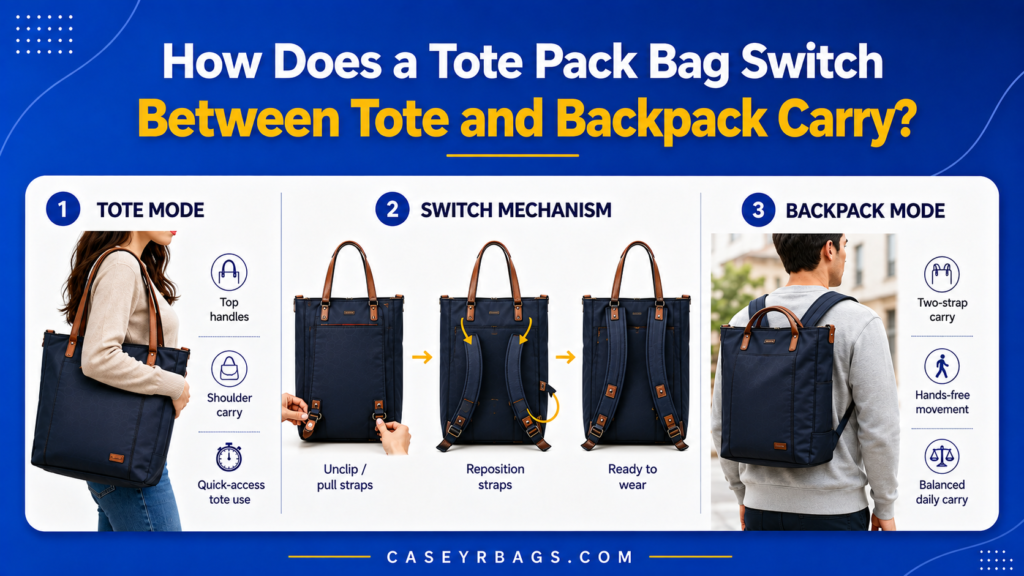
How Does a Tote Pack Bag Switch Between Tote and Backpack Carry? A Tote Pack Bag switches between Tote and Backpack carry by transferring the active carry role from its Tote handles to a two-strap Backpack system while keeping inactive components, bag orientation, opening access, and load position under control. Tote mode suspends the bag through its handles, while Backpack mode activates shoulder straps through upper and lower anchors to create a different load path. Effective conversion requires more than simply adding extra straps. Routing, adjustment hardware, stowage, body orientation, and the position of the primary opening must continue to work after the switch. Multiple straps ≠ effective carry conversion, and carry-mode change ≠ bag-type change. The same Tote Pack body remains the central structure; only the active support system and its interaction with the body change. KEY TAKEAWAY A strong Tote Pack conversion system does more than offer two sets of straps. It changes the active load path cleanly, controls inactive components, preserves usable orientation and opening access, and keeps the bag stable enough for the intended mode. Tote Pack Carry-Conversion Signal Key ACTIVE CARRY SYSTEMThe handles or Backpack straps currently supporting the bag’s load. INACTIVE COMPONENT CONTROLUnused straps or handles stay stowed, tucked, folded, detached, or otherwise controlled. ORIENTATION & ACCESS CHECKThe bag body, opening, and contents remain usable after the mode switch. GRAY ZONETwo carry modes exist, but interference, routing, access, or stability still weakens conversion quality. What Does Tote-to-Backpack Carry Conversion Mean in a Tote Pack Bag? Tote-to-Backpack carry conversion means one Tote Pack body supports two carrying configurations by shifting active load support between Tote handles and Backpack shoulder straps. In Tote mode, the handles suspend the body from their attachment points; in Backpack mode, two shoulder straps use upper and lower anchors to support the same body against the back. The switch depends on how the second carry system is integrated and controlled. Fixed straps may remain attached while being folded or stowed, detachable straps may connect only when needed, and adjustment hardware determines whether the active strap path reaches the intended length and routing without twisting. The same Tote Bag body must remain usable after conversion. Contents, pockets, and the primary opening should keep a functional orientation, while inactive components stay clear of the active mode. Two carry systems ≠ successful conversion unless the transition preserves access, orientation, and practical control. Which Components Directly Control Tote Pack Carry Conversion? The components that directly control conversion are the Tote handles, Backpack straps, upper anchors, lower anchors, adjustment hardware, buckles or clips, stowage zones, and the attachment panels that connect those parts to the bag body. Each component determines whether the active carry system can be engaged cleanly and whether the inactive system can remain controlled. The useful relationship is component → conversion role → practical consequence. Upper and lower anchors establish the Backpack strap path, clips can permit attachment or removal, adjusters set usable strap length, and stowage areas reduce interference. Multiple components are only useful when they operate as one clear transition system rather than as unrelated extra straps. How Does Tote Carry Differ Mechanically From Backpack Carry? Tote carry suspends the bag body from its Tote handles, placing the active load path through the handle attachments and allowing hand, forearm, or shoulder carry where handle drop permits. The bag often remains farther from the torso and can move more freely as the user walks or repositions it. Backpack carry activates two straps connected through upper and lower anchors, placing the same body closer to the back and distributing the active support path across both sides. The body orientation may remain the same or change depending on the design. Tote carry and Backpack carry therefore use different support geometry even though the bag itself remains the same type. Why Does One Conversion System Not Work the Same Way on Every Tote Pack? One conversion system does not work the same way on every Tote Pack because designs vary in fixed versus detachable straps, exposed versus stowable components, handle length, anchor geometry, body orientation, and opening location. A design with permanently attached Backpack straps may switch quickly but leave more inactive strap material exposed in Tote mode. A detachable system can create a cleaner inactive configuration but may require more connection steps. Some bodies preserve orientation while others rotate or reposition during the switch. Same two carry modes ≠ same conversion mechanism, so conversion quality should be evaluated from the actual component layout rather than from the simple presence of Tote handles and Backpack straps. Tote-to-Backpack Carry Conversion SVG Tote Pack Tote-to-Backpack carry conversionDiagram showing Tote handles active in Tote mode, a controlled carry conversion stage, and Backpack straps active through upper and lower anchors in Backpack mode. Tote Mode → Carry Conversion → Backpack Mode The active support system changes while the same Tote Pack body remains in use TOTE MODETote Handles ActiveBackpack Straps Controlled CARRY CONVERSIONRelease • route • attach • adjustControl inactive components BACKPACK MODEBackpack Straps ActiveTote Handles Controlled Figure 1.0:Conversion transfers the active load path from Tote handles to the Backpack strap system.CASEYRBAGS.COM • Tote Pack carry-conversion mechanism How Do Handles & Backpack Straps Enable the Carry Switch? Handles and Backpack straps enable the switch by alternating which attachment system carries the Tote Pack’s load while the other system becomes inactive and controlled. How Do Tote Handles Function During Tote Carry? During Tote carry, the handle attachments support the suspended bag body and establish the primary active load path. Depending on handle drop, the Tote Pack may be carried by hand, over the forearm, or on the shoulder, but the defining mechanism remains the same: the handles rather than the Backpack straps are supporting the body. Handle attachment → suspended body → Tote carry position. The Backpack system may still be physically present, but it should not interfere with hand placement, the opening, or the bag’s normal movement. Tote handles do not need to disappear during Backpack mode, but
Which Shopping Tote Bag Seams and Handle Anchors Determine Safe Load Capacity?
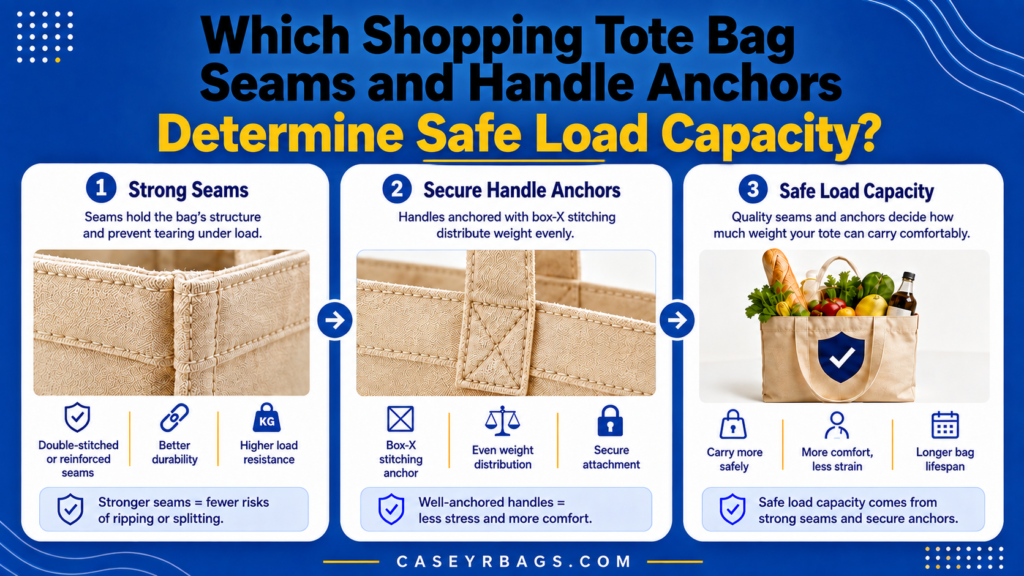
Which Shopping Tote Bag Seams and Handle Anchors Determine Safe Load Capacity? Shopping Tote Bag load capacity depends on the complete structural path that transfers force from the handles through their anchors, surrounding panels, load-bearing seams, and base rather than on one visibly reinforced attachment. Handle tension enters the Tote through the anchor zone, then spreads into the top edge, body panels, side or gusset seams, and lower structure that supports the carried contents. Visible reinforcement ≠ verified load capacity, and strong handle ≠ strong handle-to-body connection. A box-X pattern, heavy fabric, broad anchor, or reinforced base may contribute to structural support, but no single visible feature establishes a universal safe kg/lb value. The correct question is whether the complete handle-to-base load path remains intact and whether any capacity claim is supported by applicable whole-bag manufacturer guidance or testing. KEY TAKEAWAY Safe Shopping Tote load capacity cannot be inferred from one seam, handle, anchor pattern, or material. The relevant basis is the complete load-transfer path—handles, anchors, surrounding panels, top/side/base seams, and verified whole-bag evidence. Shopping Tote Structural Evidence Key VISIBLE STRUCTURAL SIGNALAn observable reinforcement, seam, anchor, or material feature. VERIFIED STRUCTURAL EVIDENCEApplicable whole-bag manufacturer guidance or suitable load testing. WARNING SIGNALSeparation, tearing, distortion, or repeated deformation in the load path. GRAY ZONEConstruction appears reinforced, but verified whole-bag capacity remains unavailable. What Do Seams & Handle Anchors Mean for Shopping Tote Bag Load Capacity? Seams and handle anchors affect Shopping Tote load capacity by forming the structural path that transfers handle tension through the bag body and into the wider load-support system. A loaded Tote creates tension in the handles, and that force enters the body through the handle-anchor zones rather than remaining isolated in the straps. Structural continuity depends on what surrounds those anchors. The reinforced top edge, body panels, seam allowances, reinforcement layers, side or gusset seams, and base must continue the force path without excessive separation or distortion. A locally strong attachment can still be limited by weaker material or seams elsewhere. The complete Tote therefore matters more than one visible feature. A strong local anchor does not guarantee a strong complete Tote. The broader Tote Bag structure provides the parent context for how this structural-capacity question fits with opening form, handles, storage behavior, and adaptable utility carry. Which Seams Directly Participate in the Tote Load Path? Several seams can participate in the structural load path because handle tension must pass from the anchor zone into the rest of the Tote body. Handle-anchor seams connect the straps to local material, top-edge seams stabilize the upper structure, side and gusset seams connect body panels, and base seams help contain the load supported by the lower portion of the bag. Panel-joining seams and reinforcement-layer seams can also matter when they carry tension between structural zones. Seam location → transferred force → structural consequence. No single seam necessarily carries the entire load, so capacity should be assessed across the connected network rather than from the appearance of one reinforced joint. What Role Do Handle Anchors Play in Load Transfer? Handle anchors are the points where handle tension enters the Tote body. As the bag is lifted, the handles pull against the anchor zones, which must transfer that demand into the surrounding material and wider panel structure. An effective anchor spreads force through enough supported material to avoid relying on one narrow attachment line. The useful chain is handle tension → anchor zone → surrounding material → wider Tote body. Broader integration can improve potential force distribution, but anchor size alone does not establish capacity. The surrounding panel, reinforcement, seams, and downstream structure must remain able to carry the transferred load. Why Can One Strong Seam Not Determine Total Tote Capacity? One strong seam cannot determine total Tote capacity because the load path continues through several connected structural components. A reinforced anchor seam may remain intact while a weaker panel tears beside it, a side seam opens, a base seam separates, or a reinforcement layer pulls away from the surrounding body. Local strength ≠ whole-bag strength. The limiting component can appear somewhere other than the visibly reinforced area, especially when material has already been damaged or when the load is uneven. Whole-bag capacity therefore requires evidence that applies to the complete connected structure, not just one seam or attachment detail. Shopping Tote Load-Path SVG Shopping Tote structural load pathVisual path showing carried load through the base, bag body, side seams, reinforced top panel, handle anchors and handles.Shopping Tote Structural Load PathCapacity depends on connected force transfer from loaded body into the handlesBASE + CONTENTSSupported loadBAG BODYPanels + side seamsANCHOR ZONETop seam + panelHANDLESSuspensionFigure 1.0:Load transfer is a whole-bag path, not a single-anchor event.CASEYRBAGS.COM • Shopping Tote structural load path How Do Seam Construction & Stitching Affect Tote Load Capacity? Seam construction affects Shopping Tote load transfer by controlling how effectively joined material carries force across structural connections. Which Seam Characteristics Matter Most Under Load? Seam performance under load depends on seam type, seam allowance, stitch continuity, stitch spacing, thread integrity, reinforcement layers, and how much surrounding material is captured in the joint. These factors determine how force passes across the connection and whether the joined material remains supported as tension rises. A continuous seam with intact thread and adequate captured material can provide a more reliable transfer path than a damaged or partially separated connection. However, visual quality alone is not a capacity rating. Structural behavior still depends on material, workmanship, load direction, and how the seam interacts with the rest of the Tote. Why Does Stitch Density Alone Not Determine Seam Strength? Stitch density alone does not determine seam strength because performance also depends on thread, body material, stitch geometry, needle perforation, seam allowance, loading direction, and workmanship. More stitches can create additional transfer points, but excessive perforation or weak surrounding material can still limit the connection. More stitches ≠ automatically stronger seam. A dense pattern in weak, torn, or highly perforated material may perform worse than a simpler intact
How Much Weight Can a Shopping Tote Bag Carry Comfortably?
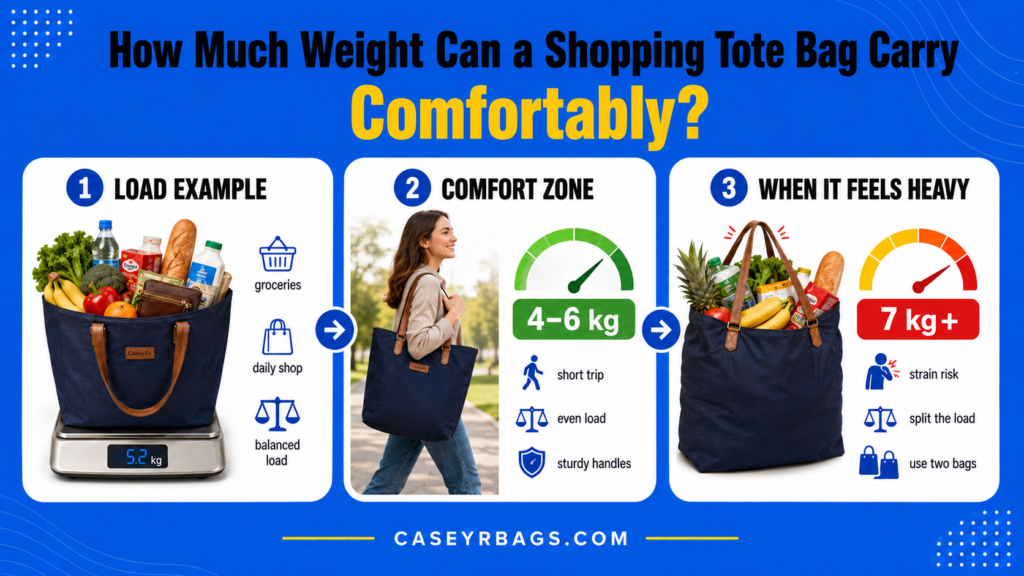
How Much Weight Can a Shopping Tote Bag Carry Comfortably? A Shopping Tote Bag does not have one universal comfortable weight limit because practical carrying capacity depends on loaded weight, handle design, Tote structure, load distribution, carry position, and carrying duration. Structural capacity describes what the bag can physically support, while comfortable carrying weight describes what remains practical through the handles and normal carry interface. A large Tote may still become demanding with dense contents, and a structurally strong Tote can remain uncomfortable when handles concentrate pressure or the load shifts to one side. Structural load limit ≠ comfortable carry limit, and available volume ≠ comfortable weight capacity. The useful target is a practical real-use load that stays balanced, supported, manageable through the handles, and appropriate for the actual distance and duration of carry. KEY TAKEAWAY Comfortable Shopping Tote weight is not a universal kg/lb number. It depends on total loaded weight, handle interface, Tote structure, load distribution, carry position, and duration. A bag can remain structurally intact while the load has already become impractical to carry. Shopping Tote Load-Fit Limit Key STRUCTURAL LIMITWhat verified construction guidance or structural evidence indicates the Tote can support. VOLUME LIMITWhat physically fits inside the Tote body without proving comfortable weight. PRACTICAL COMFORTABLE LIMITWhat remains manageable through the normal carry system under real use. GRAY ZONEThe Tote remains intact, but balance, handling, or duration fit begins to deteriorate. What Does Comfortable Carrying Weight Mean for a Shopping Tote Bag? Comfortable Shopping Tote weight is the load that remains structurally supported and practically manageable through the Tote’s normal carry system under the actual distance and duration of use. Structural capacity describes what the bag construction can support, while comfortable carrying load describes what remains practical for the person using the normal handles. Handle width, handle attachment, Tote balance, and item distribution all change how the same loaded weight behaves. Broader contact can spread the carry interface, strong attachment can transfer load more predictably into the body, and centered contents can reduce twisting or repeated repositioning. The broader Tote Bag structure provides the parent context for these load questions. Duration completes the distinction because a load that feels manageable over a short distance may become increasingly demanding when it must be supported for longer periods or through repeated walking. Short-distance tolerance ≠ sustained carrying comfort. The final comfortable load therefore depends on structure, interface, balance, and real-use duration working together. How Is Structural Load Capacity Different From Comfortable Carry Weight? Structural load capacity describes the Tote construction: seams, handles, body material, base, and attachment points determine whether the bag can physically support a load without excessive structural failure or deformation. Verified manufacturer guidance, when available, belongs to this structural question because it refers to the bag’s construction rather than the user’s carrying experience. Comfortable carry weight is different. It depends on total loaded weight, handle interface, carry position, distribution, and duration. A structurally strong Tote can still become impractical if narrow handles concentrate the load, the body twists under uneven contents, or the carry lasts too long. Bag survives load ≠ load is comfortable to carry. Which Factors Most Directly Change Comfortable Tote Weight? The most direct factors are loaded weight, handle width, handle drop, carry position, bag balance, base support, item density, load movement, and duration. Total weight establishes the overall carrying demand, while the handle interface determines how that force is transferred into the hand, forearm, or shoulder. Handle drop also changes where the Tote sits and how freely it can move. Base support and balance affect whether dense contents remain stable or pull the bag off its normal carry line. Duration then extends the same demand over time. Loaded weight + carry interface + load behavior + duration → comfort outcome. No single factor proves comfortable fit by itself. Why Can One Weight Limit Not Apply to Every Shopping Tote Bag? One universal weight limit cannot apply because Shopping Totes vary in size, construction, handle design, body structure, and intended carry position. Contents also vary in density: a Tote filled with light bulky items can occupy more space than a partly filled Tote containing dense objects, even when the smaller load is heavier. Carrying distance, duration, and individual capability add further variation. A load that works for a brief hand carry may not remain practical for a longer walk or repeated shoulder carry. The correct approach is therefore to evaluate the real load and carry system rather than invent a universal kg/lb threshold that ignores Tote design and actual use. Structural Capacity vs Comfortable Carry Map Limit What Determines It? What It Tells the Reader Structural limit Handles, seams, body, base, attachment strength Whether the Tote can physically support the load Volume limit Interior dimensions and shape Whether contents physically fit Comfortable limit Weight, handles, distribution, position, duration Whether the load remains practical to carry Structural capacity versus comfortable carryDiagram separating Tote structural support, physical volume and practical comfortable carrying limit. Structural Capacity ≠ Comfortable CarryPhysical support, available volume, and practical carrying comfort are separate limits STRUCTURAL LIMITSeams • handles • baseCan the Tote support it? VOLUME LIMITInterior size • shapeDoes it physically fit? COMFORTABLE LIMITWeight • handles • durationDoes real carry remain practical? Figure 1.0:Structural strength and interior volume do not define the load that remains comfortable under real carrying conditions.CASEYRBAGS.COM • Shopping Tote load-fit distinction How Does Handle Design Affect Comfortable Tote Weight? Handle design affects comfortable Tote weight by changing how the loaded bag transfers force into the hand, forearm, or shoulder and how that load enters the Tote structure. How Does Handle Width Change Load Pressure? Handle width changes load pressure by changing the contact area through which the Tote’s weight is supported. A narrow handle concentrates the loaded Tote over a smaller interface, while a broader handle spreads that same load across a wider contact area. The total bag weight does not change, but the carrying experience can. Same load + different handle interface → different carrying