How Does Soft Bucket Bag Drawstring Closure Affect Security?
How Does Soft Bucket Bag Drawstring Closure Affect Security? | CaseyrBags How Does Soft Bucket Bag Drawstring Closure Affect Security? Soft Bucket Bag drawstring closure improves ordinary access control by reducing the main opening and requiring the cord to be loosened before the chamber can return to its broad access state. Pulling the drawstring gathers the flexible upper perimeter inward, which can limit content exposure, help retain larger items, and make immediate access less direct than with a fully open top. Its security remains limited because soft gathered material can leave residual gaps, deform when handled, or reopen if the cord slips. The practical result depends on routing, material response, retained tension, hardware, load clearance, and movement, so the drawstring should be treated as an access-control and content-retention mechanism rather than a true lock. KEY TAKEAWAY Soft Bucket Bag drawstring closure can improve ordinary access control and content retention by reducing the exposed aperture and preserving a selected cord position, but the soft gathered opening remains flexible, may leave residual gaps, and should not be treated as a lock or theft-proof system. Functionally Effective Reduced & Retained OpeningThe aperture reduces meaningfully, the selected cord position remains reasonably stable, contents stay controlled in ordinary use, and reopening remains practical. Conditionally Effective Useful Control With LimitsThe closure improves ordinary retention, but design-dependent gaps, friction, load height, movement, or hardware behavior keep the result near a practical limit. Mismatch Signal Opening or Retention Breaks DownBroad residual gaps, uneven gathering, cord slippage, blocked gather clearance, over-tightening, or post-movement reopening indicate a named closure mismatch. What Security Does a Soft Bucket Bag Drawstring Actually Provide? Practical access security in a Soft Bucket Bag means the drawstring reduces the main opening, helps retain contents during ordinary carrying, and requires a deliberate loosening step before the chamber returns to its broad access state. The mechanism works through cord pull, perimeter tension, material gathering, residual aperture, and retained cord position. A smaller opening can reduce direct exposure and support content retention, but the result remains flexible rather than locked or sealed. The practical threshold is evidence-safe: the closure should reduce the aperture meaningfully, keep the selected position reasonably stable under a normal load and ordinary movement, and reopen normally without being described as theft-proof security. For the wider structure, see Bucket Bag. SOFT BUCKET BAG DRAWSTRING-SECURITY ANATOMY SLIDER RESIDUAL GAP MAIN CHAMBER SOFT BODY + CLOSURE CLEARANCE CASEYRBAGS.COM Figure 1. Soft Bucket Bag Drawstring-Security Anatomy Shows the drawstring cord, guide points, gathered upper edge, reduced opening, residual gap, retention hardware, closure clearance, soft body, chamber, and loaded contents. How Does the Drawstring Improve Ordinary Access Control? The drawstring improves ordinary access control by contracting the upper perimeter from a broad opening into a smaller gathered aperture. Pulling the cord contracts the upper perimeter and changes a broad access opening into a smaller gathered aperture. Connect the smaller aperture to reduced direct chamber exposure and the need to loosen the cord before full access returns. The condition: the improvement exists only when the perimeter gathers meaningfully and the selected cord position remains reasonably stable under the normal load. Describe the outcome as increased access friction, not prevention of access. The result should be judged under repeatable normal use and should not be expanded into a locking or theft-prevention claim. How Does the Drawstring Support Content Retention? The reduced upper aperture can help retain larger chamber contents by making direct movement through the top less likely during ordinary carrying. A reduced upper aperture can make it less likely for larger contents to move directly through the top during ordinary carrying. Keep the claim tied to the actual residual opening, item geometry, and load position. The limit: small loose items may still approach or pass through localized gaps, especially when stored near the top. Main-opening reduction therefore supports retention but does not guarantee containment of every object. The result should be judged under repeatable normal use and should not be expanded into a locking or theft-prevention claim. What Does the Drawstring Not Prove? The drawstring does not prove theft resistance, tamper resistance, sealed construction, or unauthorized-access prevention. Directly that a flexible cord closure does not automatically prove theft resistance, tamper resistance, sealed construction, or unauthorized-access prevention. A person can usually loosen, manipulate, or deform the opening depending on its construction. The conclusion should remain tied to the actual cord route, material response, load state, and observed aperture rather than the appearance of a tightened drawstring. Lock the article’s interpretation: Soft Bucket Bag drawstring security means ordinary opening control and content retention. Use that definition throughout; do not let “secure” expand into a claim that the structure or evidence cannot support. The result should be judged under repeatable normal use and should not be expanded into a locking or theft-prevention claim. How Does Cord Pull Reduce the Main Opening? Cord pull changes the opening through a mechanical sequence rather than by shrinking the chamber itself. Slack removal, route tension, fabric gathering, and the final retained aperture determine whether ordinary access becomes less direct. What Happens When the Cord Is Pulled? Pulling the cord begins a predictable chain from slack removal to route tension, upper-perimeter gathering, and a smaller central opening. The causal chain precisely: pull → slack removal → cord tension → tension transfer around the route → upper-perimeter gathering → smaller central opening. Explain that the cord acts through the surrounding material rather than shrinking the chamber independently. Smooth, reasonably coordinated movement. If one section moves before another, the result may reflect route friction, guide-point geometry, asymmetry, or obstruction rather than insufficient pulling force. Keep this upper-opening mechanism connected to the complete Bucket Bag: Drawstring Access and Base-Stabilized Capacity structure, preserving the exact anchor and destination once. For the wider structure, see Bucket Bag. Why Does a Smaller Aperture Change Access? A smaller aperture reduces immediate hand entry and visibility and usually requires a deliberate loosening action before broad access returns. A smaller practical aperture can reduce direct hand entry,
Why Does a Bucket Bag Use Drawstring Access & Base-Stabilized Capacity?
Why Does a Bucket Bag Use Drawstring Access & Base-Stabilized Capacity? | CaseyrBags Why Does a Bucket Bag Use Drawstring Access & Base-Stabilized Capacity? A Bucket Bag uses drawstring access because its broad upper perimeter needs to shift between an open retrieval position and a contracted carry position without requiring a rigid framed opening. Pulling the cords gathers the upper body inward, reducing the opening while preserving the bag’s generally vertical storage chamber. Its capacity is stabilized from below because a defined or moderately supported base gives the chamber a consistent lower footprint for contents to settle into. The base does not need to make the entire bag rigid; it provides enough shape control for the side walls and vertical volume to remain functional while the upper body stays flexible enough for drawstring contraction. KEY TAKEAWAY A Bucket Bag works as a coordinated two-part system: the drawstring changes upper access by gathering the flexible perimeter, while the lower base preserves enough footprint for the vertical chamber to hold and organize a normal load without becoming a rigid shell. Balanced System Access + Base Work TogetherDrawstring movement is smooth, gathering is predictable, the lower footprint remains controlled, and normal contents stay retrievable. Conditional State One Mechanism Near Its LimitRouting friction, reduced upper clearance, deep settlement, or borderline base support remains manageable but needs one controlled variable check. Mismatch Signal Access or Capacity Breaks DownBinding, uneven gathering, severe sag, over-rigidity, item pooling, overfill, or repeated unloading indicates a structural or retrieval mismatch. What Defines Drawstring Access & Base-Stabilized Capacity in a Bucket Bag? A Bucket Bag combines two complementary mechanisms: a variable upper opening controlled by the drawstring and a lower footprint that remains defined enough to support a usable vertical chamber. The drawstring lets the upper perimeter loosen for access and contract for ordinary carry, while the lower base preserves enough width, depth, and resting shape to keep contents from collapsing into the same gathered form. Functional identity comes from the interaction of these two zones. The top must remain flexible enough to gather, while the lower body must remain controlled enough to support contents, settlement, and retrieval under the normal load. BUCKET BAG STRUCTURAL ANATOMYDRAWSTRING + GATHER ZONEVERTICAL CHAMBERSTABILIZED BASE + FLEXIBLE WALLSCASEYRBAGS.COM Figure 1. Bucket Bag Structural Anatomy Shows the coordinated drawstring opening, gather zone, flexible walls, vertical chamber, seams, stabilized lower footprint, and loaded contents. What Role Does the Drawstring Perform? The drawstring changes the upper opening by transferring tension around the perimeter and gathering the flexible upper body. The drawstring as the mechanism that changes opening size by transferring tension around the upper perimeter. Explain loosened access, fabric gathering, reduced-opening carry, and upper-body compression without claiming that the cords lock the bag. The mechanism should be judged from the exact construction and normal loaded state rather than from a product label or empty appearance. The cord system to the flexible upper body: the opening can expand and contract instead of remaining at one rigid width. End with the practical requirement that movement and gathering stay predictable under the normal load. The practical pass condition is smooth, repeatable behavior without forcing the drawstring, collapsing the lower chamber, or sacrificing retrieval. What Role Does the Stabilized Base Perform? The stabilized base gives the lower chamber a predictable footprint into which contents can settle without requiring a hard shell. The base as the lower footprint that gives contents a predictable place to settle and preserves enough width and depth for a vertical chamber. Explain that stabilization may come from shape, seams, material, layering, or reinforcement. The base need not become a hard platform. The pass condition is retained lower geometry with controlled sag and wall behavior, not maximum rigidity. The practical pass condition is smooth, repeatable behavior without forcing the drawstring, collapsing the lower chamber, or sacrificing retrieval. Why Must Both Mechanisms Work Together? The drawstring controls upper access while the base controls lower capacity geometry, so neither mechanism completes the Bucket Bag system alone. The division of labor: the drawstring controls upper access while the base controls lower capacity geometry. Show how a flexible top without a workable lower footprint can produce collapse, and how a stable base without compatible upper gathering can produce poor access. The defining rule: a Bucket Bag works when the variable opening, vertical body, and more defined base behave as a coordinated loaded system. Use this rule to anchor every later construction and capacity claim. The practical pass condition is smooth, repeatable behavior without forcing the drawstring, collapsing the lower chamber, or sacrificing retrieval. For the parent category context, see Fashion Bag Types: Silhouette Identity and Style-Led Carry. For the parent category context, see Fashion Bag Types. Why Does a Bucket Bag Use a Drawstring Opening? A drawstring opening suits a flexible vertical Bucket Bag because the access width can change without requiring a rigid frame. Cord travel, material behavior, opening clearance, and the normal load determine whether that access remains practical. How Does a Loosened Drawstring Preserve Broad Access? Loosening the cord removes perimeter tension and lets the upper body expand toward its practical opening state. Releasing cord tension lets the upper perimeter expand, reduces gathering, and exposes more of the chamber. Connect the practical opening—not merely the widest bag body—to hand entry, visibility, and item insertion. The mechanism should be judged from the exact construction and normal loaded state rather than from a product label or empty appearance. Broad access by construction: cord travel, channel endpoints, flap or secondary closure elements, material stiffness, and contents near the top can limit the usable opening. Do not promise one opening width for all Bucket Bags. The practical pass condition is smooth, repeatable behavior without forcing the drawstring, collapsing the lower chamber, or sacrificing retrieval. How Does Pulling the Cord Change the Opening? Pulling the cord removes slack, distributes perimeter tension, and gathers the upper material into a smaller opening. The sequence exactly: cord pull → slack removal → perimeter tension → fabric gathering
When Does a Mini Satchel Bag Suit Daily Essentials?

When Does a Mini Satchel Bag Suit Daily Essentials? | CaseyrBags When Does a Mini Satchel Bag Suit Daily Essentials? A Mini Satchel Bag suits daily essentials when the user’s recurring load is compact enough to fit inside its structured chamber without forcing the opening, closure, or body shape. A practical core load commonly includes a smartphone, cardholder or slim wallet, compact keys, wireless earbuds, and one or two small personal-care items. The bag remains suitable when those essentials stay independently accessible, internal pockets remain usable, loaded depth stays controlled, and modest reserve space remains for normal hand entry or occasional small variation. If ordinary use repeatedly requires overfilling, unloading, or omitting a genuinely necessary item, the daily load has moved beyond the practical Mini Satchel format. KEY TAKEAWAY A Mini Satchel suits daily essentials when the ordinary recurring load fits naturally, stays independently retrievable, closes without pressure, preserves usable pockets and a controlled compact profile, and leaves enough working clearance for normal hand entry and small daily variation. Strong Daily Match Core Load Works NaturallyRecurring essentials fit with direct retrieval, normal closure, usable pockets, controlled depth, and modest working clearance. Conditional Daily Match One Variable Near the LimitThe routine remains workable only when a named optional or capacity-expensive item, placement choice, or daily variation is controlled. Mismatch Signal Ordinary-Day Function FailsRepeated crowding, closure pressure, buried Core items, blocked pockets, omission of a necessary item, or light-day-only success signals a mismatch. When Is a Mini Satchel Bag Practical for Daily Essentials? A Mini Satchel is practical for daily essentials when the ordinary recurring load fits its usable geometry naturally and remains easy to access, organize, close, and retrieve throughout the day. Its structured body makes geometry important because fixed walls, pockets, seams, and closure paths reduce how much the chamber can adapt around irregular or capacity-expensive items. The practical threshold is reached before maximum physical fill: the bag should preserve normal closure, usable pockets, controlled loaded depth, direct retrieval, and modest working clearance with the recurring load. MINI SATCHEL DAILY-ESSENTIAL ANATOMY USABLE OPENING CORE CHAMBER POCKET RESERVE HIGH-FREQUENCY ZONE + CONTROLLED LOADED DEPTH CASEYRBAGS.COM Figure 1. Mini Satchel Daily-Essential Anatomy Maps the usable chamber, opening span, closure clearance, pocket intrusion, high-frequency zone, loaded depth, and reserve-space zone. Which Conditions Indicate a Strong Daily Match? A Strong Daily Match exists when the ordinary recurring load fits naturally and remains easy to access, close, organize, and carry without crowding. A Strong Daily Match: the core load fits naturally; the phone, wallet/cardholder, and keys have workable positions; the opening stays clear; the closure operates normally; pockets remain usable; and the intended shape stays controlled. Explain that the assessment concerns the ordinary recurring day, not an unusually light test. Require independent retrieval of frequent-use items and modest working clearance after packing, then state that a pass depends on the combined storage, access, closure, shape, and reserve-space result rather than item count alone. The result should be classified by the first failed function and retested with the same bag, contents, and access sequence. Which Conditions Make Suitability Conditional? Suitability becomes conditional when one capacity-expensive or variable item pushes opening clearance, fixed depth, organization, or reserve space close to its practical limit. A rigid eyewear case, power bank, small notebook, extra cosmetics, or additional electronic accessory can shift the same bag from strong to conditional because each consumes fixed depth or opening clearance. Keep the examples conditional on actual recurring need and geometry. Conditional Daily Match as a load that works only when one variable is controlled—for example, an optional item is omitted, an accessory is resized, or daily variation stays low. Do not label such a case a failure unless the user’s ordinary necessary load cannot pass consistently. What Defines the Practical Suitability Threshold? — Satchel Bag The practical threshold is the point at which the complete ordinary-day load remains storable, closable, organized, retrievable, and stable with some working clearance. Establish the threshold: the complete recurring load must fit without forced insertion, chronic crowding, closure pressure, strong panel distortion, blocked pockets, or repeated unloading. Explain why a one-time successful pack does not prove daily suitability. The decision rule in plain language: a Mini Satchel suits daily essentials when normal contents remain storable, closable, organized, retrievable, and stable with some working clearance. Name the first failed function as the limiting variable, then connect this supporting question once to the broader Satchel Bag: Carry Fit and Work-Oriented Capacity parent definition. Preserve that exact anchor and destination. See the broader Satchel Bag: Carry Fit and Work-Oriented Capacity framework. Which Items Should Define the Core Daily Load? The core daily load should be defined before optional items are allowed to influence capacity. Recurring need, access importance, and actual geometry establish which items deserve first claim on the Mini Satchel’s limited structured space. Which Essentials Usually Deserve First Priority? The first priority belongs to items that are genuinely used or predictably required on ordinary days and cannot be easily substituted. The smartphone, cardholder or slim wallet, and required keys as common—not universal—core candidates. Define core status through recurring daily use, high access importance, and limited substitute availability rather than convention. The judgment should remain tied to the ordinary recurring day rather than an unusually light or specially arranged test load. Instruct the reader to record each exact item with its case, contents, rings, or attachments. Explain that these real dimensions establish the first chamber, opening, and retrieval requirements before the bag is judged. The result should be classified by the first failed function and retested with the same bag, contents, and access sequence. Which Compact Items Commonly Form the Second Layer? Secondary items belong in the second layer only when their recurring usefulness justifies the capacity they consume after Core items are secure. Earbuds, lip balm, a small sanitizer, and one compact care product as possible Secondary items. Explain that frequent usefulness may justify their space, but their role must be tested after Core items rather than assumed. Show
What Fits Inside a Mini Satchel Bag?

What Fits Inside a Mini Satchel Bag? | CaseyrBags What Fits Inside a Mini Satchel Bag? A Mini Satchel Bag is generally best suited to a smartphone, cardholder or slim wallet, compact keys, wireless earbuds, and one or two small personal-care items. Depending on its actual opening and internal dimensions, it may also accommodate sunglasses, a compact eyewear case, small power bank, or small notebook; a tablet is more conditional, while a laptop is generally outside this format’s natural role. The practical combination depends on usable width, height, depth, opening, closure, pockets, item rigidity, and arrangement. A strong load allows each item to enter without force, sit inside without distorting the structured body, close normally, and remain retrievable without removing most contents. A restrained, accessible everyday load is more useful than maximizing item count. KEY TAKEAWAY A Mini Satchel works best with a restrained recurring load: compact core essentials first, conditional rigid items only when geometry allows, and enough working clearance for normal closure, direct retrieval, controlled panels, and repeatable everyday use. Strong Fit Core Everyday LoadPhone, slim payment storage, compact keys, earbuds, and one or two small care items are the strongest starting combination when actual geometry passes. Conditional Fit Rigid or Larger ExtrasEyewear case, power bank, notebook, or tablet must justify their fixed space demand without displacing core access, closure, or reserve space. Mismatch Signal Bulky / Dominant LoadLaptops, thick books, large bottles, full cosmetic pouches, or bulky organizers usually conflict with the Mini Satchel’s compact structured role. Which Everyday Items Commonly Fit Inside a Mini Satchel Bag? A smartphone, cardholder or slim wallet, compact keys, wireless earbuds, and one or two small personal-care items form the strongest common Mini Satchel load. Actual item dimensions and the specific bag geometry still determine whether that combination works. Sunglasses, a compact rigid eyewear case, small power bank, or small notebook are conditional because each can consume a meaningful share of fixed width, height, or depth. Their fit should be tested only after the core everyday essentials are loaded. Compact tablets are weak-to-conditional, while laptops, large bottles, thick books, large cosmetic pouches, bulky organizers, and other dominant structured loads are generally poor fits. The Mini Satchel’s natural role remains compact everyday carry. For the wider carry-and-capacity system, see Satchel Bag. MINI SATCHEL CAPACITY ANATOMY USABLE OPENING MAIN CHAMBER POCKET RESERVE CONTROLLED BASE + USABLE DEPTH CASEYRBAGS.COM Figure 1. Mini Satchel Capacity Anatomy Shows the usable opening, structured chamber, pocket intrusion, closure clearance, base, and reserve space that determine practical capacity. Which items are the strongest fit candidates? The smartphone, cardholder or slim wallet, compact keys, wireless earbuds, and one or two small recurring-care items. Explain that these categories can form a restrained everyday load when their actual dimensions and placement remain proportional to the bag. Practical fit should be judged with the actual item and the same complete recurring load because category labels do not define one fixed geometry. Preserve the boundary: a large phone case, thick wallet, bulky key ring, oversized earbud case, or duplicated care products can still create a mismatch. Common candidacy does not guarantee complete-load fit. The item passes only when insertion, closure, structure, retrieval, and remaining working clearance continue to function together under normal use. Which items are more conditional? Sunglasses, a rigid eyewear case, compact power bank, small notebook, and compact tablet as conditional. Connect each to its primary constraint: width, fixed depth, opening clearance, rectangular area, or loss of remaining capacity. Practical fit should be judged with the actual item and the same complete recurring load because category labels do not define one fixed geometry. The phone, payment storage, keys, and other recurring essentials to remain functional after the conditional item is added. An item does not practically fit when it displaces a higher-priority essential or eliminates normal closure and retrieval. The item passes only when insertion, closure, structure, retrieval, and remaining working clearance continue to function together under normal use. Which items usually conflict with Mini Satchel capacity? Laptops, large tablets, large bottles, thick books, full cosmetic pouches, bulky organizers, and other large structured loads as generally unsuitable because they demand substantial fixed geometry or dominate the chamber. Practical fit should be judged with the actual item and the same complete recurring load because category labels do not define one fixed geometry. Universal impossibility claims because product labels vary. Keep the practical rule: the Mini Satchel’s natural role is compact everyday carry, and any large item must pass exact opening, chamber, closure, remaining-load, and retrieval checks rather than relying on the label. The item passes only when insertion, closure, structure, retrieval, and remaining working clearance continue to function together under normal use. Everyday Item → Mini Satchel Fit Matrix Item Fit Tendency Primary Constraint Smartphone Strong–Conditional Carried dimensions and opening Cardholder Strong Minimal width/depth demand Slim wallet Strong–Moderate Thickness Compact keys Strong–Moderate Irregular bulk Wireless earbuds Strong Predictable placement One or two small care items Strong–Moderate Duplication and rolling clutter Sunglasses Conditional Width and surrounding pressure Rigid eyewear case Conditional Fixed three-dimensional volume Small power bank Conditional Thickness, rigidity, placement Small notebook Conditional Rectangular clearance Compact tablet Weak–Conditional Opening, planar fit, remaining capacity Laptop / large structured load Generally Unsuitable Overall fixed geometry and category mismatch How Does Structured Mini Satchel Geometry Determine What Fits? A structured Mini Satchel preserves a recognizable width, depth, base, and silhouette, but its fixed walls, seams, pockets, and closure geometry prevent every part of the exterior volume from becoming usable item space. What does a structured body preserve? Reinforced front/back panels, side walls, gussets, and a controlled base can keep the chamber stable and make recurring item placement more predictable. The phone, wallet, and keys can have clearer zones than in an unstructured pouch. Practical fit should be judged with the actual item and the same complete recurring load because category labels do not define one fixed geometry. Pair the benefit with its limit: structure does not expand freely around thick, irregular, or stacked objects. Treat
Which Laptop Size Fits a Professional Satchel Bag?
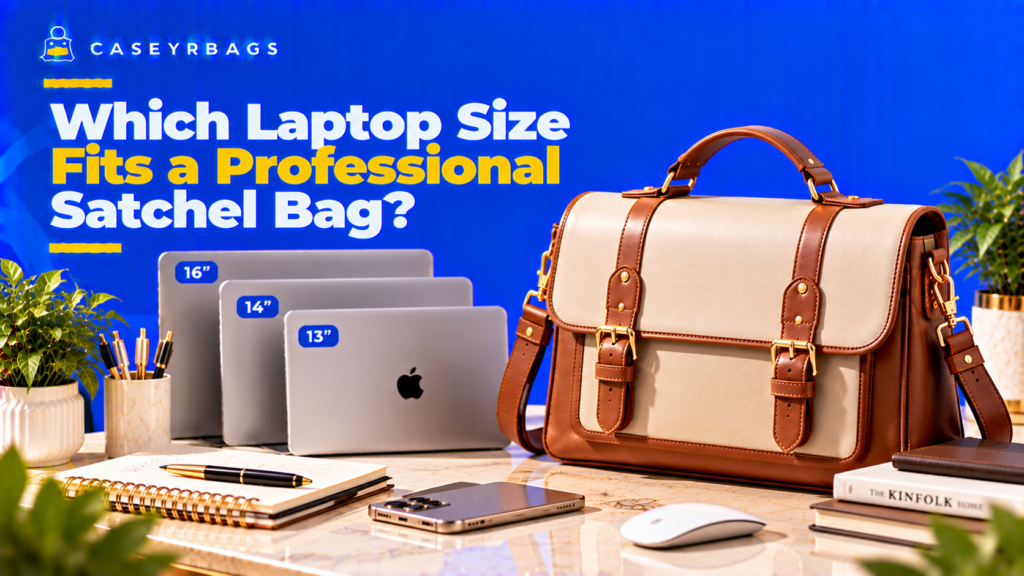
Which Laptop Size Fits a Professional Satchel Bag? | CaseyrBags Which Laptop Size Fits a Professional Satchel Bag? Many Professional Satchel Bags most naturally accommodate 13-inch to 14-inch laptop classes, while larger designs may fit 15-inch, 15.6-inch, or some 16-inch devices when their usable opening, internal geometry, and intended device zone provide sufficient clearance. These labels indicate likely compatibility only because laptops with the same screen diagonal can have different chassis widths, heights, thicknesses, hinges, bezels, and protective cases. Compare the laptop’s complete carried dimensions with the Satchel’s opening, sleeve mouth, sleeve body or chamber, and closure. A practical fit allows unforced insertion and retrieval while preserving room for documents, a notebook, charger, accessories, personal essentials, and controlled loaded depth. The final choice should be the smallest Professional Satchel that passes the complete recurring-load test. KEY TAKEAWAY 13–14-inch laptop classes are often the easiest starting point, while 15–16-inch classes require increasingly specific Satchel geometry. The reliable decision comes from the actual carried width, height, thickness, opening clearance, device zone, closure, retrieval, and remaining work capacity—not screen size alone. Strong Tendency 13–14 InchOften easier to accommodate while preserving documents, charger space, access, and controlled loaded depth. Conditional Fit 15 / 15.6 InchRequires stronger verification of carried chassis, opening, sleeve or chamber, closure, and remaining work capacity. Design-Specific 16 InchNeeds deliberately compatible opening and device-zone geometry; small chassis or case differences can decide the outcome. Which Laptop Sizes Commonly Fit a Professional Satchel Bag? 13-inch and 14-inch laptop classes are often the easiest to accommodate in Professional Satchels because their fixed rectangular demand is commonly lower. Actual carried chassis dimensions, not the screen-size label, determine fit. 15-inch and 15.6-inch devices can fit larger or better-proportioned Professional Satchels when internal width, height, opening, sleeve, and depth are sufficient. These devices use more of the bag’s fixed rectangular area and can reduce remaining work capacity. 16-inch compatibility is increasingly Satchel-specific and usually requires a deliberately larger opening and device zone. Small differences in chassis, case, sleeve padding, or opening structure can decide the outcome near this fit boundary. For the wider carry-and-capacity system, see Satchel Bag. PROFESSIONAL SATCHEL LAPTOP-FIT ANATOMY CARRIED LAPTOP CHARGER /ACCESSORY USABLE OPENING DEVICE ZONE + REMAINING WORK CAPACITYCASEYRBAGS.COM Figure 1. Professional Satchel Laptop-Fit Anatomy Maps carried-device dimensions, opening, sleeve mouth/body, padding, closure, document and charger zones, and loaded depth. Which laptop classes are usually easiest to accommodate? 13-inch and 14-inch laptop classes are often the easiest starting points for many Professional Satchels because their fixed rectangular demand is usually lower. 13-inch and 14-inch classes as strong starting tendencies in many Professional Satchels. Explain that their smaller footprints often preserve more room for documents, a notebook, charger, accessories, and personal essentials. The comparison should use actual carried-device geometry and the same Professional Satchel structure rather than screen-size labels alone. Preserve the boundary: a bulky case, unusually wide chassis, narrow opening, or compact sleeve can still create a mismatch. Do not guarantee that any 13-inch or 14-inch device fits by label alone. The result should be verified through opening, seating, closure, retrieval, remaining-capacity, and loaded-profile checks before compatibility is accepted. When do 15-inch and 15.6-inch laptops fit? 15-inch and 15.6-inch laptops fit only when the actual carried chassis clears the opening, device zone, and remaining work-load requirements without forcing the Satchel. Actual carried width, height, thickness, opening clearance, sleeve or chamber dimensions, and enough loaded-depth capacity. Explain that chassis width and opening width frequently become the limiting pair, depending on design. The comparison should use actual carried-device geometry and the same Professional Satchel structure rather than screen-size labels alone. The normal documents and charger to remain functional after insertion. A 15/15.6-inch laptop does not practically fit when it enters but consumes the closure path, document zone, or nearly all flexible capacity. The result should be verified through opening, seating, closure, retrieval, remaining-capacity, and loaded-profile checks before compatibility is accepted. When is a 16-inch laptop practical? A 16-inch-class laptop is practical only when the exact carried geometry matches a deliberately compatible opening and device zone while the rest of the work load still functions. A 16-inch-class device is practical only when the exact carried chassis clears the opening and intended device zone without force and the Satchel still supports its recurring work load. Treat the class as increasingly design-specific. A larger Satchel may be justified when the 16-inch device is a recurring requirement and smaller structures crowd or distort. Do not force a large device into geometry designed for a smaller class or size permanently around a hypothetical future laptop. The result should be verified through opening, seating, closure, retrieval, remaining-capacity, and loaded-profile checks before compatibility is accepted. Screen Size → Fit-Likelihood Matrix Laptop Class Professional Satchel Fit Tendency Primary Constraint 13-inch Strong in many designs Actual carried chassis and opening 14-inch Strong–Moderate Sleeve/opening clearance 15-inch / 15.6-inch Conditional Width, height, remaining capacity 16-inch More design-specific Overall geometry, opening, loaded depth Larger workstation class Usually weak Fixed rectangular demand and bulk Why Does Screen Size Not Determine Professional Satchel Fit? Advertised screen size usually describes the display diagonal, while a Professional Satchel must accommodate the complete exterior chassis and protective setup. Screen class is therefore an orientation tool, not a bag-dimension substitute. What does advertised screen size actually describe? Advertised screen size describes the display diagonal, not the complete exterior width, height, thickness, hinge, case, or corner geometry the Satchel must accommodate. 13-inch, 14-inch, 15.6-inch, and 16-inch labels normally refer to the visible display diagonal rather than the laptop’s external side-to-side width, front-to-back height, or closed thickness. The comparison should use actual carried-device geometry and the same Professional Satchel structure rather than screen-size labels alone. Screen size ≠ laptop chassis size. Use the class only to narrow the search; do not convert the diagonal directly into a sleeve-width or bag-width requirement. The result should be verified through opening, seating, closure, retrieval, remaining-capacity, and loaded-profile checks before compatibility is accepted. Why can two laptops in the same class have different footprints? Two laptops
What Capacity Range Suits a Professional Satchel Bag?
What Capacity Range Suits a Professional Satchel Bag? | CaseyrBags What Capacity Range Suits a Professional Satchel Bag? A practical Professional Satchel Bag generally falls within a broad \~8–20 liter functional range, with \~12–16 liters serving as a useful core band for many recurring work loads. The \~8–12 L band suits restrained document-and-essentials carry, while \~16–20 L is better reserved for recurring thicker documents, a larger compatible device setup, additional accessories, or meaningful day-to-day variation. Usable geometry matters more than liters alone: internal width and height must clear normal documents and the protected device, while depth, opening, sleeves, compartments, and closure must preserve direct retrieval. Choose the smallest capacity that holds the recurring load with a controlled profile and modest access clearance rather than sizing permanently around a rare maximum day. KEY TAKEAWAY A Professional Satchel usually works within a broad \~8–20 L reference range, but the right choice is the smallest usable structure that fits the recurring professional load while preserving opening access, organized retrieval, controlled depth, practical carry, and modest reserve space. Compact Signal \~8–12 LBest when the recurring load is deliberately restrained and flat items clear the chamber and opening without crowding. Core Signal \~12–16 LA useful middle band for many document-and-device loads when geometry, intrusion, and opening remain practical. Expanded Signal \~16–20 LJustified when larger recurring demand genuinely uses the extra space without creating permanent bulk or difficult carry. What Capacity Range Is Practical for a Professional Satchel Bag? A Professional Satchel commonly works within a broad \~8–20 L functional reference range, while actual fit depends on internal geometry and the recurring work load. Compact, core, and expanded bands are comparison tools rather than strict category limits. The \~8–12 L band represents compact capacity for deliberately restrained loads, while \~12–16 L is a useful core band for many document-and-device setups. The middle range is not mandatory for every professional user. The \~16–20 L band represents expanded capacity for recurring thicker documents, larger compatible device zones, additional work accessories, or greater daily variation. Added volume must solve normal demand without creating unnecessary depth, movement, or permanent unused bulk. For the wider carry-and-capacity system, see Satchel Bag. PROFESSIONAL SATCHEL CAPACITY ANATOMY DOCUMENT ZONE DEVICE SLEEVE OPENING SPAN SUPPORTED BASE + RESERVE SPACECASEYRBAGS.COM Figure 1. Professional Satchel Capacity Anatomy Maps the internal dimensions, opening, document/device zones, structural intrusion, supported base, closure clearance, and reserve space. What does the \\\~8–12 L compact range suit? A restrained load such as one slim folder or document set, a compact notebook, phone, wallet or cardholder, keys, and a few small accessories. A compact compatible device may be included only when the actual protected dimensions clear the chamber and opening. The result should be verified with the same recurring item list rather than judged from an empty bag or stated liters alone. The condition: compact capacity works when daily work items are intentionally limited and retrieval remains direct. If the normal load bends documents, crowds the protected device, blocks the opening, or removes all reserve clearance, the band fails regardless of its stated liters. The final judgment should remain tied to measurable geometry, opening access, loaded behavior, and the complete recurring-work-load test. Why is \\\~12–16 L a useful core range? A balanced recurring setup: document folder, compatible portable device when required, notebook or planner, charger, selected work accessories, personal essentials, and modest reserve space. Keep the example illustrative, not mandatory. The result should be verified with the same recurring item list rather than judged from an empty bag or stated liters alone. The band can balance flat-item area, moderate depth, organization, and controlled external bulk. Add the boundary that poor proportions, a large intrusive sleeve, excessive organizers, taper, or a narrow opening can make a core-band Satchel less practical than its volume suggests. The final judgment should remain tied to measurable geometry, opening access, loaded behavior, and the complete recurring-work-load test. When does the \\\~16–20 L expanded range make sense? Expansion to recurring evidence: thicker document sets, a larger compatible protected device, an additional planner or notebook, a larger charger setup, more work tools, or meaningful daily variation. Do not justify the band with a rare maximum-load day alone. The result should be verified with the same recurring item list rather than judged from an empty bag or stated liters alone. The trade-off: greater capacity can add external dimensions, loaded depth, item movement, and more load potential. The expanded band passes only when its added space is used regularly and the normal load still preserves direct access, controlled shape, and practical handle or shoulder carry. The final judgment should remain tied to measurable geometry, opening access, loaded behavior, and the complete recurring-work-load test. Capacity Band → Work-Load Matrix Capacity Band Functional Role Typical Recurring Load Primary Watchpoint \~8–12 L Compact Professional Slim documents, notebook, limited essentials, compact compatible device where geometry permits Crowding and blocked opening \~12–16 L Core Professional Documents, compatible device, notebook, charger, selected accessories, modest reserve Poor proportions or intrusion \~16–20 L Expanded Professional Thicker documents, larger compatible device zone, additional accessories, greater variation Excess depth and permanent unused bulk Why Do Nominal Liters Not Tell the Full Capacity Story? Nominal liters describe total volume but do not reveal chamber proportions, rectangular clearance, opening path, taper, or structural intrusion. Two similarly rated Professional Satchels can therefore support different recurring work loads. How does nominal volume become usable capacity? Nominal volume becomes usable capacity only after panels, padding, lining, sleeves, dividers, pockets, taper, reinforcement, and closure clearance are accounted for. Panels, seam allowances, padding, lining, a device sleeve, dividers, pocket layers, taper, reinforcement, and closure clearance occupy or reshape some of the stated volume. Avoid presenting a fixed deduction because construction varies. The result should be verified with the same recurring item list rather than judged from an empty bag or stated liters alone. Direct the reader to use the liter figure for initial band selection, then verify the actual chamber and load. Maintain nominal liters ≠ usable work capacity and