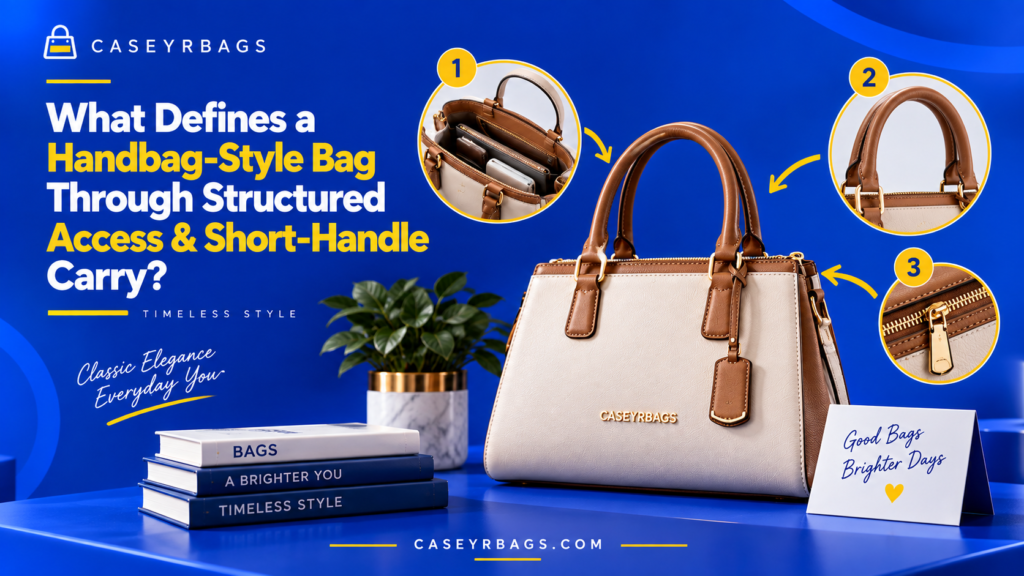
What Defines a Handbag-Style Bag Through Structured Access & Short-Handle Carry?
A Handbag-Style Bag is typically defined by a relatively shape-controlled body, a deliberate main opening, and short handles designed primarily for hand or forearm carry. These features create a compact personal-item container whose opening, contents, and carry position remain more structurally defined than those of many open or long-strap bag formats.
Its identity does not depend on decoration, price, or small size alone. The strongest definition comes from the combination of structured access, short-handle carry, predictable bag shape, and organized personal-item storage working as one system.
What Structurally Defines a Handbag-Style Bag?
A Handbag-Style Bag generally combines a compact personal-item carrying body with enough structure to preserve a recognizable shape when opened, carried, or set down. The body may be soft-structured, semi-structured, or highly structured rather than completely rigid.
Its opening is usually more deliberate than a continuously open carry chamber. Zippers, framed openings, flaps, snaps, or other closure systems create a defined access boundary and help keep the bag’s internal storage organized around personal-item retrieval.
Short handles complete the primary carry identity. Within Everyday Carry, their geometry normally positions the bag in the hand, at the forearm, or close to the upper side rather than creating the long suspension path associated with dedicated shoulder or crossbody formats.
Which Features Create the Strongest Handbag-Style Identity?
A shape-retaining body, controlled main opening, short handles, integrated handle anchors, a compact personal-item chamber, and purposeful internal organization all reinforce the same structural identity. Each feature contributes either to body control, access control, or the primary carry path.
Feature → functional role → identity signal. The strongest classification appears when these features work together rather than when one isolated characteristic dominates the judgment.
Which Features Are Secondary Rather Than Defining?
Decorative hardware, color, ornamentation, brand identity, detachable long straps, and exterior styling can change appearance or versatility without necessarily changing the bag’s core structural function.
Visual styling can modify the bag without defining its structural category. Secondary features matter only when they begin to alter the dominant body-access-carry system.
Why Must the Features Be Evaluated Together?
Short handles alone can appear on totes, briefcase-style bags, and utility formats, while a structured body can appear on many shoulder or travel bags. Neither signal independently establishes Handbag-Style identity.
Handbag-Style identity comes from a coherent body-access-carry system. Structure, access, organization, and primary carry geometry should all point in the same direction.
How Does Body Structure Define a Handbag-Style Bag?
Body structure creates the stable geometry that lets the opening, compartments, handles, and base behave predictably during personal-item use.
What Does a Structured Handbag Body Actually Mean?
Structure can come from material stiffness, layered panels, reinforcement, edge construction, base support, or internal shaping. These features help the bag retain a recognizable form rather than collapse completely around its contents.
Structured ≠ hard-shell. A Handbag-Style Bag can remain soft-structured or semi-structured as long as enough shape retention supports its intended access and carry geometry.
Why Does Shape Retention Matter for Access?
Stable body geometry keeps the main opening in a more predictable position and helps internal compartments remain where the user expects them during retrieval.
Stable body geometry → predictable opening position → predictable compartment access. Shape retention therefore reinforces structured access without requiring maximum rigidity.
When Can a Softer Bag Still Remain Handbag-Style?
Flexible panels can coexist with a defined main opening, short-handle geometry, a stable upper edge, and organized personal-item storage. Softness does not automatically erase category identity.
Structure exists on a spectrum rather than as a rigid/soft binary. The relevant question is whether the overall form remains sufficiently controlled for predictable access and short-handle carry.
| Body Character | Shape Retention | Access Predictability | Handbag-Style Potential |
|---|---|---|---|
| Highly structured | High | High | Strong |
| Semi-structured | Moderate–high | High | Strong |
| Soft-structured | Moderate | Context-dependent | Possible |
| Fully collapsible/open | Low | Lower | Weaker identity signal |
What Does Structured Access Mean in a Handbag-Style Bag?
Structured access means that the main entry point, surrounding body panels, and compartment system keep retrieval deliberate and predictable rather than simply making the bag difficult to open.
How Does a Defined Main Opening Create Structured Access?
A known opening boundary gives the user a predictable entry point and limits where the compartment expands during retrieval. The opening can be narrow, broad, framed, zipped, or covered depending on design.
Known opening boundary → predictable entry point → controlled retrieval. Structured access refers to repeatable access behavior, not one mandatory closure format.
How Does Body Shape Support Opening Control?
Stable surrounding panels can help prevent the opening from collapsing, twisting, becoming difficult to locate, or changing shape excessively while the bag is handled.
Body structure supports opening control by preserving geometry around the access zone. The closure still works as part of the system rather than as the sole source of structure.
Why Is Structured Access Different From Maximum Closure Security?
Structured access means the opening remains predictable and controlled during normal use; it does not mean the bag must be difficult or slow to open.
Controlled access ≠ restricted access. When added structure begins to create unnecessary retrieval friction, Structured Access becomes the narrower supporting question.
How Do Main Opening & Closure Design Reinforce Handbag Identity?
Closure architecture shapes how the controlled opening behaves, but the closure reinforces Handbag-Style identity only when body structure and carry geometry support the same personal-item access system.
How Does a Zipper Support Structured Handbag Access?
A zipper can create a defined opening path, allow controlled compartment exposure, and let the user vary how widely the main chamber opens during retrieval.
The zipper strengthens identity only when the surrounding body and organization remain handbag-oriented. A zipper by itself can appear on many bag categories.
How Do Frame, Flap, Snap, or Magnetic Closures Change Access?
A frame can preserve a defined opening geometry, a flap can cover the entry point, and snaps or magnets can provide quick controlled closure. Each changes the opening sequence in a different way.
No closure type is universally superior. The useful question is how the closure works with body structure, opening geometry, and personal-item access.
Why Does Closure Type Not Define the Category by Itself?
The same zipper, flap, snap, or magnetic closure can appear on totes, shoulder bags, crossbody bags, and other formats. Closure type is therefore not a unique taxonomic signal.
Closure supports identity only when body and carry geometry reinforce it. The full body-access-carry relationship remains the stronger classifier.
Why Are Short Handles Central to Handbag-Style Carry?
Short handles are one of the strongest carry-format signals because they keep the support path compact and connect the bag directly to hand or forearm control.
How Do Short Handles Create Hand Carry?
Limited handle drop keeps the bag suspended directly below the hand and reduces the long free suspension associated with dedicated shoulder straps.
Short handle → direct hand support → compact suspension path. The result strengthens Handbag-Style carry identity when the body and access system reinforce it.
How Can Short Handles Support Forearm Carry?
Where the opening beneath the handles permits it, the hand can move through to the forearm while the bag remains relatively close to the upper side.
Hand → forearm transition can preserve compact carry, but not every handle opening suits every forearm. Geometry and user dimensions still matter.
Why Do Short Handles Create a Different Carry Identity From Long Shoulder Straps?
Short handles create direct hand or forearm support, while a longer shoulder strap creates a longer side-suspension path from the shoulder.
Carry path is a strong bag-type signal. For the dedicated mechanism, Short Handles explains why this geometry matters to Handbag-Style identity.
How Does Handle Drop Affect Handbag-Style Carry?
Handle drop determines how much clearance exists beneath the handles and therefore whether the bag remains primarily hand-oriented or expands into forearm, elbow, or possible shoulder carry.
What Does a Short Handle Drop Do?
A short drop supports direct hand carry, limits shoulder clearance, keeps the bag near the carrying hand, and preserves compact carry geometry.
Limited drop strengthens short-handle identity but does not define the entire category. Body structure and access still need to reinforce the same function.
When Does a Longer Handle Drop Begin to Change Carry Behavior?
Increasing clearance can support forearm, elbow, or in some designs shoulder carry. The exact transition depends on bag width, handle spacing, flexibility, clothing, and body dimensions.
Longer handle drop → more carry-mode flexibility → greater hybrid identity potential. No universal numerical threshold defines the change.
Why Is Handle Drop Relative Rather Than Absolute?
The same measured drop can behave differently on bags with different widths, handle spacing, clothing conditions, body dimensions, or handle flexibility.
Handle drop should be interpreted through intended carry mode, not one universal measurement. When the geometry begins shifting from hand to elbow carry, Elbow Carry becomes the supporting transition question.
| Handle Drop Character | Likely Carry Role | Identity Effect |
|---|---|---|
| Very short | Hand carry | Strong short-handle signal |
| Short–moderate | Hand / forearm | Strong handbag signal |
| Longer | Forearm / possible shoulder | Identity becomes more hybrid |
| Long shoulder clearance | Shoulder-oriented | Weaker short-handle identity |
How Do Handle Anchors Support Short-Handle Carry?
Handle anchors connect the short handles to the upper bag structure and influence whether the opening and body remain predictably oriented while carried.
How Do Separated Handle Anchors Stabilize the Bag Body?
Separated attachment points feed the handle load into multiple upper-body zones and can provide broader control of the bag’s orientation.
Separated anchors → load enters multiple upper-body points → more controlled orientation. The geometry strengthens short-handle function when the body panels remain stable.
Why Does Anchor Reinforcement Matter?
Reinforcement helps preserve attachment position, transfer load into the bag panels, and resist local deformation around the handle connection.
Reinforcement strength ≠ carry-mode identity. Strong construction supports the system, but the classification still depends on the complete body-access-carry relationship.
How Can Poor Anchor Geometry Affect Handbag-Style Carry?
Poor anchor placement can contribute to upper-edge collapse, bag tilt, handle twisting, or uneven opening geometry while the bag is suspended.
These effects weaken the predictability expected from structured personal-item access and short-handle carry. Orientation therefore matters alongside anchor strength.
How Does the Structured Base Support Handbag-Style Form?
The base supports lower-body geometry so the body panels, compartments, and opening can retain a more predictable form when the bag is loaded or set down.
How Does a Stable Base Help Maintain Bag Shape?
Base support helps retain the lower geometry and gives the surrounding panels a more predictable platform from which to hold the bag’s intended form.
Base support → retained lower geometry → more predictable body shape. The base reinforces structure without requiring a hard rigid shell.
How Does Base Structure Affect Internal Organization?
A stable lower area can reduce bottom collapse, keep items from pooling unpredictably, and help compartment boundaries retain useful positions.
The result is more predictable item placement and compartment geometry. Base structure therefore supports both shape and access.
Does Every Handbag-Style Bag Need a Rigid Base?
No. Flexible, lightly reinforced, or semi-structured bases can still support Handbag-Style identity when they retain enough stability for the intended form.
Base stability matters more than maximum rigidity. The relevant test is whether the lower body supports predictable structure during normal use.
How Does Internal Organization Reinforce Structured Access?
Internal organization reinforces Handbag-Style identity when it supports repeatable personal-item retrieval rather than simply maximizing the number of pockets.
How Do Internal Pockets Create Predictable Item Zones?
Internal pockets separate small items, create repeatable storage positions, and reduce the need to search through the entire main chamber.
Defined item zones strengthen personal-item access by making retrieval more deliberate and predictable. Pocket placement matters more than raw pocket count.
How Do Divided Compartments Change Handbag Access?
Dividing the main chamber creates distinct item zones and can limit how much of the bag must be searched or exposed during retrieval.
Main chamber subdivision → defined item zones → more deliberate retrieval. The benefit depends on useful organization rather than maximum segmentation.
Why Do More Compartments Not Automatically Strengthen Handbag-Style Identity?
Too many compartments can fragment usable space, duplicate pocket roles, or make simple retrieval more complicated.
Structured organization ≠ maximum pocket count. The organization should support predictable access rather than add complexity for its own sake.
How Do Structured Access & Short Handles Work Together?
Structured access and short-handle carry reinforce each other when direct hand control keeps the bag oriented while the defined opening and compartments support predictable retrieval.
How Does Short-Handle Carry Stabilize Access Orientation?
Direct hand control makes it easier to keep the bag body in a deliberate orientation while positioning the main opening for access.
Direct hand control → predictable bag orientation → easier positioning of the main opening. Carry geometry therefore supports access behavior.
How Does Structured Access Support Hand-Held Retrieval?
A defined opening can remain easier to locate and control when the bag is set down, stabilized with one hand, or held close during retrieval.
The structured body and opening work with the short handles to keep personal-item access predictable across common carry and set-down states.
Why Does Neither Feature Fully Define the Bag Alone?
Short handles without structured personal-item access may resemble utility or Tote formats, while structured access without short-handle identity can belong to Shoulder Bag or Crossbody formats.
The combination creates the strongest Handbag-Style signal. For the dedicated access mechanism, Retrieval explains how this structural system changes item access.
How Does Load Placement Affect Handbag-Style Carry?
Internal loading should preserve the bag’s structured form, opening geometry, and short-handle orientation rather than distort them through concentrated weight or overfilling.
Where Should Dense Items Be Positioned?
Dense items generally behave more predictably when kept reasonably low and centered instead of concentrated strongly at one end. The exact placement depends on the bag’s internal architecture.
Centered dense loading helps preserve orientation and base stability without creating one universal exact placement rule.
How Can One-Sided Loading Distort Handbag Form?
Weight concentrated at one end can create tilt, uneven anchor demand, upper-edge distortion, or unequal pressure across the base.
These changes can weaken structured access by changing how the opening and handles align. Load placement therefore supports taxonomy as well as carry behavior.
Why Can Overfilling Reduce Structured Access?
An overfilled chamber can create closure tension, distort the opening, deform the upper edge, and make retrieval less predictable.
Overfilled chamber → closure tension → opening distortion → poorer structured access. Available volume ≠ useful structured capacity.
When Does an Optional Shoulder Strap Change Handbag Carry?
An optional long strap can add versatility without replacing Handbag-Style identity when short handles remain the dominant structural carry path.
Can a Handbag-Style Bag Include a Detachable Shoulder Strap?
Yes. Primary short handles can coexist with a secondary long strap and give the user more than one carry option.
Multiple carry options do not automatically change classification. The dominant body, access, and primary handles still determine the main identity.
When Does the Long Strap Remain a Secondary Feature?
The long strap remains secondary when short handles stay structurally primary, the body and opening remain handbag-oriented, and the long strap is detachable or supplementary.
Optional long strap remains secondary → primary short-handle identity preserved. Versatility does not automatically override taxonomy.
When Does Carry Identity Become More Hybrid?
Hybrid identity becomes stronger when the long shoulder strap becomes the main carry path, short handles become minor, and the bag geometry is optimized primarily for shoulder suspension.
Accessory strap presence ≠ automatic category change. The category shifts only when the dominant carry architecture itself changes.
How Does a Handbag-Style Bag Differ From a Tote Bag?
The distinction is strongest when comparing dominant access behavior, handle geometry, and internal use rather than relying on size or appearance.
How Does Structured Access Differ From Classic Open Tote Access?
Handbag-Style Bags typically use a more defined main opening, closure relationship, and personal-item access pattern, while classic Tote Bags often emphasize broader, more open chamber access.
These are typical structural tendencies rather than absolute rules. Some totes can be structured and some handbags can be relatively open.
How Do Short Handles Differ From Adaptable Tote Handles?
Tote handles often support direct hand carry and, depending on drop, possible shoulder carry. Handbag handles are more strongly associated with compact hand or forearm positioning.
Handle behavior therefore reinforces the larger access-and-body distinction. Handle length alone should not be used as the full classifier.
What Is the Strongest Structural Distinction?
Handbag-Style identity emphasizes controlled personal-item access and compact short-handle carry, while Tote identity often emphasizes open-volume utility and adaptable loading.
The distinction should remain structural and probabilistic rather than absolute. Dominant use and access architecture matter most.
| Structural Signal | Handbag-Style Bag | Tote Bag | Shoulder Bag |
|---|---|---|---|
| Main access | More controlled/defined | Often broad/open | Controlled but variable |
| Primary handles | Short | Short–long adaptable | Longer shoulder strap |
| Body shape | Often structured | Flexible to structured | Variable |
| Carry identity | Hand/forearm | Hand/shoulder utility | Single-strap shoulder |
| Organization | Personal-item focused | Open-volume focused | Side-access focused |
How Does a Handbag-Style Bag Differ From a Shoulder Bag?
The clearest boundary comes from the primary carry path: short-handle hand/forearm suspension versus direct shoulder suspension from a longer strap.
What Separates Short-Handle Carry From Shoulder Carry?
A Handbag-Style Bag typically uses short handles for hand or forearm support, while a Shoulder Bag uses a longer strap or drop intended for direct shoulder suspension.
Short handle → hand/forearm path; longer shoulder strap → direct shoulder suspension. The carry path is a strong taxonomic distinction.
Can Both Bags Have Structured Bodies?
Yes. Handbag-Style Bags and Shoulder Bags can both use structured or semi-structured bodies and controlled closures.
Structure alone cannot distinguish them. The opening architecture and primary carry path must also be considered.
Which Feature Combination Provides the Clearest Distinction?
Use body structure + main access architecture + primary carry path rather than appearance alone. These three signals show how the bag actually functions.
A bag with a structured body and short handles can still become shoulder-oriented if long-strap suspension dominates real use. Dominant function controls the classification.
When Does a Bag Stop Reading Structurally as Handbag-Style?
Handbag-Style identity weakens when one or more defining signals become secondary to open-volume utility, long-strap suspension, or another dominant carry-access pattern.
When Does Open-Volume Access Weaken Handbag-Style Identity?
If the main chamber is extremely open, closure control is minimal, and the bag behaves primarily as unrestricted utility storage, Tote-like access behavior becomes stronger.
Open-volume body + weak closure control → utility-style access dominates → Handbag-Style identity weakens. The shift is structural rather than visual.
When Does Long-Strap Suspension Weaken Short-Handle Identity?
If the long shoulder strap becomes the main suspension system, short handles become secondary, and the body is optimized around side carry, Shoulder Bag or hybrid identity strengthens.
Long strap becomes primary → shoulder suspension dominates → short-handle identity weakens. Optional presence alone is not enough; dominance matters.
Why Should Classification Use the Dominant Structure?
Decorative details, detachable accessories, and small dimensions can create visual ambiguity without changing the core way the bag carries and opens.
Primary structural function should outweigh secondary decorative or optional features. Taxonomy should follow the system that dominates normal use.
How Can Handbag-Style Bag Identity Be Evaluated?
Final classification should inspect body shape, access behavior, handle geometry, organization, and the role of optional straps in a fixed sequence.
What Should Be Checked About the Body?
Inspect shape retention, base support, upper-edge structure, and compartment geometry. These checks show whether the bag maintains enough form to support predictable access.
The body does not need to be rigid. The test is whether the geometry remains recognizable and functional when the bag is opened, carried, or set down.
What Should Be Checked About Access?
Inspect the main opening, closure, opening predictability, and compartment zoning. These features show whether access behaves as a controlled personal-item system.
Structured access should remain predictable rather than unnecessarily difficult. The body and opening should reinforce each other.
Which Sequence Should Determine Final Structural Identity?
- Identify the primary bag body.
- Check whether the body retains a defined shape.
- Identify the main opening.
- Determine whether access is controlled and predictable.
- Identify the primary handles.
- Evaluate handle drop.
- Determine the intended primary carry mode.
- Check internal organization.
- Treat optional long straps as secondary unless they dominate use.
- Compare the dominant structure with Tote and Shoulder Bag patterns.
- Classify according to the strongest structural signals.
Use the sequence in order so classification begins with the primary body and shape retention before opening, handles, and carry mode are judged. Internal organization and optional straps should only be evaluated after the main structure is understood.
Finish by comparing the dominant pattern with Tote and Shoulder Bag structures, then classify from the strongest structural signals. Do not let decoration, size, one closure, or one optional strap override the dominant system.
How Can Handbag-Style Classification Mismatches Be Avoided?
Classification mismatches are avoided by preventing size, appearance, short handles, or one closure from replacing the full structural evaluation.
Why Is Small Size Alone a Weak Handbag-Style Signal?
Compact bags can also be crossbody bags, shoulder bags, clutches, or utility formats. Small dimensions therefore do not uniquely identify Handbag-Style structure.
Small size ≠ handbag identity. The body, opening, organization, and primary carry path still need to reinforce the same category.
Why Are Short Handles Alone Insufficient?
Short handles also appear on totes, briefcase-style bags, travel bags, and utility bags, so the presence of top handles is not a unique taxonomic feature.
Short handles become meaningful only when structured access, personal-item organization, and the body form reinforce the same Handbag-Style function.
What Should Be Verified Before Classifying the Bag as Handbag-Style?
Verify that the body retains a defined shape, the opening has a clear access boundary, organization supports personal-item retrieval, short handles are structurally integrated, handle drop supports hand or forearm use, anchors maintain orientation, and the base supports the intended form.
Also confirm that dense items and overfilling do not destroy geometry, optional long straps remain secondary, and appearance, price, small size, or one isolated feature is not driving the decision. Final classification should follow the dominant body-access-carry relationship.
- Bag has a recognizable personal-item carrying structure.
- Body retains a reasonably defined shape.
- Structured does not need to mean rigid.
- Main opening has a clear access boundary.
- Closure supports predictable access where present.
- Main opening does not behave primarily as unrestricted utility access.
- Internal organization supports personal-item retrieval.
- Short handles are structurally integrated.
- Handle drop primarily supports hand or forearm carry.
- Handle anchors maintain bag orientation.
- Bag remains manageable when carried from the short handles.
- Base provides enough support for the intended structure.
- Dense items do not excessively distort the bag.
- Overfilling does not destroy opening geometry.
- Optional long strap remains secondary where present.
- Appearance, brand, or price is not used as the defining criterion.
- Small size alone is not treated as handbag identity.
- Short handles alone are not treated as handbag identity.
- Tote-like open utility access is distinguished from handbag structured access.
- Shoulder-suspension identity is distinguished from short-handle carry.
- Final classification is based on the dominant body-access-carry relationship.
Conclusion
A Handbag-Style Bag is defined most strongly by the combination of a shape-controlled body, a deliberate personal-item access system, and short handles that prioritize hand or forearm carry. These features create a compact bag architecture in which the body, opening, organization, and carry geometry remain structurally coordinated.
The category should not be assigned from decoration, price, small size, one closure, or short handles alone. Handbag-Style identity is strongest when structured personal-item access and short-handle carry operate as one coherent system, supported by shape retention, stable handle anchors, predictable opening behavior, and organization designed around everyday retrieval. Optional long straps can add versatility without changing that identity unless they become the dominant carry path.
FAQs
No. Handbag-Style Bags may range from soft-structured to semi-structured or highly structured bodies.
The important requirement is enough shape retention and opening control to support predictable access, personal-item organization, and the intended short-handle carry geometry. Structured does not have to mean rigid.
No. Short handles are an important carry-format signal, but they also appear on totes, briefcase-style bags, and other formats.
Body structure, opening architecture, personal-item organization, and the primary carry role must reinforce the same Handbag-Style identity before the category is structurally convincing.
Yes. An optional shoulder strap can add a secondary carry mode without automatically changing the bag’s primary identity.
Handbag-Style classification can remain appropriate when short handles stay dominant, structured handbag access remains dominant, and the longer strap functions as a supplementary rather than primary carry path.