When Does Open-Top Tote Bag Access Need Added Security?
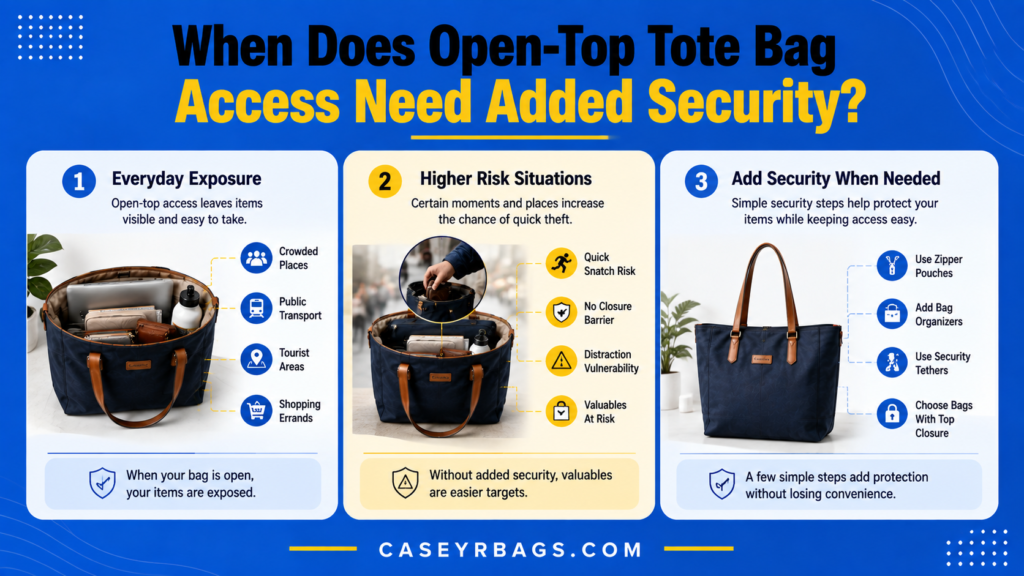
When Does Open-Top Tote Bag Access Need Added Security? Open-Top Tote Bag Access needs added security when unrestricted entry creates enough retention, exposure, or access-control risk to outweigh the convenience of leaving the main opening fully unrestricted. Movement, orientation changes, tipping, crowding, weather, item sensitivity, and retrieval frequency can all change how much control the Tote needs during normal use. The correct response may be no added closure, partial retention, protected internal storage, or a stronger top closure. Open access ≠ automatic insecurity, and greater security ≠ automatically better Tote usability. The goal is to match the security layer to the actual risk while keeping routine retrieval practical, rather than sealing the entire Tote simply because its main opening is broad and direct. KEY TAKEAWAY Added Tote security should solve a real retention or exposure problem. Stable low-risk carry may need no extra closure, while movement, tipping, sensitive contents, or environmental exposure can justify partial, selective, or stronger retention—provided the added control does not create unnecessary access friction. Open-Top Tote Security Need Key LOW SECURITY NEEDOpen access remains appropriate when actual exposure and retention risk stay low. PARTIAL RETENTION NEEDLight opening control improves retention without requiring full closure. SELECTIVE PROTECTION NEEDOnly particular contents need stronger protected storage. STRONGER TOP RETENTIONMovement, exposure, or contents justify greater opening containment. GRAY ZONESecurity improves retention but creates meaningful routine access friction. What Makes Added Security Necessary for Open-Top Tote Bag Access? Added security becomes necessary when unrestricted Open-Top Tote access creates a meaningful retention, exposure, or access-control problem during normal carrying. Stable upright use in a controlled setting can leave the broad opening practical when contents are low-risk, predictable, and unlikely to move toward the rim. The need changes when movement, tipping, crowding, weather, loose objects, or sensitive contents increase the consequence of leaving the opening unrestricted. A security feature should answer that specific condition rather than being added automatically because the Tote has an open top. Access frequency also matters because repeatedly used essentials can become frustrating behind a high-friction closure, while lower-frequency sensitive contents may justify stronger control. Security level must match both risk and retrieval frequency. The broader Tote Bag structure provides the parent context for how security interacts with opening form, handles, storage behavior, and utility carry. Which Conditions Create the Strongest Need for Added Security? The strongest need for added security appears when multiple exposure conditions act together. Frequent movement can shift contents toward the opening, tipping can convert convenient access into spill exposure, and crowding can reduce control over who or what contacts the upper cavity. Loose small items and sensitive contents increase the consequence if the opening remains uncontrolled. Weather and unpredictable orientation can add further pressure when the Tote is repeatedly set down, angled, or carried through changing environments. The useful chain is condition → retention or exposure risk → security consequence. A strong trigger is not the Open-Top label itself; it is a real use condition that makes unrestricted access meaningfully harder to control. When Can an Open-Top Tote Remain Secure Enough Without Added Closure? An Open-Top Tote can remain appropriately controlled without added top closure when it stays mostly upright, moves predictably, and carries contents with low spill or exposure consequences. A shallow or well-organized interior can keep items below the rim, while protected internal storage can isolate the few objects that need more control without changing the main opening. Low tipping exposure and a controlled setting reduce the value of adding another fastening step. No added closure can therefore be appropriate when actual risk remains low. The correct description is appropriate retention, not guaranteed safety: the absence of a closure does not remove all risk, but neither does it automatically create a meaningful retention problem. Why Does One Security Level Not Fit Every Open-Top Tote? One security level does not fit every Open-Top Tote because contents, movement, environments, and retrieval patterns differ. Low-risk items accessed many times a day benefit from a short, low-friction path, while higher-consequence items retrieved less often can tolerate stronger retention or a protected internal zone. The same closure can therefore be useful for one load and excessive for another. Different contents + different environments → different security requirements. A single sensitive item does not necessarily justify sealing the entire main compartment, and a low-friction opening should not remain unrestricted when repeated tipping makes loose contents difficult to retain. Security works best when it follows the actual risk pattern rather than a universal Tote rule. Open-Top Access → Security Need Map Open-Top Tote access to security need mapA visual path from open-top access through movement, exposure, item sensitivity and access frequency to an appropriate security response. Open-Top Access → Security Need Security should respond to actual exposure, not the Open-Top label alone OPEN ACCESSDirect entry MOVEMENTShift + tipping EXPOSUREContents at risk? ITEM NEEDSensitivity + use MATCHED SECURITY RESPONSENone • partial • selective • stronger Figure 1.0:Movement, exposure, item sensitivity, and retrieval frequency determine whether added control is justified.CASEYRBAGS.COM • Open-top security mechanism How Does Movement Increase the Need for Tote Bag Security? Movement increases the need for Tote security when changes in bag position or orientation allow contents to shift toward the opening, become less controlled, or leave their predictable storage zones. How Can Normal Movement Affect Open-Top Contents? Normal movement affects Open-Top contents by changing their position relative to the opening. Walking, swinging the Tote, setting it down, lifting it again, or moving between hand and shoulder carry can cause loose objects to migrate, stack differently, or press against flexible sidewalls. Handle tension can also deform the opening as the body moves. The mechanism is movement → content displacement → retention need. Movement does not automatically require a zipper, but repeated displacement can make a light closure, stable pocket, or stronger containment more useful when important items repeatedly move toward the rim or become difficult to keep in a controlled zone. When Does Tipping Make Added Closure More Important? Tipping makes added closure more important when the
How Does Open-Top Tote Bag Access Work?
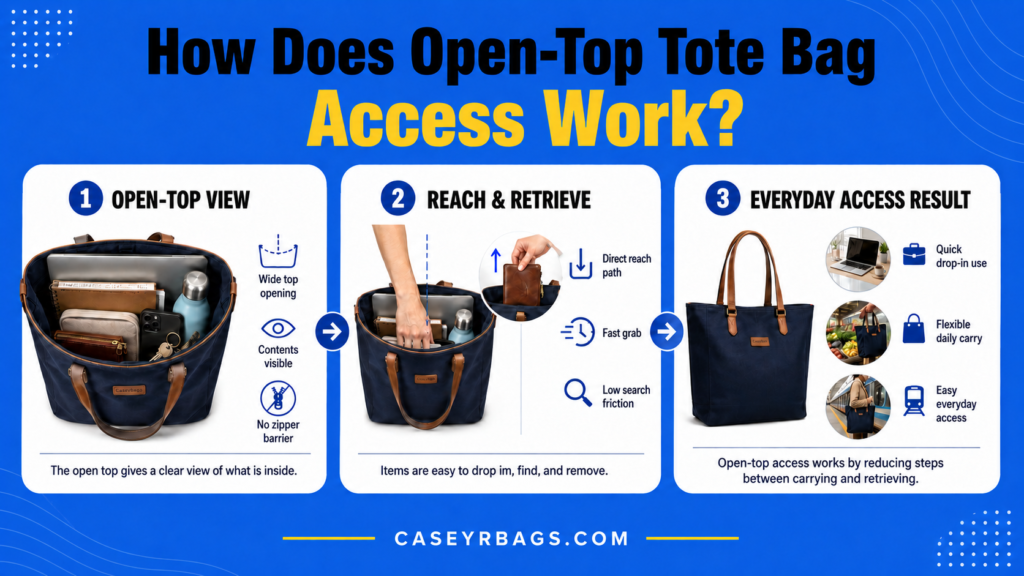
How Does Open-Top Tote Bag Access Work? Open-Top Tote Bag Access works through a broad direct entry into the main storage area, while opening geometry, Tote depth, item position, handles, organization, and retention determine how usable that access becomes. The opening can make loading immediate and expose much of the cavity, but the full access path continues after the hand passes the rim. A Tote may therefore be easy to load yet difficult to search when small items settle below larger objects, handles fall across the opening, or a deep flexible body reduces visibility. Large opening ≠ complete access quality. Strong access depends on whether intended items can be located, reached, and retained with acceptable effort under the way the Tote is actually carried. KEY TAKEAWAY Open-top access is a system, not just an opening. A broad entry lowers loading friction, but manageable depth, predictable item position, clear hand reach, useful organization, and appropriate retention determine whether retrieval remains efficient. Open-Top Tote Access Signal Key STRONG ACCESS SIGNALConsistently lowers retrieval friction for the intended everyday use. SUPPORTING ACCESS SIGNALImproves access under a narrower item, position, or retrieval condition. RETENTION SIGNALMainly controls contents rather than directly improving retrieval. GRAY ZONEImproves loading while reducing retention or item predictability. What Does Open-Top Access Mean in a Tote Bag? Open-Top Tote access means the primary storage area is reached through a broad upper entry that creates a relatively direct loading and retrieval path. Fewer opening steps let the hand move into the main cavity quickly, which makes placement and unloading simple when contents change throughout the day. That direct entry still depends on structural conditions. Opening width determines exposed space, Tote depth determines how far the hand must travel, handle clearance can obstruct or preserve the entry path, body rigidity affects whether the rim stays open, and item position determines what is actually reachable. Low entry friction can therefore coexist with high search effort. The broader Tote Bag structure explains how this access mechanism works with body form, handles, capacity, and utility carry rather than treating the opening as a complete Tote definition. Which Structural Features Directly Control Open-Top Tote Access? Opening width and length control how much of the upper cavity is exposed, while Tote depth controls the vertical reach needed after the hand enters. Side flexibility can let the opening widen around irregular contents or collapse inward when the bag is lightly loaded. Handle spacing and drop affect whether the hand can move through the opening without straps crossing the path. Base width and internal partitions then influence where objects settle. A wider stable base can spread contents laterally, while narrow or shifting interiors can stack them vertically. The mechanism is structural feature → access effect → retrieval consequence. No single dimension proves strong access because the opening, depth, handles, and interior layout work together. Why Does a Broad Opening Make Tote Loading Easier? A broad opening makes Tote loading easier by exposing a larger entry area and reducing the need to align objects with a narrow zipper path or rigid compartment. Irregular item shapes, changing loads, books, clothing, work materials, or shopping contents can be placed directly into the cavity with fewer opening steps. The same geometry also supports fast unloading because the hand can remove larger objects without navigating a small access point. The useful chain is broad opening → low loading friction → easier Tote loading. The boundary is retrieval efficiency: fast entry does not guarantee fast item location after contents begin to stack, migrate, or hide one another inside the body. Why Does Open-Top Access Not Guarantee Easy Retrieval? Open-top access does not guarantee easy retrieval because the opening controls entry into the bag, not the final position of every object. A deep interior can place small items below the natural hand-reach zone, while stacking and crowding can hide frequent objects beneath larger contents. Flexible bodies may also let items migrate toward corners or the base as the Tote moves. Weak organization adds another layer of search effort. If keys, a phone, or a wallet have no predictable location, the user may still need to scan or move several objects despite the opening being fully exposed. Easy opening ≠ easy item location; retrieval quality depends on position, visibility, and reach after entry. Open-Top Tote Access Map Open-Top Tote access mapAnimated access path showing opening, visibility, item position, hand reach, retrieval, and retention.Open-Top Tote Access PathOpening quality depends on the full loading and retrieval pathOPENINGEntry areaVISIBILITYWhat is exposed?POSITIONWhere is the item?HAND REACHReach distanceRETRIEVALRemoval effortRETENTION + ACCESS FITCan the item be reached and kept?Figure 1.0:Opening, visibility, item position, hand reach, retrieval, and retention determine complete access quality.CASEYRBAGS.COM • Open-top access mechanism How Does Opening Geometry Affect Tote Bag Access? Opening geometry affects Tote access by determining how much interior space is exposed, how freely the hand enters, and how stable the access path remains while the bag is loaded or carried. How Does Opening Width Change Access? Opening width changes access by controlling the exposed entry area available for the hand and for wider objects. A wider opening can improve visibility, allow larger items to enter without rotation, and give the hand more lateral freedom during placement or removal. It can also make the upper cavity easier to scan when contents remain below the rim. Wider opening ≠ automatically better access. If the Tote is very deep, heavily crowded, or flexible enough for the rim to collapse, the extra width may improve loading without reducing search effort. Opening width is strongest when it works with manageable depth, stable geometry, and predictable item position. How Does Opening Shape Affect Retrieval? Opening shape changes retrieval because rectangular, narrow elongated, curved, and gathered entries expose different parts of the interior. A rectangular opening can create broad corner-to-corner visibility, while a narrow elongated opening may provide length without much side-to-side hand freedom. Curved or gathered rims can adapt around contents but may reduce the visible area when the material folds inward. The mechanism
What Defines a Tote Bag Through Open-Top Access & Adaptable Utility Carry?
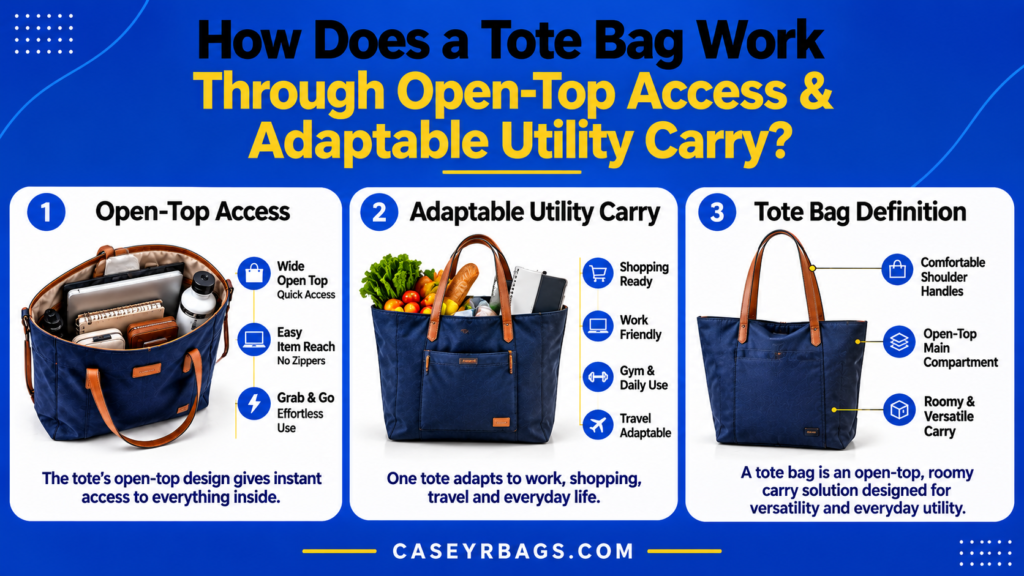
What Defines a Tote Bag Through Open-Top Access & Adaptable Utility Carry? A Tote Bag is defined through the relationship between a broad accessible opening, paired handles, usable interior volume, and a body structure designed for straightforward loading and adaptable utility carry. The recognizable form can be flexible, semi-structured, or structured, but its opening, body, handles, and storage behavior still work together as one practical carry system. Open-top access supports Tote identity because it reduces loading friction and makes changing daily contents easier to place or remove, but open access alone does not make a bag a Tote. Paired handles, body proportions, usable depth, base behavior, and the way the bag carries its normal load also matter. Flexible bodies adapt around irregular contents, while structured bodies preserve shape and item position; both can retain Tote identity when the same core carry architecture remains recognizable. KEY TAKEAWAY A stronger Tote identification comes from the combined relationship between broad top access, paired handles, practical interior volume, recognizable body form, and straightforward utility carry—not from one feature in isolation. What Does Open-Top Access & Adaptable Utility Carry Mean for a Tote Bag? Within Everyday Carry Bag Types, open-top access and adaptable utility carry describe how a Tote Bag combines broad loading access, practical interior volume, paired handles, and straightforward carrying architecture. The form remains identifiable when those features work together to support repeated loading, carrying, and retrieval without depending on a complex harness or highly specialized use case. Which Structural Features Directly Define a Tote Bag? A Tote Bag is most recognizable when a broad primary opening sits above a practical body supported by paired or parallel handles. The body may be tall, wide, shallow, deep, flexible, or structured, but it needs enough usable interior volume to support the general-purpose loading behavior associated with the form. A simple opening-and-handle relationship usually matters more than decorative styling because it controls how the bag is loaded, lifted, and repositioned. The useful mechanism is structural feature → practical effect → Tote identity consequence. Paired handles create a direct lifting architecture, the broad opening reduces loading steps, and the body provides a flexible or controlled storage cavity. Two handles alone are not enough; the relationship between opening, body, usable volume, and carry behavior is what makes the architecture read as a Tote. How Does Open-Top Access Support Tote-Bag Identity? Broad top access supports Tote identity by allowing items to be placed and removed with little setup. A wide opening can accommodate changing daily loads, irregular shapes, work items, shopping contents, or mixed personal objects without requiring every item to pass through a narrow access point. That direct-loading behavior is one of the strongest functional signals associated with the Tote form. Open-Top Tote Access still does not define the category alone. Other open bags can use the same access pattern, so Tote identification also depends on paired handles, body proportion, practical volume, and utility carry. Why Does One Tote Structure Not Fit Every Carrying Use Equally? One Tote structure cannot serve every load equally because flexible and controlled forms respond differently to contents. A soft open Tote can expand around irregular items and compress when lightly loaded, but the same flexibility can allow small objects to migrate or make the opening less predictable. A structured or closable Tote can keep a more stable shape and improve item control, but reinforcement and closures add structure, weight, and access steps. The correct comparison is therefore not open versus secure or flexible versus structured. The useful question is which relationship best matches the repeated load. A Tote remains a Tote across these variations when its broad-access body, paired handles, usable volume, and straightforward utility carry remain structurally recognizable. Tote Structure → Identity Map Tote Feature Practical Effect Identity Consequence Broad primary opening Reduces loading and removal steps Supports characteristic Tote access Paired handles Creates direct hand/elbow/shoulder handling Reinforces recognizable Tote carry architecture Usable body volume Accommodates changing daily contents Supports general-purpose utility Flexible or structured panels Controls how the body responds to load Changes behavior without automatically changing type Simple carry system Limits conversion friction Keeps Tote handling straightforward Tote structure to identity mapAnimated navy diagram showing a Tote Bag in the center with broad opening, paired handles, body volume, and utility carry feeding into Tote identity. Tote Structure → IdentityOpening, handles, body, and utility work as one classification system TOTE BODY BROAD OPENINGLower loading frictionPAIRED HANDLESDirect carry architectureUSABLE VOLUMEChanging-load utilityUTILITY CARRYStraightforward handling Figure 1.0:Tote identity strengthens when opening, handles, body volume, and utility carry reinforce each other.CASEYRBAGS.COM • Tote structure illustration How Does Open-Top Access Shape Tote Bag Use? Open-top access shapes Tote use by reducing loading steps while changing visibility, retrieval effort, retention, security, and organization. The practical value comes from how the opening works with body depth and storage layout, not from opening width by itself. Why Does a Broad Opening Make Tote Loading Adaptable? A broad opening makes Tote loading adaptable because the user can place items directly into the cavity without aligning them with a narrow zipper path or rigid compartment. Irregular objects, changing daily loads, folded garments, books, work materials, or shopping contents can occupy the available volume according to shape rather than a fixed internal grid. The opening therefore reduces loading friction and makes the body more responsive to variation. The same openness can also expose the consequences of poor internal control. If the cavity becomes crowded or too deep, fast loading can create slower retrieval later. Broad opening → low loading friction → flexible Tote use is strongest when the body remains easy to scan and the load stays within the practical range of the structure. How Does Open-Top Access Affect Everyday Retrieval? Open-top access can shorten the path to an item because the user does not need to complete a closure sequence before reaching into the bag. That does not guarantee easy item location. Deep bodies, shifting small objects, limited pockets, and a crowded flexible cavity can create search friction even
How Do Everyday Carry Bag Types Differ Through Carry Adaptability & Everyday Access?
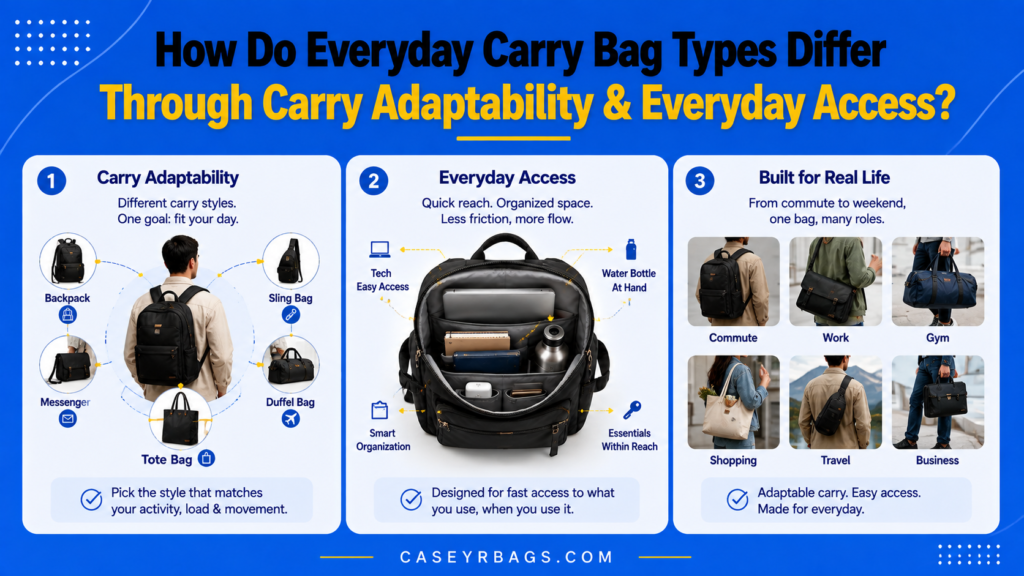
How Do Everyday Carry Bag Types Differ Through Carry Adaptability & Everyday Access? Everyday Carry Bag Types differ through how their carrying systems position and reposition a daily load while their openings and organization control repeated access to frequently used items. A Backpack, Crossbody, Tote, Sling, Messenger, Shoulder Bag, or Daypack can hold a similar amount yet feel completely different because strap systems, handles, body position, opening geometry, and storage zones change how the bag behaves during a normal routine. Carry Adaptability is therefore not the same as simply having more straps or modes, and Everyday Access is not the same as having a fast-opening closure. The useful question is whether a bag can move between the positions you actually use and keep high-frequency items predictably reachable without creating a worse load, security, or organization trade-off. KEY TAKEAWAY Feature flexibility does not automatically create useful Carry Adaptability, and fast retrieval does not automatically create effective Everyday Access. The stronger fit is the one that supports repeated carry transitions and predictable retrieval with acceptable trade-offs. What Do Carry Adaptability & Everyday Access Mean for Everyday Carry Bag Types? Carry Adaptability describes how effectively an Everyday Carry Bag Type can change carrying position or configuration, while Everyday Access describes how predictably routine items can be reached during repeated use. Both signals depend on structure, not marketing labels: straps, handles, openings, pockets, internal layout, and body position determine whether flexibility and access remain useful in practice. This category belongs within the Bag Types explained hub. Which Bag Features Directly Affect Carry Adaptability? Carry Adaptability begins with the bag’s actual carry system: strap count, usable strap-length adjustment, attachment points, handles, removable components, convertible configurations, and the body positions those features make possible. An adjustable diagonal strap can move a bag from hip to front-body carry; a second handle can support a short hand-carry transition; removable hardware can change how the load is supported. The important boundary is whether the transition solves a repeated need. A bag with several theoretical configurations may still have weak adaptability if the user never changes modes or if the transition requires awkward setup. Useful adaptability follows a practical chain: carry feature → possible transition → everyday consequence. Adjustment range alone is not proof that the adjustment improves the routine. Which Bag Features Directly Affect Everyday Access? Everyday Access depends on opening location, closure type, external pockets, compartment layout, bag orientation, body position, and whether the bag must be removed before the main contents can be reached. A front-facing pocket may reduce retrieval steps for a phone or keys, while a rear main compartment can require a larger movement even when the zipper itself opens quickly. This distinction matters because opening access and actual item access are not identical. A wide opening can expose a large cavity but still produce search friction when frequently used items move around. Predictable access occurs when storage position, closure behavior, and body position work together so the same item can be reached with a repeatable sequence. Why Does One Everyday Bag Form Not Provide the Best Balance for Every Routine? Each everyday bag form emphasizes a different combination of stability, access, retention, and repositioning. Front- or side-oriented bags can shorten the retrieval path, but their smaller or asymmetrical carry systems may become less useful as load volume or duration increases. Rear-positioned bags can stabilize a larger load but commonly require more repositioning for primary access. The same trade-off appears in closures and organization. An open top can reduce access steps while offering less retention control; a secure flap or zipper can improve containment while adding an opening action. Different routines therefore produce different optimal balances. The goal is not maximum access or maximum adaptability in isolation, but a pattern that remains useful under the normal daily load. Everyday Carry Type → Adaptability & Access Map Bag Feature Practical Effect Everyday Consequence Adjustable strap Changes carrying height or position Increases positional flexibility Multiple handles Enables alternative handling Supports short carry transitions Front/side positioning Brings contents closer Reduces retrieval steps Rear positioning Stabilizes load May increase access effort External pockets Separates frequent items Improves predictable retrieval Secure closure Adds retention May increase opening steps Adaptability and everyday access behavior map An advanced animated dark navy illustration with a walking person carrying a crossbody bag, a glowing Carry Adaptability card, a glowing Everyday Access card, and a yellow directional flow showing transition and retrieval behavior. Adaptability + Everyday Access Behavior map of position, transition, and retrieval path CARRY ADAPTABILITY Useful transitions EVERYDAY ACCESS Predictable retrieval Figure 1.0: Useful carry transitions change body position, while useful everyday access shortens and stabilizes a repeatable retrieval path.CASEYRBAGS.COM • Advanced carry/access illustration How Do Common Everyday Carry Bag Types Balance Adaptability & Access? Common Everyday Carry Bag Types balance adaptability and access differently because their carrying systems, body positions, openings, and practical load ranges create different daily behaviors. The comparison is most useful when each form is judged by its primary position, realistic repositioning pattern, retrieval method, and the trade-off that appears as the normal load changes. How Do Backpacks Differ From Crossbody & Sling Bags? Backpack Two-strap rear positioning distributes the load across both shoulders and tends to stabilize movement, especially when the contents become larger or the carrying duration grows. The main-compartment trade-off is repositioning: the bag is usually behind the body, so direct access often requires removal, partial rotation, or use of a dedicated quick-access zone. External pockets and predictable organization can reduce that penalty. Crossbody A diagonal strap supports close-body front or side positioning, which can keep personal items inside the user’s immediate reach. That can reduce retrieval repositioning because the bag can remain on-body during access. The boundary appears as volume and weight increase: a larger asymmetric load can make the same close-body position less useful. Sling A Sling Bag uses asymmetrical carry plus back-to-front rotation to create a temporary access position. That movement can work well for compact items because the bag does not
13 Bag Type Categories by Structural Identity & Use Context
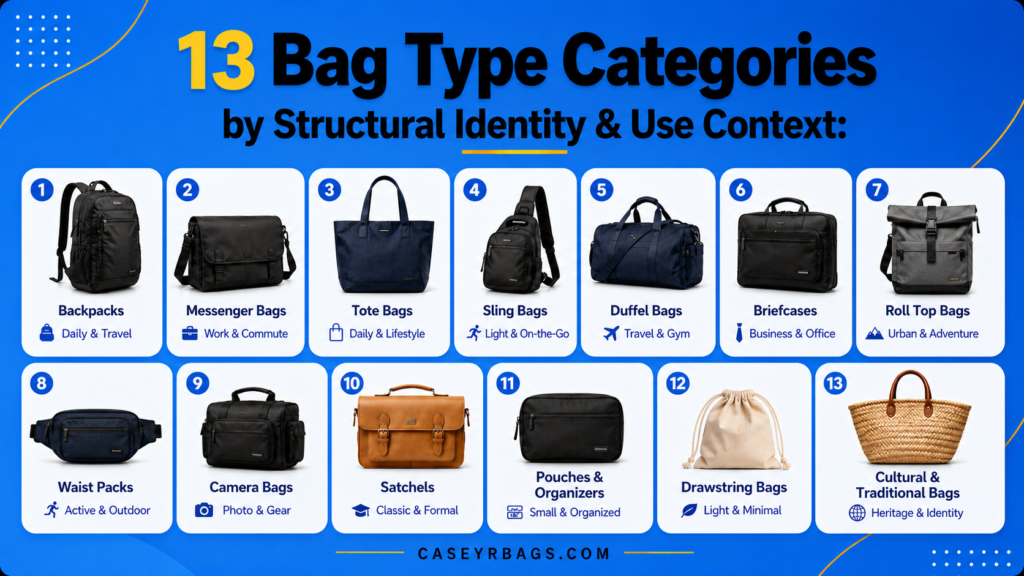
13 Bag Type Categories by Structural Identity & Use Context The 13 Bag Type Categories can be distinguished by examining both what a bag physically is and the context it is designed to serve. Silhouette, construction, size, opening structure, carry configuration, capacity, and internal architecture create structural identity, while task, environment, professional role, specialized function, material significance, and cultural context explain why that form exists. The two signals do not need equal weight. A Compact Bag may be recognized mainly through reduced scale, while a Medical Bag may be classified mainly through healthcare-specific purpose even when its outer form resembles a general Equipment Bag. The stronger explanatory relationship should control primary placement rather than a simple count of matching attributes. This produces one governing rule for the taxonomy: dominant structural identity plus defining use context leads to the primary category. Secondary similarities still matter for comparison, but they should not create several competing parent categories for the same bag type. Which 13 Bag Type Categories Are Defined by Structural Identity & Use Context? The 13 Bag Type Categories do not rely on one identical classification rule because different groups are recognized through different dominant signals. Everyday Bags are routine-use-led, Fashion Bags are more style-led, Compact Bags are scale-led, Travel Bags are journey-led, and several specialist groups are defined mainly by professional, environmental, equipment, healthcare, tactical, material, or cultural context. Structural identity comes from the physical form that remains recognizable: silhouette, construction, opening system, strap or handle architecture, body depth, rigidity, and capacity profile. Together, these characteristics explain what the bag physically presents as before its purpose is considered. Use context explains the task, environment, user need, or specialized role that gives that form practical meaning. Classification becomes strongest when both lenses are considered together and the more explanatory relationship receives greater taxonomic weight: dominant structural identity plus defining use context leads to primary category placement. Bag Type Categories Structural Identity + Use Context Everyday Bags Fashion Bags Compact Bags Travel Bags Work Bags Outdoor Bags Utility Bags Family Bags Equipment Bags Medical Bags Tactical Bags Material Bags Heritage Bags caseyrbags.com ▣Figure 1.0: The 13 Bag Type Categories organized through structural identity and defining use context. What Defines Everyday Bags? Everyday Bags are primarily defined through routine use context, supported by familiar structures that provide manageable capacity, practical access, and general-purpose organization. Repeated personal activities such as commuting, errands, school, and ordinary daily movement create a need for predictable storage without highly specialized architecture. Frequent use alone is not enough to establish this category. A bag used every day for clinical supplies, outdoor equipment, professional tools, or travel may belong more strongly to Medical, Outdoor, Equipment, Work, or Travel Bags when that specialized context better explains its structure. What Defines Fashion Bags? Fashion Bags are distinguished primarily through style-led structural identity, where silhouette, proportion, carrying configuration, and presentation play a central role in recognition. Shape, handle or strap placement, compact personal-item storage, and presentation-oriented form work together to make the visual and carrying identity taxonomically meaningful. Attractive appearance alone does not create Fashion Bag classification. Work, Everyday, Travel, and Heritage Bags can also be visually distinctive. Fashion becomes the stronger parent only when style-led form explains the recognized family more clearly than a specialized professional, travel, cultural, or task-based purpose. What Defines Compact Bags? Compact Bags are primarily distinguished through deliberately reduced structural scale, limited capacity, and minimal bulk. Smaller dimensions narrow the carrying envelope toward essentials-focused use, while close-control handling and reduced body depth strengthen the identity of the category. A small version of another bag does not automatically become Compact. A small Medical, Equipment, Travel, or Fashion Bag may retain its stronger specialized identity if clinical organization, equipment protection, trip transport, or style-led form explains the bag more clearly than scale alone. What Defines Travel Bags? Travel Bags are defined mainly through journey-related use context, with structures adapted to packing, portability, transit handling, organization, and movement between locations. The category is strengthened when the bag’s capacity, access system, handles, mobility features, or internal layout clearly support the transport of belongings across a trip. Large capacity alone does not establish Travel Bag identity. Outdoor, Equipment, Work, and Utility Bags can also provide substantial volume. Travel should remain primary when journey-based transport requirements explain the architecture more strongly than another task or environment. What Defines Work Bags? Work Bags are defined mainly through professional or occupational use context supported by organization for laptops, documents, electronics, tools, or business essentials. Repeated workplace and commuting needs shape compartment placement, protective sections, access patterns, and carrying formats around professional contents. Being carried to work is not sufficient by itself. Everyday, Utility, Equipment, or Travel Bags may also appear in professional settings. Work Bags remain the stronger category when professional organization and repeat-use occupational carry explain the design more clearly than general or specialized alternatives. What Defines Outdoor Bags? Outdoor Bags are defined through recreational, sports, or expedition-oriented outdoor use context supported by movement, load stability, durability, and environmental exposure management. Hiking, trekking, camping, climbing, and field activity can shape strap systems, closures, storage placement, and overall carry behavior. Rugged construction alone does not make a bag Outdoor. Tactical and Equipment Bags may use similarly durable materials, webbing, or reinforced structures. Outdoor placement becomes stronger when activity and environmental exposure provide the main reason the bag is built that way. What Defines Utility Bags? Utility Bags are primarily defined through practical task-support context and structures that prioritize access to tools, supplies, reusable contents, or frequently handled items. Accessible compartments, open or semi-structured capacity, and functional organization support repeated household, service, or general-purpose tasks. A bag is not Utility simply because it is useful. Dedicated equipment requirements, professional role, healthcare workflow, or tactical operation can outweigh general task support. Utility remains primary when broad practical storage explains the design better than a more specialized context. What Defines Family Bags? Family Bags are mainly defined through caregiver and shared-use context, with structures that support multiple users,