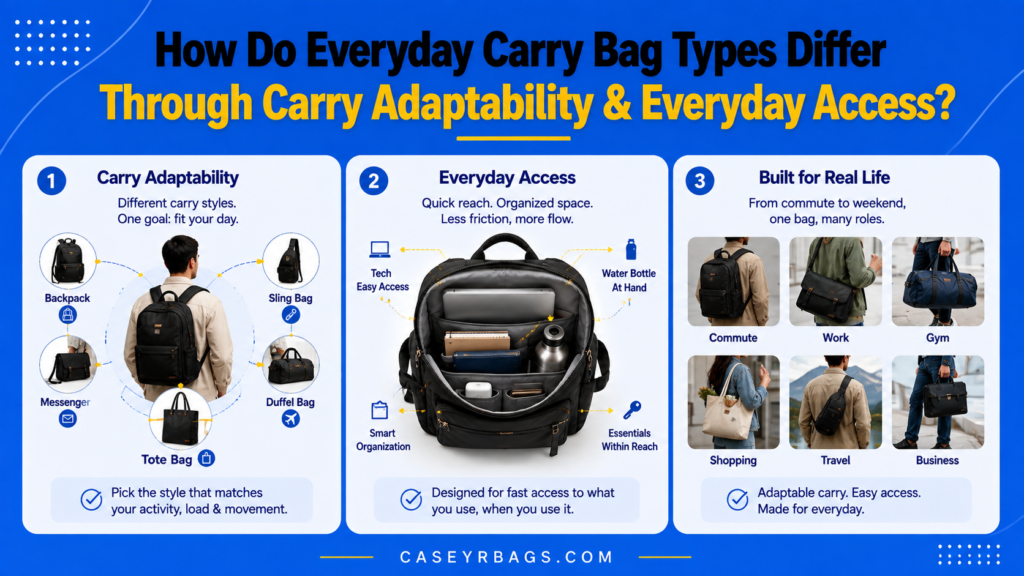
How Do Everyday Carry Bag Types Differ Through Carry Adaptability & Everyday Access?
Everyday Carry Bag Types differ through how their carrying systems position and reposition a daily load while their openings and organization control repeated access to frequently used items. A Backpack, Crossbody, Tote, Sling, Messenger, Shoulder Bag, or Daypack can hold a similar amount yet feel completely different because strap systems, handles, body position, opening geometry, and storage zones change how the bag behaves during a normal routine.
Carry Adaptability is therefore not the same as simply having more straps or modes, and Everyday Access is not the same as having a fast-opening closure. The useful question is whether a bag can move between the positions you actually use and keep high-frequency items predictably reachable without creating a worse load, security, or organization trade-off.
What Do Carry Adaptability & Everyday Access Mean for Everyday Carry Bag Types?
Carry Adaptability describes how effectively an Everyday Carry Bag Type can change carrying position or configuration, while Everyday Access describes how predictably routine items can be reached during repeated use. Both signals depend on structure, not marketing labels: straps, handles, openings, pockets, internal layout, and body position determine whether flexibility and access remain useful in practice. This category belongs within the Bag Types explained hub.
Which Bag Features Directly Affect Carry Adaptability?
Carry Adaptability begins with the bag’s actual carry system: strap count, usable strap-length adjustment, attachment points, handles, removable components, convertible configurations, and the body positions those features make possible. An adjustable diagonal strap can move a bag from hip to front-body carry; a second handle can support a short hand-carry transition; removable hardware can change how the load is supported.
The important boundary is whether the transition solves a repeated need. A bag with several theoretical configurations may still have weak adaptability if the user never changes modes or if the transition requires awkward setup. Useful adaptability follows a practical chain: carry feature → possible transition → everyday consequence. Adjustment range alone is not proof that the adjustment improves the routine.
Which Bag Features Directly Affect Everyday Access?
Everyday Access depends on opening location, closure type, external pockets, compartment layout, bag orientation, body position, and whether the bag must be removed before the main contents can be reached. A front-facing pocket may reduce retrieval steps for a phone or keys, while a rear main compartment can require a larger movement even when the zipper itself opens quickly.
This distinction matters because opening access and actual item access are not identical. A wide opening can expose a large cavity but still produce search friction when frequently used items move around. Predictable access occurs when storage position, closure behavior, and body position work together so the same item can be reached with a repeatable sequence.
Why Does One Everyday Bag Form Not Provide the Best Balance for Every Routine?
Each everyday bag form emphasizes a different combination of stability, access, retention, and repositioning. Front- or side-oriented bags can shorten the retrieval path, but their smaller or asymmetrical carry systems may become less useful as load volume or duration increases. Rear-positioned bags can stabilize a larger load but commonly require more repositioning for primary access.
The same trade-off appears in closures and organization. An open top can reduce access steps while offering less retention control; a secure flap or zipper can improve containment while adding an opening action. Different routines therefore produce different optimal balances. The goal is not maximum access or maximum adaptability in isolation, but a pattern that remains useful under the normal daily load.
| Bag Feature | Practical Effect | Everyday Consequence |
|---|---|---|
| Adjustable strap | Changes carrying height or position | Increases positional flexibility |
| Multiple handles | Enables alternative handling | Supports short carry transitions |
| Front/side positioning | Brings contents closer | Reduces retrieval steps |
| Rear positioning | Stabilizes load | May increase access effort |
| External pockets | Separates frequent items | Improves predictable retrieval |
| Secure closure | Adds retention | May increase opening steps |
How Do Common Everyday Carry Bag Types Balance Adaptability & Access?
Common Everyday Carry Bag Types balance adaptability and access differently because their carrying systems, body positions, openings, and practical load ranges create different daily behaviors. The comparison is most useful when each form is judged by its primary position, realistic repositioning pattern, retrieval method, and the trade-off that appears as the normal load changes.
How Do Backpacks Differ From Crossbody & Sling Bags?
Backpack Two-strap rear positioning distributes the load across both shoulders and tends to stabilize movement, especially when the contents become larger or the carrying duration grows. The main-compartment trade-off is repositioning: the bag is usually behind the body, so direct access often requires removal, partial rotation, or use of a dedicated quick-access zone. External pockets and predictable organization can reduce that penalty.
Crossbody A diagonal strap supports close-body front or side positioning, which can keep personal items inside the user’s immediate reach. That can reduce retrieval repositioning because the bag can remain on-body during access. The boundary appears as volume and weight increase: a larger asymmetric load can make the same close-body position less useful.
Sling A Sling Bag uses asymmetrical carry plus back-to-front rotation to create a temporary access position. That movement can work well for compact items because the bag does not need to be fully removed. Weight and duration still matter; single-strap rotational access becomes less attractive when the load is too large or carried for too long.
How Do Shoulder Bags & Tote Bags Differ in Everyday Access?
Shoulder Bag A single-strap side position places the opening around the underarm or hip, making repeated retrieval familiar and direct. The carry system is simple, but a heavier load places more demand on one side of the body and can make long-duration use less attractive.
Tote Bag A broad top opening and simple hand or shoulder handling support flexible loading with few opening steps. That can be useful when items change throughout the day, but open access does not automatically produce predictable organization or strong retention.
How Do Messenger Bags Combine Repositioning & Organized Access?
A Messenger Bag typically combines an adjustable shoulder or crossbody position with a broad, relatively flat body. That structure allows the bag to move from rear or side carry toward the front for access, creating a repeatable repositioning path for documents, devices, notebooks, and other flat items. Compartment structure can keep those items in predictable zones, while the flap controls the opening sequence and adds retention.
The trade-off is that moderate diagonal loads can still become demanding over time, and the flap adds an access step compared with an open top. Messenger Bags therefore do not automatically outperform Backpacks or Crossbody Bags; their advantage depends on organized flat-item retrieval being important to the routine.
When Does a Duffel Bag Fit an Everyday Carry Routine?
A Duffel Bag can fit Everyday Carry when flexible cavity capacity and simple handling support a repeated gym, sports, work-gear, or mixed daily routine. Its large main cavity can absorb variable item sizes, while short handles and an optional shoulder strap provide straightforward hand-to-shoulder transitions. That flexibility is useful when the load changes more than the storage categories do.
The access boundary is organization: a deep flexible cavity can make small frequent-use items less predictable unless pockets or pouches separate them. A Duffel also becomes a weak everyday choice when its capacity encourages recurring excess bulk. Occasional travel use should not define this comparison.
When Does a Handbag-Style Bag Fit Everyday Carry?
A Handbag-Style Bag can fit Everyday Carry when a structured compact body and short handles support a repeatable personal-item routine. A firm opening and defined internal zones can make wallets, keys, small accessories, and similar items easier to locate because the bag keeps its shape instead of collapsing around the contents.
Short-handle handling is most practical when the load remains modest and the user accepts frequent hand carry or brief forearm positioning. Style alone is not enough to establish everyday fit; the structure still needs to support repeated personal-item access without creating avoidable handling friction.
When Does a Daypack Bag Fit Everyday Carry?
A Daypack Bag fits Everyday Carry when lightweight two-strap support and moderate organization are enough for a short-duration or modest daily load. The rear position stabilizes movement, while a smaller body and simpler compartment structure can reduce the bulk associated with larger backpacks. This creates a stable carry option for routines that need more support than a small shoulder bag but less capacity than a full backpack.
The boundary is category inflation: a Daypack should not be treated as a full-capacity Backpack simply because both use two shoulder straps. Its useful range depends on keeping the normal load within the smaller form’s structure.
| Bag Type | Primary Carry Position | Adaptability | Access Pattern | Typical Load | Main Trade-Off |
|---|---|---|---|---|---|
| Backpack | Rear, dual strap | Moderate | Stable carry; reposition for main access | Moderate to larger daily load | More access repositioning |
| Crossbody | Front/side, diagonal | High positional adjustment | Close on-body retrieval | Compact to moderate | Asymmetric load demand |
| Sling | Rear/side rotating to front | High rotational access | Quick compact-item retrieval | Compact | Single-strap duration limit |
| Shoulder Bag | Underarm/side | Low to moderate | Familiar side access | Compact to moderate | One-side loading |
| Tote | Hand/shoulder | Simple transitions | Low opening effort | Variable | Retention/organization |
| Messenger | Rear/side/front diagonal | High repositioning value | Organized flat-item access | Moderate | Flap + asymmetric load |
| Duffel | Hand/shoulder | Moderate | Large cavity access | Variable/bulky | Small-item predictability |
| Handbag-Style | Hand/forearm | Low | Structured personal-item access | Compact | Limited hands-free carry |
| Daypack | Rear, dual strap | Low to moderate | Stable with moderate organization | Light to moderate | Less immediate main access |
How Does Carry Adaptability Affect Everyday Bag Use?
Carry Adaptability improves Everyday Carry usability when changes in strap length, body position, or carrying mode solve recurring transitions rather than simply adding configuration options. The useful test is whether a change reduces friction in a real part of the day: movement, access, clothing layers, a short hand-carry segment, or a switch between transport and retrieval.
How Do Adjustable Straps Change Everyday Carry Adaptability?
Adjustable straps can change carrying height, front/side/rear positioning, clothing clearance, load control, and the position from which the bag is accessed. On a Crossbody or Messenger Bag, shortening the strap can pull the bag higher and closer; lengthening it can move the bag lower or create more room for heavier clothing. On a Backpack, shoulder-strap adjustment changes how tightly the load stays against the body.
The mechanism is adjustment → body-position change → routine consequence. A broader range is useful only when the user can reach a stable preferred position or an access position that recurs during the day. Adjustment range alone is not useful adaptability if the extra length never changes how the bag is carried.
When Is a Fixed Carry System More Practical Than a Convertible One?
A fixed carry system can be more practical when the routine itself is stable. A Backpack used mainly in rear carry, a Tote repeatedly moved between hand and shoulder, a Shoulder Bag kept at the same side position, or a Crossbody maintained at one reliable strap length can create less setup friction than a multi-mode design.
Convertible construction adds value only when an alternative mode solves a repeated transition. Extra straps, attachment hardware, removable components, or conversion steps become a disadvantage when they add weight or setup without changing how the bag is actually used. One reliable transition can therefore provide more practical adaptability than several rarely used configurations.
| Carry Feature | Available Transition | Real Daily Benefit | Added Complexity | Adaptability Fit |
|---|---|---|---|---|
| Adjustable diagonal strap | Hip ↔ front ↔ side | Changes access and body position | Low | Strong when repositioning repeats |
| Dual backpack straps | Rear carry ↔ short hand carry | Stable movement with brief handling option | Low | Strong for stable routines |
| Removable shoulder strap | Hand ↔ shoulder | Useful when hands-free periods recur | Moderate | Conditional |
| Multi-point convertible harness | Several carry modes | Can cover distinct environments | High | Weak if modes remain unused |
| Multiple short handles | Hand ↔ brief forearm carry | Simple handling transitions | Low | Useful for short movements |
How Does Everyday Access Differ Across Bag Types?
Everyday Access differs according to how body position, opening structure, closure, storage zones, and internal organization affect repeated retrieval. Access quality is not a single speed measurement. It includes how many actions are required, whether the item stays in a predictable location, whether the closure provides acceptable retention, and whether the bag must be repositioned or removed.
How Does Opening Structure Change Everyday Access?
An open top usually reduces opening steps because the user can reach directly into the bag, while a zipper adds a controlled closure action. A flap can add both coverage and an extra movement; a drawstring changes the opening diameter as the cord tightens; magnetic closures can reduce steps but may provide different retention than a fully zipped opening. Multi-step fastenings prioritize containment over immediate entry.
The useful sequence is opening structure → retrieval steps → retention/security → access fit. Fewer steps can matter for high-frequency retrieval, but the fastest opening is not automatically the strongest everyday choice. The closure must also keep contents controlled during movement and suit the environments in which the bag is repeatedly used.
How Does a Drawstring Bag Balance Lightweight Form & Controlled Access?
A Drawstring Bag combines a cord closure with a flexible, generally unstructured body. That design can create lightweight capacity because the same cord may act as both closure and carry system, while the soft body accommodates irregular contents. Access is simple in the sense that the opening can be widened by releasing the cord, but the cavity itself may not keep small items in fixed locations.
A drawstring opening therefore does not guarantee faster or more predictable retrieval. The value is strongest when low weight and flexible capacity matter more than rigid organization or highly controlled access.
How Does Internal Organization Affect Familiar Access?
Internal organization affects whether the user can predict where an item will be before reaching into the bag. Open interiors preserve flexible capacity but allow objects to shift. Fixed pockets create stable locations for smaller items. Divided compartments separate categories, while external quick-access pockets move frequent-use items outside the main storage zone.
More compartments are not automatically better. Excess structure can force items into awkward dimensions, reduce flexible capacity, or make the user check several pockets before finding the right one. Familiar access depends more on predictable location than compartment count. A simple layout with one reliable high-frequency pocket can outperform a heavily divided interior that does not match the user’s actual item pattern.
Why Is the Fastest Access Pattern Not Always the Best?
Retrieval speed captures only one part of access quality. A very open bag may reduce opening steps but provide less retention during movement, less protection from weather, or less control in crowded environments. A front-positioned bag can reduce repositioning but may move more when the load becomes heavier. A secure rear compartment can take longer to reach while offering greater stability or containment.
The useful comparison is therefore not “fast versus slow.” It is whether the access pattern remains predictable, secure enough, stable enough, and compatible with the normal load. Retrieval speed is one variable inside a broader access system that also includes closure, orientation, organization, movement, and body position.
| Access Factor | Everyday Question |
|---|---|
| Opening location | Can the opening be reached from the normal carry position? |
| Closure type | How many actions are required, and what retention does the closure provide? |
| External pockets | Do high-frequency items have a predictable dedicated zone? |
| Internal organization | Can the user locate routine items without searching through the full cavity? |
| Body position | Must the bag be rotated, lowered, or removed before retrieval? |
| Bag orientation | Do contents stay stable when the bag moves into an access position? |
How Does Carry Position Affect Everyday Access?
Carry position affects Everyday Access by changing how much repositioning is required before frequently used items can be reached. Front, side, hip, underarm, and rear positions each create a different retrieval path. The best position depends on whether the routine prioritizes immediate on-body access, stable movement, larger load support, or a repeated transition between movement and access positions.
Which Body Positions Support the Easiest On-Body Access?
Front and side positions generally shorten the path between the hand and the opening because the user can see or feel the bag without removing it. Hip and underarm positions can provide similarly direct access when the opening faces upward or toward the body. These positions are common in Crossbody, Shoulder, Tote, and some Messenger configurations.
Rear carry usually creates more repositioning before main-compartment access, but that does not make it inherently poor. Rear positioning can stabilize a larger load, keep the front of the body clear, and work well when retrieval is occasional. The correct comparison is the total routine: how often access occurs, how much the bag weighs, and whether the access transition remains simple.
When Does Bag Repositioning Improve Everyday Usability?
Repositioning improves usability when the bag has a clear movement position and a clear access position. A Sling may sit on the back during walking and rotate to the front for retrieval; a Crossbody may shift from the hip toward the abdomen; a Messenger may move from rear or side carry to the front before the flap is opened.
The useful sequence is movement position → access position → retrieval → return. A transition counts as adaptability only when it is easy, repeatable, and useful without requiring a full reconfiguration. If the bag catches on clothing, twists the strap, or forces the user to unload it before rotating, the theoretical repositioning feature provides less everyday value.
How Does a Musette Bag Use Lightweight Positioning for Daily Access?
A Musette Bag uses a flat lightweight body and a simple shoulder strap to create low-bulk side positioning. That structure can place small essentials close to the hand and makes it easy to shift the bag across the torso for rapid lightweight retrieval. Cycling is one practical context because the form can remain simple and compact, but the same mechanism can support other light daily routines.
The boundary is load range. A flat, minimally structured body is not designed to replace a more supportive bag when the daily load becomes larger or heavier.
When Does Stable Carry Matter More Than Immediate Retrieval?
Stable carry becomes more important when the normal load is larger, carrying duration is longer, retrieval is less frequent, or movement stability matters more than immediate item access. In those conditions, rear-positioned dual-strap forms can keep the load closer to the body and reduce unwanted shifting while walking or commuting.
Slower main access is not automatically a defect if the user only opens the bag occasionally. High-frequency items can also be separated into external pockets, side zones, or small accessible compartments so the stable main carry position is preserved. The stronger fit is the one that matches the actual frequency of access instead of maximizing access speed for items that are rarely retrieved.
| Body Position | Repositioning Required | Retrieval Effort | Stability | Routine Fit |
|---|---|---|---|---|
| Front | Low | Low for frequent items | Load-dependent | Frequent retrieval, compact load |
| Side/Hip | Low to moderate | Low to moderate | Moderate | Repeated personal-item access |
| Underarm | Low | Low when opening faces upward | Moderate | Compact routine load |
| Rear | Moderate to high | Higher for main compartment | High | Larger loads, longer duration |
How Should Carry Adaptability & Everyday Access Be Balanced?
Carry Adaptability and Everyday Access should be balanced according to which carrying transitions and retrieval behaviors occur most often during the normal routine. A bag does not need to maximize both signals simultaneously. It needs enough positional flexibility to support real transitions and enough access quality to keep frequent items predictable without creating unacceptable instability, insecurity, or complexity.
When Does Adaptable Positioning Improve Access?
Adaptable positioning improves access when the preferred movement position can change into a useful access position with little effort. A Crossbody can shift from the side toward the front; a Sling can rotate from the back to the chest; a Messenger can move from rear or hip carry to the front before the flap is opened. The bag does not need to remain in the access position continuously.
The useful sequence is preferred carry position → access transition → retrieval → return. This lets the movement position prioritize stability or clearance while the temporary access position prioritizes reach. If the transition is awkward, requires repeated strap adjustment, or disrupts the load, the flexibility exists structurally but provides weaker everyday adaptability.
When Can Easier Access Reduce Stability or Security?
Easier access can reduce stability when the bag must sit farther from the body, remain open, or use a loose position that allows more movement. It can reduce retention when an open top or minimal closure lets items shift or exit more easily. In crowded environments, a highly exposed opening may also provide less control than a more secure body-facing or zipped compartment.
These trade-offs are not automatic defects. A lightweight routine may tolerate more movement because the load is small, and an open top may be acceptable when the bag stays under direct control. The comparison should remain neutral: improved access has value when the associated movement, retention, and security costs remain acceptable for the user’s normal context.
Which Carry/Access Trade-Offs Should Be Accepted?
The acceptable trade-off depends on repeated behavior. Quick access may justify a simpler closure when the user retrieves items constantly; a secure closure may justify another opening step when access is occasional. Flexible positioning may be useful for short transitions, while stable rear carry may matter more for a heavier load. Convertible construction can help a changing routine but add unnecessary complexity to a stable one.
The same logic applies to storage. Open interiors preserve flexible capacity, while divided organization improves location predictability at the cost of some usable space. Everyday suitability therefore depends on acceptable trade-offs, not maximum Carry Adaptability and maximum Everyday Access at the same time.
| Priority | Structural Benefit | Access Benefit | Trade-Off | Suitable Routine |
|---|---|---|---|---|
| Fast retrieval | Front/side orientation | Shorter access path | Potentially lower heavy-load stability | Frequent small-item access |
| Stable movement | Rear dual-strap support | Quick zones can remain external | Main compartment needs repositioning | Longer carry, larger daily load |
| Flexible loading | Open cavity | Few opening steps | Less location predictability | Variable item mix |
| Secure retention | Zipper/flap/multi-step closure | Controlled access | More opening actions | Crowded or movement-heavy use |
| Multi-mode carry | Convertible hardware | Several access positions | Added weight/setup | Routine with repeated mode changes |
Which Everyday Carry Bag Type Best Fits a Daily Routine?
The strongest Everyday Carry Bag Type is the form whose normal load support, body position, useful carry transitions, and access behavior align most closely with repeated daily activity. Selection should begin with what is carried and how often it is retrieved, then move through body position, opening structure, organization, stability, and only then secondary modes or edge-case flexibility.
How Should Normal Daily Load Affect Bag-Type Choice?
Normal daily load sets the baseline requirement for the carry system. Item volume, normal weight, the largest routine object, day-to-day variation, and carrying duration determine whether compact asymmetrical carry remains practical or whether a more stable two-strap or larger-cavity form becomes useful. The largest occasional load should not automatically define the bag if it rarely occurs.
The sequence is normal load → carry-system requirement → access consequence. A larger load may favor a Backpack or Daypack for stability but accept more repositioning; a smaller load may make a Crossbody, Sling, Shoulder Bag, or Handbag-Style Bag more practical because direct access can be prioritized without overloading the carry system.
How Should Retrieval Frequency Affect Bag-Type Choice?
High-frequency retrieval increases the value of front or side access, external pockets, and easy repositioning because the same access sequence repeats many times. Phones, keys, transit cards, small notebooks, or other frequently used items benefit when they have a known zone that can be reached without opening the entire main compartment.
Occasional retrieval can tolerate rear positioning, deeper storage, or a more secure closure because the access cost occurs less often. This is why a rear-positioned bag can still be a strong everyday fit when the load is larger and the user retrieves most items only at destination points. Retrieval frequency → access priority is a more reliable selection rule than access speed alone.
Which Criteria Should Be Verified Before Choosing an Everyday Carry Bag Type?
- Identify the normal daily load.
- Identify frequently retrieved items.
- Determine the preferred body position.
- Determine whether repositioning is needed.
- Verify opening structure.
- Verify closure behavior.
- Evaluate organization.
- Compare load stability.
- Review access/security trade-offs.
- Confirm whether secondary carry modes solve a repeated need.
This validation keeps selection tied to repeated behavior rather than feature count. If the chosen bag only works when the user changes the normal load, ignores frequent-item access, or relies on a conversion mode that is rarely used, the apparent versatility is weak. A better direction is the form that handles the routine in its normal configuration and uses secondary features only where they solve a real transition.
| Normal Load | Carry-Position Fit | Adaptability Fit | Access Fit | Organization Fit | Trade-Off Fit | Bag-Type Direction |
|---|---|---|---|---|---|---|
| Compact, frequent retrieval | Front/side | Useful repositioning | High priority | Simple, predictable zones | Accept lower heavy-load support | Crossbody / Sling / Shoulder |
| Moderate, organized flat items | Side/rear to front | Repositioning valuable | Moderate-high | Divided structure useful | Accept flap/access step | Messenger |
| Moderate to larger, longer duration | Rear | Stable primary mode | Quick zones for frequent items | Moderate-high | Accept main-access repositioning | Backpack / Daypack |
| Variable cavity load | Hand/shoulder | Simple transitions | Moderate | Supplement with small-item zones | Accept deeper search risk | Tote / Duffel |
| Compact personal items | Hand/forearm/side | Low to moderate | High | Structured placement | Accept limited hands-free support | Handbag-Style |
How Can Everyday Carry Adaptability & Access Mismatches Be Avoided?
Carry and access mismatches are avoided by testing whether a bag’s configurations and retrieval systems solve repeated daily needs rather than simply appearing flexible or accessible. Most mismatches begin with a wrong assumption about the routine, which then produces the wrong carry/access priority, poor body-position fit, and recurring carrying or retrieval friction.
Which Signs Show Carry Adaptability Is Mismatched to the Routine?
Carry Adaptability is mismatched when the bag repeatedly needs strap readjustment, hardware rearrangement, or awkward repositioning before it can move between normal parts of the day. Another warning sign is unused conversion hardware: if most alternative modes remain theoretical while adding bulk, dangling components, or setup steps, the carry system is more complex than the routine requires.
The practical test is behavioral. A useful transition should happen naturally and solve a recurring change in movement, clothing, transport, or handling. If the user avoids a carry mode because it twists the strap, shifts the load, interferes with the opening, or takes too long to configure, that mode should not count as meaningful everyday adaptability.
Which Signs Show Everyday Access Is Mismatched to the Routine?
Everyday Access is mismatched when frequently used items require full bag removal, repeated searching, several unnecessary opening actions, or frequent reorganization to remain reachable. Items that migrate inside a large cavity, a quick-access pocket that cannot be reached from the normal carry position, or a closure that feels too exposed or too slow for the environment are also practical warning signs.
The issue is not that every retrieval must be instant. The problem appears when the same access friction repeats throughout the day. A suitable system keeps high-frequency items in predictable zones, preserves acceptable retention, and allows the bag to move into an access position without disturbing the normal load.
Which Mismatch Warning Signs Should Trigger a Bag-Type Recheck?
- Most secondary carry modes remain unused.
- Strap length needs repeated correction during normal use.
- Repositioning twists the strap or destabilizes the load.
- Conversion hardware adds bulk without solving a repeated need.
- Frequently used items require full bag removal.
- Small essentials repeatedly migrate inside the main cavity.
- The user checks multiple pockets before finding routine items.
- The opening requires more actions than retrieval frequency justifies.
- The closure feels too exposed for the normal environment.
- The access position causes the load to swing or shift excessively.
- The normal load makes the preferred carry position difficult to sustain.
- The bag works mainly for edge cases rather than the repeated routine.
If several warning signs appear together, recheck the normal load, retrieval frequency, preferred body position, and closest alternative bag type before adding accessories or relying on more conversion modes. The mismatch pattern is usually straightforward: wrong routine assumption → wrong carry/access priority → repeated friction → weak Everyday Carry fit.
Conclusion
Everyday Carry Bag Types differ because their strap systems, body positions, openings, and internal layouts create different levels of Carry Adaptability and Everyday Access. Some forms prioritize stable carrying and larger-load control; others make repositioning, side access, or direct retrieval easier. The correct comparison depends on the normal load, how often items are retrieved, and which trade-offs remain acceptable during repeated use.
Feature flexibility does not automatically create useful Carry Adaptability, and fast retrieval does not automatically create effective Everyday Access. CaseyrBags compares Everyday Carry Bag Types by how their carrying systems and access structures behave during repeated daily use rather than by feature count alone. The appropriate Everyday Carry Bag Type is the one whose carry transitions, body position, opening structure, and access pattern best match the user’s normal load and repeated retrieval needs.
FAQs
Crossbody, Sling, Shoulder, Tote, and Messenger forms can reduce retrieval steps in different ways because they place openings closer to the front, side, hip, or underarm. No form is universally easiest. Actual access depends on body position, closure, internal organization, security needs, and whether the normal load remains stable in that carry system.
Convertible construction creates potential flexibility, but actual Carry Adaptability appears only when an alternative configuration solves a repeated daily need. A bag that converts into several modes can still be inefficient if those modes remain unused or add setup friction. Convertible capability is therefore not an automatic everyday advantage.
Yes. Backpacks can improve Everyday Access through external pockets, side openings, predictable organization, and dedicated high-frequency storage zones. The main compartment generally requires more repositioning than front- or side-oriented forms, but that trade-off can remain acceptable when load stability, longer carrying duration, or larger daily capacity matters more.
A Sling can be useful when a compact load is carried on the back or side and rotated forward for retrieval, while a Crossbody can keep small personal items closer to a continuous front or side access position. Neither is automatically better. The stronger choice depends on normal load, preferred body position, retrieval frequency, strap stability, and whether rotation or direct on-body access fits the routine more naturally.
A Tote can be more practical when the daily load changes often, opening effort should remain low, carrying duration is modest, and simple hand-to-shoulder transitions are enough. A Backpack becomes the stronger direction when the load is heavier, carrying lasts longer, or stable two-strap support matters more than immediate main-cavity access.