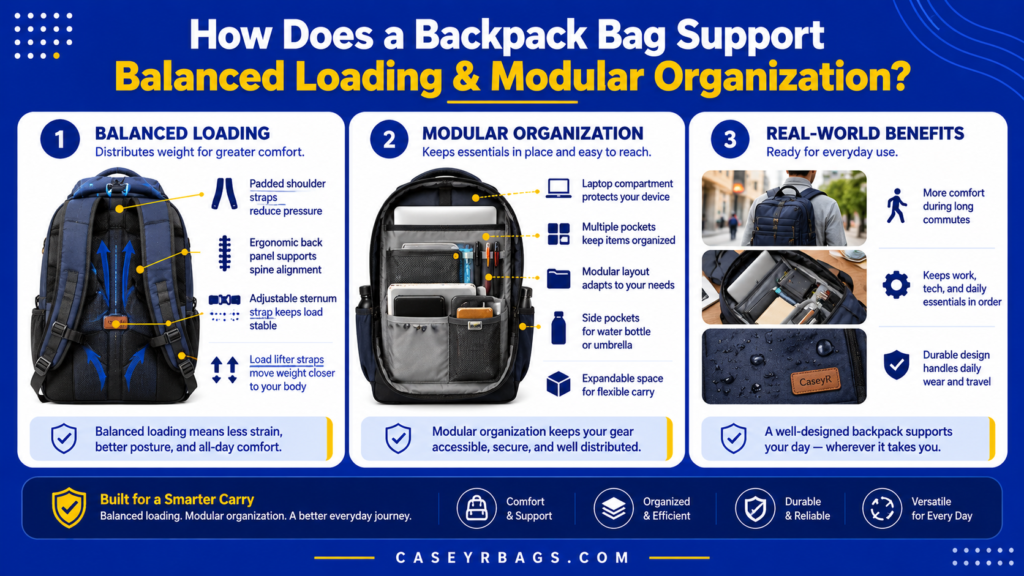
How Does a Backpack Bag Support Balanced Loading & Modular Organization?
A Backpack Bag supports balanced loading by combining two-strap carry with stable item placement, while modular organization allows storage zones to adapt when the carried item set changes without unnecessarily destabilizing the load. Shoulder straps, back-panel position, compartment layout, internal dividers, dense-item placement, side storage, adaptable organizers, and access zones all influence whether daily contents remain reasonably controlled during normal use.
Two-strap carry ≠ automatically balanced loading, and more compartments ≠ modular organization. Balanced loading depends on carry structure plus content placement, while useful modular organization depends on adaptable storage plus controlled item position. The strongest layout keeps dense items stable, limits one-sided loading, controls loose contents, preserves frequent access, and changes storage boundaries only when the actual item set changes often enough to justify that added flexibility.
What Do Balanced Loading & Modular Organization Mean in a Backpack Bag?
Balanced loading means keeping a Backpack’s contents reasonably stable and free from strong one-sided pull while both shoulder straps support the bag. Two straps can share carrying force, but internal balance still depends on dense-item position, content movement, and whether one side pocket or compartment becomes disproportionately loaded.
Modular organization means the storage layout can adapt when item combinations change. Adjustable dividers, removable organizers, flexible main compartments, dedicated sleeves, and attachment zones can change storage boundaries without requiring one permanently fixed arrangement. The broader Everyday context places this Backpack deep dive within carry.
Organization should help control the load rather than create new imbalance. A useful layout keeps dense items stable, separates frequent-access items, limits uncontrolled movement, and adds modularity only where changing contents justify it. A highly divided interior can still be a weak fit when storage zones force weight to one side or complicate retrieval.
Which Backpack Features Directly Affect Balanced Loading?
Balanced loading is influenced by two shoulder straps, strap anchor positions, the back panel, main-compartment depth, base shape, dividers, side pockets, and retention or compression features where present. These parts determine how the bag sits, how contents are contained, and whether dense items remain close to the main support zone during ordinary movement.
Structural feature → load behavior → balance consequence. A centered main compartment can support predictable placement, while a heavily loaded side pocket can create lateral offset. Straps can share carrying force, but internal position and movement still determine whether the load behaves symmetrically. No single structural feature guarantees balance by itself, so the loaded bag should be evaluated as one connected support system.
Which Features Create Modular Organization?
Modular organization can come from removable dividers, adjustable compartments, organizer panels, attachment loops, modular pouches, flexible main storage, and dedicated sleeves that can be reassigned as contents change. The defining feature is not the number of pockets but whether storage boundaries or item groups can change meaningfully while the items remain controlled.
Organization feature → storage adaptability → practical consequence. A removable divider can reshape one compartment, an organizer can move a group of accessories together, and an attachment zone can add a dedicated module when required. Modularity remains useful only when the changed layout stays secure, preserves access, and does not introduce uncontrolled shifting or one-sided loading.
Why Does One Backpack Layout Not Work for Every Load?
One Backpack layout does not work for every load because item size, density, access frequency, electronics, documents, personal items, and daily changes create different spatial relationships. A layout that works well for flat work items may be inefficient for irregular accessories, denser equipment, or a mixed load that changes between different parts of the day.
Different load patterns → different organization needs. The strongest layout matches actual contents rather than forcing every item into the same fixed positions. When contents remain predictable, fixed storage can be efficient; when item groups change frequently, adaptable zones can provide greater value if they remain stable and do not reduce the useful load-control function of the interior.
How Does Backpack Structure Support Balanced Loading?
Backpack structure supports balanced loading by combining two shoulder straps, controlled bag positioning, and internal structure that keeps the load from moving unpredictably during normal use.
How Do Two Shoulder Straps Support Load Distribution?
Two shoulder straps create the potential for shared support because the Backpack load can be carried through both the left and right strap paths instead of relying on one side. That support works best when both straps are used, adjustment is reasonably even, and the contents are not strongly offset to one side.
Backpack load → left strap + right strap → shared support. Two straps provide symmetrical support potential, not automatic load balance. Internal contents, side-pocket loading, strap adjustment, and bag deformation still influence actual behavior. For the narrower carry-system mechanism, see Shoulder Straps.
How Does the Back-Panel Position Affect Load Stability?
The back-panel position affects load stability because a relatively close, controlled bag position can reduce uncontrolled swing, backward shifting, and exaggerated movement during normal carrying. The closer the loaded body remains to its intended support zone, the more predictable the Backpack’s movement can become as the user walks, turns, or changes direction.
Closer stable load → more predictable Backpack behavior. A centered external bag position still does not prove the internal load is centered, because dense contents can remain offset inside. When the question shifts to strap angles, attachment positions, and force direction, see Strap Geometry.
Why Can a Backpack Still Feel Unbalanced With Two Straps?
A Backpack can still feel unbalanced with two straps when contents are uneven, one side pocket is overloaded, dense items sit off-center, objects shift during movement, strap adjustments differ significantly, or the bag structure deforms around the load. These internal and structural factors can create asymmetry that the paired straps cannot fully correct.
Symmetrical straps cannot fully correct asymmetrical loading. The support system can only respond to the load it receives, so strap symmetry does not replace content control. If soft structure no longer controls dense or irregular contents, the limiting factor may shift from strap use to internal structure; see Framing.
| Load Position | Backpack Behavior | Balance Effect | Main Check |
|---|---|---|---|
| Centered and controlled | Predictable movement | Supports balanced behavior | Does the item remain stable? |
| Dense item offset left/right | Lateral pull or tilt | Raises imbalance risk | Can the item be repositioned? |
| Dense item far from support zone | More outward movement | Can reduce stability | Is position structurally controlled? |
| Loose shifting contents | Changing load center | Balance varies during movement | Can movement be restricted? |
How Should Weight Be Positioned Inside a Backpack Bag?
Weight should be positioned so dense items remain controlled, reasonably centered, and close to the Backpack’s main support zone without forcing one universal item position for every load.
Where Should Denser Items Sit for Stable Everyday Carry?
Denser items generally benefit from controlled placement near the Backpack’s main support zone, with reasonable centering and enough internal restraint to limit unwanted movement. The objective is not a universal centimeter rule but a stable position that keeps the load predictable as the bag is lifted, carried, set down, and reopened during normal daily use.
Dense item → stable central position → reduced unwanted movement. The exact position varies with bag shape, item dimensions, compartment structure, and normal contents. A dense item placed centrally but allowed to slide freely can still destabilize the load, so movement control matters as much as starting location.
Why Does Left-Right Balance Matter?
Left-right balance matters because more weight on one side can create asymmetric Backpack behavior even when both shoulder straps are used. Uneven loading can produce tilt, different strap tension, repeated repositioning, or a tendency for the bag to move toward the heavier side during normal movement and access.
More weight on one side → asymmetric Backpack behavior. Perfect numerical equality is not required for every small item, but major dense components should not create a strong lateral offset. The practical check is whether the loaded bag remains reasonably level and predictable rather than whether every object has a mirror-image counterpart.
Why Should Loose Items Be Controlled Inside the Main Compartment?
Loose items should be controlled because free movement can change the internal load center, shift pressure against the bag body, reduce retrieval predictability, and alter stability while the Backpack is moving. Contents that begin in a balanced position can become unbalanced after repeated motion if they are free to slide, stack, or collapse into open space.
Stable load placement matters as much as initial placement. Dividers, sleeves, organizers, or appropriate compartment geometry can help limit excessive movement without requiring a rigid interior. When the issue moves beyond normal placement to structural response under greater load demand, see Heavy-Load Structure.
How Does Modular Organization Work in a Backpack Bag?
Modular organization allows a Backpack’s storage layout to change as item relationships change rather than forcing every load into one permanently fixed compartment arrangement.
How Do Fixed & Modular Compartments Differ?
Fixed compartments create predictable storage positions because their boundaries stay in the same place each time the Backpack is used. Modular organization allows those boundaries or item groups to change through adjustable dividers, removable organizers, flexible storage zones, or attachment points that can be reassigned.
Predictable layout → consistent positions, while adaptable storage zones → greater layout flexibility. Neither is inherently better for every Backpack. Stable repeated contents may benefit from fixed zones, while changing loads can benefit from modularity. The useful distinction is whether the layout matches how often contents actually change and whether the changed zones remain stable.
When Are Removable Organizers Useful?
Removable organizers are useful when work items, electronics, accessories, tools, personal essentials, or other item groups change repeatedly but still need predictable containment. A removable organizer can keep related items together, move between layouts, or free main-compartment space when that item group is not required for the current day.
Changing contents → adaptable module → reusable organization. The organizer should remain securely positioned when installed, because a loose module can become another shifting load. Modularity is strongest when it solves repeated layout changes without adding excessive setup, unused hardware, or uncontrolled movement inside the Backpack.
When Does Modularity Become Unnecessary Complexity?
Modularity becomes unnecessary complexity when pouches remain unused, dividers duplicate existing storage, hardware consumes interior space, modules shift, or retrieval becomes slower because the user must open multiple layers to reach ordinary items. Extra flexibility has little value when the normal item set rarely changes and the fixed layout already supports it.
Useful modularity solves repeated organization changes. More modular components do not automatically create better organization, especially when they reduce usable volume or create unstable internal boundaries. For an equipment-oriented subtype where modular storage becomes more deliberate, see Tactical Organization.
How Does Organization Affect Backpack Load Balance?
Backpack organization affects load balance because compartments, organizers, and attachment zones determine where dense items sit, how much they move, and whether weight becomes concentrated toward one side.
How Can Compartments Keep Dense Items Stable?
Compartments can keep dense items stable by limiting lateral movement, vertical movement, unwanted stacking, and uncontrolled shifting within the main interior. A dedicated sleeve or bounded zone can keep a dense item from sliding into another part of the bag when the Backpack changes orientation during lifting, walking, or set-down use.
Dedicated zone → controlled position → more stable load. The compartment should fit the item closely enough to limit excessive movement without forcing it into an unstable location. A dedicated pocket can still create imbalance if it is positioned far to one side or is repeatedly overloaded with dense contents.
How Can Poor Compartment Placement Create Imbalance?
Poor compartment placement can create imbalance when heavy side pockets, dense items far from the support zone, one-sided organizer layouts, or uneven expansion pockets concentrate weight away from the Backpack’s center. The contents can remain neatly separated and visually organized while the overall load still becomes asymmetric during normal carry.
Organized does not always mean balanced. Storage convenience should not override load behavior. If the most accessible pocket encourages repeated one-sided loading, the organization system can undermine the stability the two-strap carry system is intended to support, even though every item appears to have a dedicated place.
How Should Modular Organizers Be Positioned?
Modular organizers should support stable placement, predictable access, reasonable left-right balance, and minimal free movement. Their exact position can change with the carried item group, but the installed module should remain secure enough that it does not become a shifting dense object inside or outside the Backpack.
There is no universal module position for every bag or load. The useful position is the one that supports normal contents without pulling the layout strongly to one side unnecessarily. When modularity extends to an external equipment-attachment system, see MOLLE.
| Organization Pattern | Load Effect | Balance Consequence |
|---|---|---|
| Centered dense-item zone | Controls dense items | Supports stable load |
| One-sided dense pocket | Offsets weight | Can create imbalance |
| Flexible main compartment | Accepts changing loads | Requires item control |
| Modular organizer | Creates adaptable zones | Useful if secure |
| Loose open interior | Maximum flexibility | Greater shifting risk |
How Should Backpack Access Be Organized Without Disrupting Load Balance?
Backpack access should prioritize retrieval frequency while preventing quick-access storage from concentrating too much weight in unstable or strongly one-sided locations.
Which Items Belong in Quick-Access Zones?
Quick-access zones should prioritize retrieval frequency rather than item size alone. Keys, phone, wallet, small accessories, identification items, or frequently used tools can benefit from predictable locations when they are accessed repeatedly during the day and need to be retrieved without disturbing the main load.
The storage zone should still remain proportionate to the item’s density and position. A quick-access pocket designed for small essentials can become a balance problem when it is repeatedly used for dense or bulky objects. Access convenience should therefore support, not override, the overall load layout and structural control of the Backpack.
When Can Exterior Pockets Create Load Imbalance?
Exterior pockets can create imbalance when one side pocket, one front pocket, or one external module carries significantly more weight than the surrounding storage zones. External loading changes both lateral distribution and how far weight sits from the Backpack’s main support area, which can alter bag movement and strap response.
Quick access should not create unnecessary one-sided weight. Frequently used dense items may need a more central or structurally controlled location, while lightweight essentials can remain in exterior access zones. The practical check is whether the loaded pocket changes the bag’s position, shape, or left-right strap behavior.
How Should Low-Frequency Items Be Organized?
Low-frequency items can occupy secure, deeper, or less immediately accessible zones when they do not need repeated retrieval during normal use. This can preserve the most accessible storage for frequently used items while keeping the overall layout predictable and reducing unnecessary opening of the main load zone.
Less-used items should still remain controlled and should not collapse into open space or shift when nearby items are removed. A deeper zone is only useful when it supports load stability and does not force dense objects into a poor position simply because they are accessed less often.
When Is Modular Organization Better Than a Simple Backpack Layout?
Modular organization is more useful when the Backpack repeatedly carries changing item groups, while a fixed layout may be more efficient when normal contents remain stable and predictable.
When Does a Changing Daily Load Benefit From Modular Organization?
A changing daily load benefits from modular organization when item relationships regularly shift between work, school, commuting, personal use, or mixed equipment sets. The key need is not variety by itself but repeated changes in which items must stay grouped, separated, protected, or quickly accessible during different parts of the routine.
Changing content relationships → adaptable storage → better layout fit. A removable organizer or adjustable divider can reshape the interior without requiring an entirely different Backpack. The benefit is strongest when the changed layout remains secure, preserves dense-item control, and does not introduce extra movement merely to gain flexibility.
When Is a Simple Fixed Layout Better?
A simple fixed layout is often better when normal contents remain stable, item positions are predictable, setup complexity should stay low, and there is little need to reconfigure storage boundaries. Fixed compartments can reduce repeated setup because each item has a consistent location and retrieval sequence.
Stable load → fixed organization may be more efficient. A fixed layout can still be a poor fit if its compartments force dense items into unbalanced locations, but simplicity is valuable when repeated modular changes would add no functional benefit. The right system follows actual content-change frequency rather than feature count.
Which Organization System Should Be Prioritized?
- Identify normal contents.
- Identify dense items.
- Identify frequent-access items.
- Identify changing item groups.
- Identify positions that must remain stable.
- Add modularity only where repeated changes justify it.
Prioritize the organization system that matches the actual stability and change pattern of the load. Fixed storage fits predictable contents, modular storage fits recurring layout changes, and hybrid layouts can combine stable dense-item zones with adaptable accessory storage. The choice should preserve balance, access, item control, and predictable retrieval rather than maximize compartment count. Recheck the decision against the normal daily contents so added modules solve repeated changes instead of creating unused complexity. For a lateral comparison with simpler short-duration daily organization, see Daypack.
| Content Stability | Load Density | Access Frequency | Change Frequency | Organization Type |
|---|---|---|---|---|
| High | Low–moderate | Predictable | Low | Simple open or fixed layout |
| High | Moderate–dense | Predictable | Low | Fixed compartment layout |
| Mixed | Mixed | Variable | Moderate | Hybrid layout |
| Frequently changing | Variable | Variable | High | Modular layout |
How Can Backpack Loading & Organization Be Evaluated Together?
Backpack loading and organization should be evaluated together because a layout is only effective when load placement, strap support, structure, compartments, access, and modular storage remain functional as one system.
What Should Be Checked After the Backpack Is Loaded?
After loading, check whether the Backpack sits reasonably level, left-right weight is not strongly uneven, dense items remain stable, both shoulder straps support the bag as intended, compartments retain useful shape, and contents do not move excessively during ordinary lifting, carrying, turning, and set-down movement.
The goal is not perfect geometric symmetry but predictable load behavior. A small item difference may have little practical effect, while one dense off-center object can change the bag noticeably. The loaded Backpack should therefore be evaluated with its normal contents rather than as an empty shell or a carefully staged test load.
What Should Be Checked While Accessing Items?
While accessing items, check whether frequent essentials remain reachable, removing one item causes nearby contents to collapse or shift, organizers stay secure, openings remain clear, and the load remains reasonably stable after retrieval. Access should not repeatedly destabilize the same area of the bag or force dense items into new positions.
A layout that is balanced only when untouched is not fully effective. Retrieval should preserve enough structure that remaining contents continue to behave predictably, especially around dense items, modules, and high-frequency access zones. Repeated access is therefore part of the load-balance evaluation rather than a separate convenience test.
Which Criteria Should Determine Final Backpack Layout?
- Identify the normal load.
- Separate dense from lightweight items.
- Position dense items securely.
- Check left-right balance.
- Check structural support.
- Assign frequent-access zones.
- Identify changing item groups.
- Add modularity where useful.
- Test movement.
- Test retrieval.
- Adjust if balance or access deteriorates.
The final layout should keep dense items controlled, limit major left-right offset, use the two-strap system effectively, preserve access, and add adaptability only where the load actually changes. Recheck the layout after movement and retrieval because a configuration that looks balanced when first packed can become unstable after contents shift or modules move. The best fit remains predictable across normal carrying, access, and repeated daily changes while keeping organizers secure, dense items controlled, and compartment loading consistent with the intended layout.
How Can Backpack Loading & Organization Mismatches Be Avoided?
Backpack loading and organization mismatches are avoided by evaluating load behavior, structural support, and storage usefulness together instead of assuming that two straps or a high compartment count automatically produce a balanced, organized Backpack.
Why Is Adding More Compartments a Weak Organization Rule?
Adding more compartments is a weak organization rule because extra pockets can waste usable volume, force rigid item positions, add retrieval steps, fit changing loads poorly, or concentrate weight in areas that are convenient to access but poorly positioned for balance. Compartment count does not reveal whether the layout matches the actual contents.
More compartments ≠ better organization. A smaller number of well-positioned zones can be more effective than many redundant pockets when they preserve item stability, predictable retrieval, and useful interior volume. Organization should be judged by functional fit and controlled load behavior, not by how divided or feature-rich the interior appears.
Why Is Even Strap Adjustment Not Enough to Guarantee Balanced Loading?
Even strap adjustment cannot guarantee balanced loading because symmetrical strap length does not correct one-sided dense items, overloaded side pockets, shifting contents, or poor internal placement. The two straps can be adjusted similarly while the Backpack’s internal load remains laterally offset or unstable during movement.
Strap balance cannot replace load balance. Strap symmetry supports the carry system, but the contents and internal structure still determine the force being delivered to that system. A visibly level bag should therefore be checked internally before assuming the load itself is balanced, especially when one pocket or module carries dense contents.
What Should Be Verified Before Relying on a Backpack Bag for Balanced & Modular Carry?
- Normal Backpack contents are identified.
- Dense items are identified.
- Dense items are positioned securely.
- Left-right load is reasonably balanced.
- Loose items cannot shift excessively.
- Both shoulder straps are used as intended.
- Strap adjustment is reasonably even.
- Main structural support suits the normal load.
- Compartments support intended contents.
- Quick-access items have predictable locations.
- Exterior pockets do not create major one-sided loading.
- Fixed compartments provide actual value.
- Modular organizers solve repeated layout changes.
- Removable modules remain securely positioned.
- Organization does not push dense items into unstable locations.
- Empty or overloaded compartments do not distort the bag excessively.
- Access remains practical when fully loaded.
- Overall layout supports load stability and item retrieval.
Apply the checklist with the normal daily contents and test the Backpack after movement and item retrieval rather than only when first packed. Recheck dense-item position, left-right loading, strap support, structural control, module security, pocket loading, and access. If one change repeatedly creates shifting, asymmetry, blocked retrieval, unstable dense-item placement, or organizer movement, revise the layout and retest the normal load before treating the complete system as a strong fit.
These are qualitative layout-fit outcomes, not safe-load ratings, medical assessments, or universal packing rules.
Conclusion
A Backpack Bag supports balanced loading by distributing carrying force through two shoulder straps while using structure and internal layout to keep dense items stable and reasonably centered. Strap geometry, back-panel position, framing where needed, left-right distribution, and movement control all influence whether the load remains predictable during normal daily use.
Two-strap carry ≠ automatically balanced loading, more compartments ≠ modular organization, and balanced distribution ≠ unlimited carrying capacity. CaseyrBags evaluates Backpack design by how effectively strap support, load placement, structural control, compartment layout, adaptable organization, and access zones work together. The strongest Backpack layout keeps dense items controlled, limits major asymmetry, preserves retrieval, and allows storage to adapt only where changing item groups justify added modularity.
FAQs
No. Two straps provide symmetrical support potential, but actual balance still depends on content placement, strap adjustment, side-pocket loading, item movement, and Backpack structure. A bag can use both straps and still behave asymmetrically when dense contents sit off-center or shift during movement.
Backpack organization becomes modular when storage zones can be adjusted, removed, repositioned, reassigned, or combined as carried items change. Examples include adjustable dividers, removable organizers, flexible storage zones, and attachment points. Modularity is useful when the changed layout remains secure and solves recurring organization changes.
Yes. Excessive compartments can waste interior volume, add retrieval steps, force poor item locations, reduce flexibility, and concentrate weight in inconvenient places. A smaller number of useful storage zones can be more efficient when they support stable load placement, predictable access, and the actual contents carried.